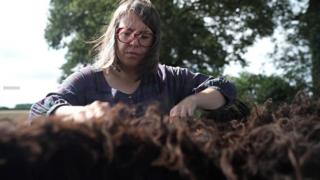
“I started my company because my dad received approximately 3p per fleece for his Hebridean wool and I thought, ‘We must be able to do better than that,’” says shepherd’s daughter Rachel Atkinson.
Rachel manufactures woollen products, but her firm is struggling.
Wool’s popularity has been in decline since the 1950s – and this year, coronavirus has added problems that businesses can ill afford.
The global wool market closed in February. This has led to vast volumes of wool lying unsold in depots and has pushed prices down.
Most farmers sell their fleeces through British Wool, formerly the British Wool Marketing Board. Some 14 million kg of wool are waiting to be shifted from its stores, while the average price per kg has nearly halved: it is now 32p, compared with 60p the previous year.
Rachel, who is based in Banbury in Oxfordshire, says: “Farmers used to be able to pay a year’s rent from the price of wool, but it’s barely worth selling anymore.”
Some producers are even chucking it away.
“I’m wishing I had more space and more money to buy from the shepherds, who are really suffering with this,” she says.
Thrown out
Gerallt Hughes runs a farm on Anglesey. He has put nearly 600 fleeces on the compost heap.
Each farmer’s costs are different, but in Gerallt’s case, it doesn’t make financial sense selling the wool this year.
“I’m not going to spend 30p on packing [a fleece] to get 24p back,” he said.
Image copyright Bill Robertson
Image caption
Andrea Meanwell has chosen to store her fleeces for better times
He is critical of British Wool and says he thinks the organisation has been over-reliant on the Chinese market.
“What the Wool Board should have been doing is looking for alternative markets for the last 20 years,” he says.
British Wool chief executive Joe Farren says the organisation is “big enough and ugly enough” to take criticism, but that a new strategy to market and sell the product is under way.
Wool produced in the UK is used in products such as carpets, knitwear, soft furnishings and bedding.
“We are a convenient outlet for farmers’ wool,” he says.
“[But] if a farmer wants to put a supply chain together and develop their wool and bring their own product to market, they’re open to do that.”
Image copyright British Wool
Image caption
British Wool is currently storing 14 million kg of wool in its depots
Andrea Meanwell, a shepherdess in the Howgill Fells, an area that straddles the Lake District and the Yorkshire Dales, says she is storing her sheep’s wool, hoping that next year demand will pick up.
Like Gerallt Hughes, she says the costs of selling the wool this year outweigh the benefits, particularly for remote farms, where transportation costs are higher.
“Lots of people that I know are burning or composting, or just leaving the wool to rot,” she says.
“It’s quite time-consuming to innovate a product yourself. Most farmers just don’t have the time to do that.”
Mr Farren says British Wool is now working “with branded manufacturers to create new consumer demand for the products”.
“We’re working hard to address the structural issues in the supply chain,” he says.
Image copyright Gerallt Hughes
Image caption
Wool produced in the UK accounts for 2% of the global wool market
Mr Farren is calling on farmers to continue working with British Wool during a “terrible year”.
“Please send the wool, let us collect it. If it’s not brought in, it will fall out of use,” he said.
He told the BBC that British Wool had been turned down for the government’s Coronavirus Business Interruption Loan Scheme “on a technicality”, but that it needed financial support “to pay our producers this year for next year’s wool”.
The reasons for the decline in the price for wool – while exacerbated by Covid-19 – are many. Industry insiders point to the growth in synthetic fibres, fewer players in the industry supply chain, Brexit uncertainty and the US-China trade war.
Image copyright Gerallt Hughes
Image caption
For most farmers, wool forms just a small part of their income
But before the pandemic, Rachel Atkinson had been optimistic.
“It’s incredibly sad, as the British wool industry had been steadily gaining in value over the past few years,” she says.
Andrea Meanwell says she hopes wool will become popular again with consumers.
“We’re hearing so much now about micro-plastics damaging the environment,” she says, “so farmers have been hoping for a while that there’ll be a return to people using wool.
“But at the moment, it doesn’t seem to have happened.”
Piracy incidents have doubled across Asia causing “deep concern”, according to a new report.
There were 50 incidents in the region in the first half of the year, compared to 25 in the same period of 2019.
The Singapore Strait, one of the world’s busiest commercial shipping routes, has seen 16 incidents since between January and June.
The rise in piracy has been attributed to the coronavirus downturn.
The half-yearly report was published by the Regional Cooperation Agreement on Combating Piracy and Armed Robbery against Ships in Asia (ReCAAP).
It said there had also been an increase in attacks in Bangladesh, India, Indonesia, the Philippines, Vietnam and the South China Sea.
Incidents are classified as piracy if they happen outside the jurisdiction of any state. Everything else is considered armed robbery.
ReCAAP’s executive director Masafumi Kuroki said the spike in cases was worrying.
“‘Small’ crimes, if not addressed, can embolden criminals to commit more serious acts,” he said.
Much of piracy and armed robbery in Asia is opportunistic, according to Brandon Prins, a scholar of sea piracy at the University of Tennessee-Knoxville.
“(Sometimes) the pirates are local fishermen who see piracy as a way to supplement their incomes,” he said. “In other parts of Asia, many are jobless young men who have travelled to Batam [in Indonesia] or other places looking for work.
“Opportunistic piracy is just like armed robbery on shore – if you see something worth taking you might give it a shot.
“We see incidents where three to eight people approach in a small boat and climb onto the bigger ship – usually with knives or other weapons to steal something then get off quickly.”
Popular items to steal include scrap metal, engine parts, communication equipment from the ship’s bridge and personal belongings from the crew to resell on the black market.
Fears for the future
Mr Prins said the global pandemic could encourage more people into criminal acts at sea.
“My fear has always been that Covid-19 would reduce global trade which lowers growth, increases poverty and joblessness (and then) leads to more sea piracy,” he added.
“There is certainly concern that with trade going down there will be fewer sailors on board ships (and therefore) fewer crew monitoring for potential pirates or armed robbers.”
Although rare in Asia, abductions do happen. The ReCAAP report details an incident off the coast of Lahad Datu, Malaysia, in January.
Five crew members who were abducted from a fishing trawler are still being held in captivity.
Globally, there has been a rise in violent attacks.
A total of 77 seafarers were taken hostage or kidnapped for ransom since January, according to the International Maritime Bureau (IMB).
It singles out The Gulf of Guinea off West Africa as accounting for just over 90% of maritime kidnappings worldwide.
Image caption
The proposed factory would be sited on former Ministry of Defence land
Plans to build a plant for producing electric car batteries in Wales are a step closer, the firm behind the proposals has said.
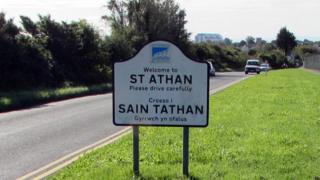
Britishvolt had also been considering a Coventry site but said it had signed a memorandum of understanding (MOU) with the Welsh Government to build the factory in St Athan, Vale of Glamorgan.
It said it could create up to 3,500 jobs and lead to £1.2bn of investment.
First Minister Mark Drakeford said the MOU was an “important next step ahead”.
He told BBC Radio Wales Breakfast: “It doesn’t mean to say it is in the bag.
“There are important things still to do, including convincing the UK government to provide funding through its automotive transformation fund, but it is an important step on the journey and we are very encouraged by it.”
The agreement is not legally binding but the company told BBC Wales it was now only considering the St Athan site for the project.
Image copyright Orral Nadjari
Image caption
Orral Nadjari wants construction to begin in St Athan in 2021
Britishvolt’s chief operating officer, Orral Nadjari, who lived in Cardiff for seven years while studying at university, said it was a “very exciting milestone”.
“The agreement that we have come to with the Welsh Government is that we’re going to exclusively build our batteries for electric vehicles in Wales.”
Mr Nadjari said the company wants to begin construction in the spring of 2021 with the plant fully operational by the middle of 2023.
Electric car sales up, but what next?
The five major challenges facing electric vehicles
Bro Tathan, a former Ministry of Defence site now owned by the Welsh Government, is already home to an Aston Martin electric car plant, which produced its first vehicle last week.
Image copyright Ineos
Image caption
Plans for a factory to build the Ineos Grenadier in Bridgend are on hold
The factory would be a significant boost to Wales’ automotive industry.
Earlier this month Ineos put on hold its plans to build a new 4×4 vehicle plant in Bridgend which would have created 500 jobs.
The Welsh Government said it had invested “significant time and money” and would look to recoup appropriate costs if Ineos pulled out.
Britishvolt’s chief strategic officer Isobel Sheldon said the company was looking to use local workers and materials.
“I think the battery industry has had some bad press over the years because of the embedded carbon in the manufacturing process…so we’re looking at how we can localise that supply chain and shorten those supply lines,” she said.
Ban on petrol and diesel car sales brought forward
Petrol and diesel car ban ‘could start in 12 years’
Dr Matthew Davies, associate professor of engineering at Swansea University, said the choice of the St Athan site was a “very significant development for Wales and the UK”.
“This industry investment will lead to more jobs and likely will catalyse greater investment into Wales in key areas of renewable and clean energy technologies.
“An additional benefit of making these batteries in Wales is that it reduces our need to import technologies from abroad, saving the associated carbon footprint from shipping, transporting the goods and enhances the sustainability of the batteries.”
Media playback is unsupported on your device
Media captionAre electric cars as “green” as you think?
Dr Jean-Paul Skeete, from Cardiff Business School, said the plant would have “knock-on effects” such as potentially attracting more electric car makers to the region.
He said the factory would show Wales was “looking ahead and ready to conduct business, which is key in a post-Brexit, post-pandemic economy”.
“Germany and most recently Sweden are by far the most serious contenders regarding lithium-ion battery production in Europe.
A factory in Wales would “puts us squarely in that discussion,” he said.
The owner of Zizzi and Ask Italian restaurant chains said it will close 75 locations, risking the loss of up to 1,200 jobs.
Azzurri Group, which also owns the Coco Di Mama pasta chain, has been sold out of administration to TowerBrook Capital Partners.
The move will keep 225 shops and restaurants open and maintain about 5,000 jobs.
The company said the coronavirus had hit restaurants hard.
“The Covid-19 crisis has had a profound impact on the casual dining sector, bringing many businesses like ours to a standstill,” said Steve Holmes, chief executive of Azzurri Group.
Coronavirus: How will bowling alleys and casinos change after lockdown?
“Despite being a successful operator, the immediate loss of revenue during lockdown meant that we have had to make some incredibly difficult decisions to protect the business for the long-term.
“It is with deep sadness that this process will result in the permanent closure of a number of sites and that we must say goodbye to greatly valued employees across our brands.”
Last month The Restaurant Group, which owns Frankie and Benny’s, said it expected to cut up to 3,000 workers after confirming plans to shut 125 sites.
And this month two of the UK’s biggest High Street retailers, John Lewis and Boots, have announced 5,300 job cuts.
The moves come amid warnings that new economic support from Chancellor Rishi Sunak will not be enough to stop millions of workers losing their jobs.
Media captionLack of jobs will exacerbate in inequalities.
The world is facing a staggering jobs challenge with a quarter of a billion people set to lose their job this year, the president of Microsoft has said.
Brad Smith says millions will need to learn new skills to get jobs, or even to hang on to their old one, as the digitisation of economies races ahead.
Microsoft recently announced a plan to deliver skills and training to 25 million people globally this year.
It will offer training, skills, certifications and help finding jobs.
The firm will do this with the help of Microsoft-owned LinkedIn. However, Mr Smith admitted that many jobs in many countries would be beyond the reach of digital retraining.
“It’s true that the nature of work varies widely around the world. Not all jobs can be digitised, particularly in the developing world.
“We live in a world of internet inequality – if we don’t do something about it we are going to exacerbate all the other inequalities that we all worry about. This is a task beyond any one company or any one government but if we can reach 25 million people we will feel like we are doing our part.”
Microsoft will donate $20m (£19.6m) in grants to non-profit organisations on this programme on top of free use of their services, which will strike many as fairly small given this is a company whose value has increased by $500bn in the past year.
If big US tech looked powerful before Covid-19, it looks imperious now. Just five companies make up 20% of the value of the S&P 500 index. Does he understand why many feel big tech is too powerful and needs reining in?
“Tech is a powerful tool but it can also be a formidable weapon in the wrong hands,” he says. “So this is a critical time for technology, it has more responsibility than ever.”
“I think people have more questions than ever and that’s not a bad thing. To ensure that technology is a force for good, governments need to move more quickly to develop technology-focused laws. While tech companies need to exert some self-restraint.”
‘Nothing can be solved without us’
Getting global agreement on how to regulate and tax technology has proved notoriously difficult and many countries are nervous as the increasing digitisation of their economies makes it harder to generate the tax revenue they will need to pay for the trillions of dollars of damage Covid-19 has done.
Advances in technology will also lead to an increase in automation and AI which may only hasten mass unemployment. What responsibility does Mr Smith feel that tech companies have to pay for the changes to employment that they are ushering in?
“I think the good news is that governments have all the tools they need to make sure that tech companies remain responsive and responsible under the rule of law,” he says.
“Fundamentally the responsibility of companies and countries is to make sure that people have the skills to ensure they reap the benefits rather than suffer from the consequences of the changes unleashed.
“I think we all need to recognise that tech cannot solve everything, but almost nothing can be solved without us. We need to be at the table.”
Image caption
Campaigners are concerned about pedestrian safety standards for US vehicles
Safety experts are urging the UK government to exclude American cars from any post-Brexit trade deal.
They say imported vehicles should meet British safety standards for accidents with pedestrians, cyclists and children.
UK PM Boris Johnson has indicated he expects cars to be included in any new transatlantic trade agreement.
But safety campaigners point to a spike of pedestrian injuries and deaths in US road accidents.
The increase is associated with a boom in large SUVs, which have been engineered to protect passengers but not pedestrians.
The UK government said safety standards would not be “diminished” as a result of talks.
In the UK and Europe, cars are designed to minimise harm to people on foot or on bikes if they are hit by a vehicle. SUVs sold in the UK must meet the standards.
The Parliamentary Advisory Committee on Transport Safety has written to Trade Secretary Liz Truss, saying: “We note that in negotiations covering food safety the USA has argued against accepting higher UK standards. It has sought to characterise these as protectionism.
“We are concerned that pressure for lower safety standards will be applied in negotiations regarding the automotive sector.
“US vehicle safety standards are much lower than those permitted for vehicles sold in the UK.”
‘Meet our rules’
David Ward, president of the Global New Car Assessment Programme, told BBC News: “US crash standards are much lower for pedestrians… we simply can’t let American vehicles into the UK if they don’t meet our standards.”
A Department for Transport spokeswoman told BBC News the government would decide its own safety regulations after Brexit.
“Road safety or environmental standards will not be diminished as part of a free trade agreement with the USA or any other country,” she said.
But safety campaigners note that, on the parallel issue of whether to allow imports of chlorinated chicken from the US, ministers are under relentless pressure to give way.
The head of the UK Transport Research Laboratory, Richard Cuerden, said: “We know the PM and others have said the automotive sector is on the cards for a new trade deal after Brexit. Well, it’s fine to trade – but they have to meet our rules in this regard.”
Image copyright Getty Images
Image caption
Donald Trump has spoken of his desire to sign a free trade deal with the UK
US President Donald Trump has previously derided safety standards for pedestrians – although the White House later said he was joking.
A Ford Europe spokesperson said the firm had no intention of trying to bring vehicles into Europe that did not comply with regulations.
But Mr Cuerden said, from past experience, US negotiators would typically insist on equivalence of free access between markets. That meant cars could be used as a bargaining chip in the talks.
Mr Cuerden also warned that many of the UK’s crash barriers were designed to resist a car of standard weight and height. If British drivers started to buy large US-style SUVs in big numbers, the barriers might have to be replaced.
Big SUVs are the focus of concern among US experts, too. A study from the US Insurance Institute for Highway Safety (IIHS) said while the number of people killed in road crashes had fallen overall, the number of pedestrians killed by vehicles had risen by 53% over a decade.
Over the same period, the share of SUVs in the vehicle fleet rose to 29% from 21% – a trend replicated in the UK.
IIHS said design changes meant US SUVs no longer posed a greater threat to the occupants of other vehicles but there had not been a similar effort to address the danger that large SUVs posed to pedestrians.
Matt Blunt, president of the American Automotive Policy Council, which represents US carmakers, said cars made there were just as safe as European vehicles.
He told BBC News: “Cars, SUVs and other light trucks that meet US safety standards achieve equivalent safety performance to the safety standards applied in the European Union.
“A US-UK trade agreement should address the tariff and technical barriers to open US-UK automotive trade. This would increase competition and provide more consumer choice.”
Image caption
Christine Clement (far left) estimates she’s paid around £275 in charges to BT over the last few years just to keep using her old email address as before
Ofcom says it is concerned some customers are “not being treated fairly” over the amount they are being charged to keep old email addresses.
This happens when customers continue to use an old email address from an internet service provider they have since left.
Many people who subsequently switched have paid hundreds of pounds just to keep using their old address as before.
Ofcom’s investigation was prompted by a Money Box report earlier this year.
“They’ve got you over a barrel”
Ofcom also found most people who use an address provided by their broadband company are former BT customers.
BT says if customers want to switch provider but keep hold of their old BT email address they’re charged £7.50 per month to be able to access and use their account like they used to, including accessing it using an app.
That’s what happened to Iain Stuart from Cardiff.
He said that first BT started charging him £1.60 per month, “then it went up to £5 and it’s now £7.50.”
“My feeling on it is was [BT] basically had you over a barrel.”
Like many other people Mr Stuart has registered his email address with dozens of websites including banks, building societies, utility companies, online shops and social media accounts – not to mention all his friends and family who use it.
“To change something I’ve been using for no end of different things… when you start looking at it, if you went through the whole lot of them, and I’ve looked at the logistics of changing my email address, it’s not something I want to waste my time doing.
“The alternative is to pay £90 per year. I can afford to pay but I shouldn’t have to pay and I don’t want to pay.”
BT says it offers a free service for people to access their old email address – but that has to be done by logging on via a web browser which doesn’t allow people to get emails via apps on their mobile phones.
That free, web browser-only service is also not something that appeals to Mr Stuart.
“I just want to be able to use my email account as I have done for years and years.”
Put off switching?
One in six UK adults say they’re likely to be put off switching broadband provider out of fear of losing their email address or being charged to keep it, according to research by comparethemarket.com.
It’s this point which Ofcom is concerned about.
Christine Clement says she’s been with other broadband providers for years but is still paying BT for an email address she first started using around the year 2000.
“I fail to see what service I get for paying £7.50 per month.
“When [the charges] first came in £1.60 seemed reasonable but £7.50 per month is £90 per year and that does seem quite a large amount,” she says.
As for the option of stop paying the charges and lose her email address Ms Clement says it’s something she’d never be able to do.
“I must have at least 40-plus accounts I’ve registered my email with. That’s quite a lot to change and that’s without even notifying friends and family.
“It would be time consuming and it’s just something I’d never do. But why should I have to pay extortionate prices to keep the address?”
BT, TalkTalk, Sky and Virgin Media supply 90% of the home broadband market in the UK and BT is not the only provider which charges customers if they want to keep old addresses and use them as before if people switch provider.
Who charges what?
BT: £7.50 a month to maintain normal access (although users can retain their BT email addresses for nothing with limitations, including only being able to log on using a browser)
TalkTalk: £5 a month (or £50 for an entire year if paid in advance)
Virgin: Account deleted 90 days after disconnection
Sky: Users can keep old email address free after switching provider
In a statement BT said: “If [customers] switch broadband providers, they can continue to use the BT email service, free of charge, through a web browser.
“This version includes unlimited storage, online virus protection and a UK based helpdesk.
“The email service with premium features is also available to customers if they switch provider, and additionally includes multiple inboxes and access through email apps, for £7.50 a month.”
‘Not being treated fairly’
Ofcom told Money Box: “We’re concerned about any industry practices that could put people off from switching, so we’ve been gathering more information from providers about their different approaches to this issue.
“We have concerns that some customers are not being treated fairly, and will be raising these with providers.”
You can hear more on BBC Radio 4’s Money Box programme by listening again here.
Holidaymakers who were given refund credit notes, rather than cash, for their cancelled package holiday are being reassured their money is safe.
The authorities have clarified that these refund promises are guaranteed even if the travel company which provided them goes bust.
They are distinct from holiday vouchers which do not have the same protection.
Anyone whose package holiday is cancelled has the right to a full cash refund.
How refunds work
Refund credit notes (RCNs) were handed out by some holiday companies instead of refunds early in the coronavirus crisis, as the businesses found themselves stretched by the level of claims.
They can be used to book another holiday, or a refund is given when the note expires.
Can I get travel insurance and what are my travel rights?
Coronavirus: Package holiday firms told to sharpen up on refunds
Anyone whose package holiday is cancelled by the provider is entitled to a refund of the whole holiday, by law, within 14 days.
However, after some of these RCNs were accepted by customers, the Department for Transport and the Civil Aviation Authority (CAA) have now confirmed that RCNs are protected under the Atol scheme, which is government-guaranteed and administered by the CAA.
This means that the refund will be honoured, and can be drawn from a central pot, even if the provider goes bust.
“This is not only good news for anyone looking to get away for a break in the sun, but also for the aviation and travel sector which has been hit hard by the pandemic,” said Transport Secretary Grant Shapps.
The announcement covers refund credit notes issued between 10 March and 30 September for package holidays cancelled owing to Covid-19.
‘My refund panic’
Image copyright Lynn Fox
Image caption
Lynn and Martin Fox are still waiting for a refund
Lynn and Martin Fox had remortgaged their home to pay for a holiday of a lifetime to Florida.
The couple finished paying for the holiday in January, but Mrs Fox, 42, then lost her cabin crew job at Flybe when the airline collapsed in March.
Weeks later, as the virus lockdown took hold, work dried up for her husband, a pipe-fitter. Then the holiday, planned for late April, was cancelled.
“We thought the refund would be money in the bank, but then panic started to set in,” said Mrs Fox.
“The move will particularly help tour operators that have not been able to immediately refund customers for cancelled package holidays because they have had to wait for money back from airlines and other suppliers,” said a spokesman for Abta, which represents the holiday companies.
Rory Boland, of consumer association Which?, said package travel companies should not use this as an excuse to “force” credit notes onto their customers and should make clear when they have the right to a cash refund.
“Holiday providers must do right by their customers – and the law – and return any outstanding refunds for cancelled holidays. Otherwise, the regulator must be ready to take strong action against those continuing to flout the law on refunds,” he said.
Some travel firms are offering vouchers rather than refund credit notes.
Although these are often worth more than the original booking, to incentivise customers not to request cash, they are not Atol protected.
The move comes as travel firm Kuoni said bookings for December departures to Barbados were 30% up on the same point last year, while demand for the Maldives has increased by 20%.
The company said people were willing to spend on luxury Christmas trips as they were planning a staycation during the summer months.
What are my rights?
If you have a package holiday cancelled by the provider, then a refund should be provided for the whole holiday within 14 days
If your flight is cancelled, you are entitled to a full refund to the original form of payment within seven days, although many airlines are struggling to meet that deadline. You can accept, or refuse, vouchers or a rebooking but a voucher will probably be invalid if the airline later goes bust
If you decide against going on a future flight, which is not yet cancelled, then there is no right to a refund. Different airlines have different rules over what you can do, but many are waiving any charges for changing to a later flight or having a voucher instead. Your travel insurance is unlikely to cover you
My Money is a series looking at how people spend their money – and the sometimes tough decisions they have to make. Here, Anna Josse Eklund from Kristinehamn in the county of Värmland in Sweden takes us through a week in her life during the coronavirus pandemic.
Anna, 52, is married to Magnus, 55. They have two children, Ellen, 26 and Oscar, 23. Anders, 28, and his seven-year-old son Loki, are also included in their family. All their children live in their own homes. Anna works as a senior lecturer and vice head of the department of nursing at Karlstad University. Her monthly salary is 52,300 Swedish Krona (£4,500), which after taxes is 35,500 SEK (£3,050). Magnus earns a bit less than she does.
When Anna is not working she likes to spend time with her extended family and friends. During the summer she likes gardening. In the winter she likes to listen to books whilst building Lego.
Over to Anna…
The day started with me searching for a new pavilion tent since ours blew to bits during a storm yesterday. I looked for a used one on Blocket (the Swedish equivalent of ebay) and Facebook Marketplace but unfortunately couldn’t find one. We bought a new one for 3,499 SEK (£300). Hopefully it will be more robust and will withstand the wind better.
I also picked up hand sanitisers for the children (don’t know if I should call them children anymore – they are all well over 20!) since I had spotted a good price: 70 SEK x 3 = 210 SEK.
Next on the to-do list was the weekly grocery shopping. Since I was hungry we started with me getting a sausage with shrimp salad and roasted onions (40 SEK) so that I could keep my mood up while shopping at our local grocery store, one of two large supermarkets in our town. It was money well-spent as we had a long shopping list with some items we do not buy regularly so we had to spend some time looking for them.
We are on a low-carbohydrate, high-fat diet which allows me to not be hungry all the time thus keeping my spirits up and not yelling at my family. This diet requires us to eat a lot of fat and protein, which is rather expensive food so today’s grocery bill was 1,816 SEK. In the evening, Magnus cooked dinner – meat sauce with zucchini pasta and regular pasta for Oscar who is living with us this summer to be closer to his summer job. The cost for the dinner was approximately 110 SEK for five good sized portions. Oscar will take one to work tomorrow. I ordered more food online for 639 SEK.
Total spend: 6,204 SEK (£533.44)
My Money
More blogs from the BBC’s My Money Series:
We’re looking for more people to share what they spend their money on. If you’re interested, please email or get in touch via our My Money (World) Facebook group, or if you live in the UK, please join our My Money (UK) Facebook group and we’ll aim to contact you.
As we are on vacation, Magnus and I decided to work on the garden. To simplify the watering process I bought a longer, self-coiling hose (1,700 SEK), which we installed. Happy with the result I watered all my plants in the house, garden and backyard.
We live in a small town of 24,000 inhabitants and commute 40km every day to Karlstad, a 30-minute trip that Magnus and I make together in our car. Although both of us work in Karlstad we have decided to stay in Kristinehamn since we have my parents, my sister and two of our children here and we can own a larger house for less money in this smaller town. One nice thing with living near your loved ones is that you can, on short notice, invite them for dinner. I love informal gatherings and cooking for such occasions. Tonight we had friends and family over for a barbecue. Due to the wind and low temperature we sat in the dining room, rather than out on the patio. The menu consisted of barbecued meat, potato gratin and tzatziki and cucumber salad from our own cucumbers. For dessert we ate lovely strawberries with milk and cream, 100 SEK for three litres.
Total spend: 1,800 SEK (£154.60)
Image copyright Anna Josse Eklund
The last few summers we have had heatwaves stretching for weeks. The temperatures have reached more than 30C, which we Swedes are not accustomed to! This makes it hard to sleep. Because of this we previously installed an air source heat pump, which doubles as an air conditioner in the summer, but we also needed to install new blinds and renovate the old ones (18,000 SEK). Now the house looks happy, as if it had veneers fitted.
Image copyright Anna Josse Eklund
In the evening my sister Marie and her foster daughter Esmerelda took me to a café. I treated myself to a sandwich with liver pate (without the bread of course) and a fizzy drink (54 SEK). The café is owned by the Swedish church and they sell small things such as books to raise money for the parish. I bought some nice button pins for my company (65 SEK).
Total spend: 18,119 SEK (£1,558.23)
Started the day with shopping, mainly for my parents who are over 70 and therefore should stay away from shops as part of their social distancing. The additional groceries for us and a screen protector for my mobile added up to 504 SEK.
After that Esmeralda and I went to the bank to do some errands and as she is a student with limited funds, I bought her and I lunch (139 SEK). I also bought a phone case (299 SEK) and some stationery, including a reusable bag (118 SEK). We all need them now as plastic bags are expensive due to a new tax which aims to reduce plastic littering.
Image copyright Anna Josse Eklund
In the afternoon my friend Anders and I took a boat trip on Lake Vänern to enjoy the nice weather and relax on a secluded island not far from our harbour. On the way home I craved onions, so I bought some to fry as a side dish for dinner (24 SEK).
Total spend: 1,084 SEK (£93.22)
Today we decided to arrange a hot dog party and bought different sausages and condiments to accommodate different tastes (717 SEK).
In the Covid-19 reality we always meet outside, and everyone has a responsibility to not participate if they feel unwell in any way. Tonight there were 13 of us and it was nice just to be able to be together. We grilled sausages over an open fire, made bread on a stick and ate lovely lemon muffins made by my dear friend Annelie. At the end of the evening we were joined by a hedgehog who lives in our garden. He/she ate some leftovers and sniffed at my foot. Feeling satisfied with the day I realise that in a way it’s more important than ever to show each other care and love, and to just enjoy the fact that we are each other’s family.
Total spend: 717 SEK (£61.66)
Image copyright Anna Josse Eklund
More cleaning of the house. In the afternoon we celebrated our family friend Johan’s 22nd birthday with his usual homemade cinnamon buns, strawberry cake, coffee and barbecue. We bought him a mosquito repellent apparatus (349 SEK) which he was pleased with. Johan’s family have a hedgehog called Kaisa and she comes every night for her meal of cat food and, I suppose, company. Sometimes she is tired, perhaps from weaning hoglets, so she takes a nap before going back to her nest.
Total spend: 349 SEK (£30)
Image copyright Anna Josse Eklund
Last day of blogging and yet another wonderfully monotonous day. Sunny weather, more work in the house. The feeling of getting rid of unusable, unmodern, and broken things is heavenly, almost cathartic, and the more things I get rid of or organise properly, the more liberated I feel.
For lunch, our son-in-law-to-be Martin, his three brothers Oliver, Emil and Adam, and my mother and father joined us. The menu consisted of potato salad and spicy meat made from leftovers from Johan’s birthday party yesterday. I love making food from leftovers since it’s a bit of a challenge to create something new and it’s always nice to eat food instead of throwing it away. In Sweden as in many other countries the management of food is a very current topic so of course we think a lot about acting responsibly with food.
My father and I went to the supermarket to get hand sanitisers for him and my mother. I bought small containers for Martin’s brothers (buying and distributing hand sanitisers seems to be a theme in my life now) and a shelf for the basement (170 SEK).
In the afternoon, my sister Marie and I visited our father’s husband Curt at his nursing home. Family are allowed to visit the elderly person outside a few times a week if you sit on each side of a portable window. It’s nice to be able to see our “honorary” father, even through a window. Due to advanced dementia it is hard to hear his speech and with the glass between us it’s even harder. We spent the hour trying to tell him about our lives, pass on regards from lots of people and Marie sang with him. It’s quite amazing that he can still sing and even in Finnish, which he learnt as an adult.
Image copyright Anna Josse Eklund
When I got home the boys had assembled the pavilion tent and we spent the last lovely hours of the day there with the family. In these Covid-19 times I count myself lucky to be able to meet my family and friends since we have ample opportunities to meet outside with adequate physical distancing.
Image copyright Anna Josse Eklund
Now it’s 11:30pm on Sunday night and I’m handing over the torch to someone else, somewhere in the world who will tell their interesting story of how they spend and save money during a week. I am looking forward to reading it. Over and out from me with a picture that embraces the Swedish summer – raspberries and cream.
Total spend: 170 SEK (£14.62)
Image copyright Anna Josse Eklund
Total spent this week: 28,443 SEK (£2,418.77)
How does Anna feel about her week?
We spent more money compared with a usual week. Mainly because of the blinds, which we had saved up for, but also due to the opportunities to socialise more during our vacation. Having said that, spending money on food and drink for gatherings in our house is usually a priority.
Image caption
German Chancellor Angela Merkel (right) called for a realistic approach
EU leaders are meeting in their first face-to-face summit since the coronavirus crisis, with low expectations of a deal on a €750bn (£670bn) post-Covid stimulus package.
The mask-wearing leaders, who met with elbow bumps not handshakes, must also agree a seven-year, €1.07tn budget.
French President Emmanuel Macron said it was a “moment of truth” for Europe.
There are splits between leaders over whether the post-Covid package should be given as grants or loans.
Mr Macron and German Chancellor Angela Merkel want grants to mostly finance the fund. Four northern nations insist on loans.
Arriving for the talks in Brussels, Mrs Merkel said “the differences are very very big and I cannot say if we will find a solution this time”. It would be desirable, she said, but people had to remain realistic.
Other leaders gave her and Portuguese Prime Minister Antonio Costa birthday gifts – however, the good-natured scenes inside the summit come after weeks of squabbling over the rescue package.
Image copyright Getty Images
Image caption
Customary handshakes and kisses made way for elbow bumps
The meeting is due to continue on Saturday but EU leaders may need longer to reach a deal.
“The stakes couldn’t be higher,” European Commission President Ursula von der Leyen said ahead of the meeting. “The whole world is watching us.”
Greek Prime Minister Kyriakos Mitsotakis said nobody should lose sight of the big picture – “we’re faced with the biggest economic depression since the Second World War”.
But Dutch Prime Minister Mark Rutte, whose country is part of the so-called “Frugal Four” northern states, said he “put the chances of getting a deal this weekend at less than 50%”.
Why is the fund so tricky?
Southern states including Italy and Spain want an urgent decision “not weakened by a lesser compromise”, in the words of Italian Prime Minister Giuseppe Conte. They need to revive economies battered by a devastating pandemic that claimed 35,000 lives in Italy and a further 28,400 in Spain.
The Frankfurt-based European Central Bank has already forecast an 8.7% slump in the eurozone economy this year because of the pandemic. But economies that only recently pulled out of a financial crisis want grants rather than taking on further debt.
Image copyright EPA
Image caption
The French president said Europe was facing an unprecedented crisis
The recovery plan, backed by France and Germany, for €500bn in grants and subsidies and €250bn in loans, is being resisted by several “frugal” Northern European countries, led by the Netherlands.
The EU recovery fund is already controversial as the money would be borrowed on the financial markets, to be paid back some time after 2027. It’s made up of a number of different instruments, but the biggest part of it would be geared to supporting green and digital investment, and reform. Some 30% of the funding could be tied to climate projects.
The frugal states, which include Austria, Sweden, Denmark and to some degree Finland, want some control over how the money is handed out. The Southern states say that will hold the process back.
There is also pressure to whittle down the size of the €750bn fund, so the solvency instrument devised to revive companies after lockdown could be under threat.
But Italian Economy Minister Roberto Gualtieri told the Corriere website that Rome “will fight hard not to modify” the structure of the recovery fund.
Some of the Central European leaders wanted rebates to be on the table too – the money paid back to wealthier EU states that pay more into the budget than they get out.
Why the rush?
Leaders have been criss-crossing Europe ahead of the summit in a bid to find a solution. Visiting Sweden, Spain’s Pedro Sánchez warned: “If we delay the response, we delay the recovery and the crisis could get worse.”
Big choices face EU leaders on Covid recovery cash
The head of the European Central Bank, Christine Lagarde, has also urged the EU27 to move quickly on an “ambitious package”, warning that uncertainty remains high on the speed and scale of the economic rebound.
If the package of grants or loans is agreed, then France would be able to put €39bn of EU funding towards its own €100bn national recovery plan. Prime Minister Jean Castex said this week that €20bn of that would go towards insulating buildings, and converting cities to using bicycles.
A group of 150 scientists and celebrities joined climate activist Greta Thunberg on Thursday in signing an open letter urging EU leaders to end “all investments in fossil fuel exploration and extraction”.
As eurozone economic activity picks up and lockdowns are lifted, there are fears of a second surge.
The ECB has confirmed its emergency €1.35tn bond-buying programme is on track to last until June next year, to help governments, banks and businesses.
Are the Dutch out on a limb?
One of the main issues for EU leaders is whether any country can have a veto over money being handed out to a member state for recovery purposes.
Ahead of the summit, a French official said the Netherlands was the only one of the so-called frugal states seeking strict control of conditions for paying out funds.
Certainly Dutch Prime Minister Mark Rutte insists on reforms to pensions, welfare and tax services in return for funding and he wants assurances that the money goes to modernising infrastructure and green investment.
“I’m only going to go along with subsidies if the reforms are nailed down,” he said in an interview with public broadcaster NOS.
But Finland too wants conditions attached to EU funding, both from the recovery pot and from the wider 2021-27 EU budget.
The task facing EU leaders is to agree not only on the size and terms of the recovery fund, but the overall EU budget too.
And Hungary’s Viktor Orban has threatened to derail both the fund and the budget if any payments are linked to a member state’s rule of law.
His ruling Fidesz party has been suspended by the big European People’s Party bloc for clamping down on media and civil society.
“We could veto it because it needs a unanimous decision. Hungary could say no,” Mr Orban said last week.