Category: Business News

  • Caution means mass return to work unlikely, say firms

    Passengers at Canning Town underground station in east London

    Image copyright
    PA Media

    Businesses remain cautious about the latest lockdown easing for England, and warn that any mass return to work immediately was unlikely.

    The British Chambers of Commerce said companies still needed “crystal-clear official guidance” on safety.

    And the Institute of Directors said “there is a significant amount of caution out there” in the country.

    New guidelines cover using public transport, while advice for employers will change from 1 August.

    Companies will have more discretion to bring staff back to workplaces if it is safe to do so, the PM has said.

    Edwin Morgan, director of policy at the Institute of Directors, doubted there would be a significant return to offices and other workplaces any time soon. “Businesses need to balance the risks, and won’t want to increase the possibility of closures down the line by rushing back.

    “On top of this, not everything is in a company’s control. Childcare is an issue for many employees, and even if the guidance is changed, some staff who use public transport will still be concerned.”

    Other employers’ organisations said firms still wanted government support to help smooth the return to work process.

    Mike Cherry, national chairman of the Federation of Small Businesses, said that smaller firms in particular would need more support in order to get workers back.

    “Small firms are being tasked with consulting employees and putting the right measures in place to ensure a safe return to work,” he said. “After weeks of little or no income, they will need help – both funding and advice – to make that happen.”

    The British Chambers of Commerce (BCC) said companies should get tax breaks to re-open offices. BCC director general Adam Marshall said: “Businesses should be able to offset the investments they make to ensure their premises are Covid-secure against their tax bill, which would help many to return to workplaces over the coming months.”

    Image copyright
    Kirsty O’Connor / PA Media

    Image caption

    At Clapham Junction station some seats are taped off to keep people apart

    The TUC backed calls for more support for companies. TUC general secretary Frances O’Grady said Friday’s announcement was the government “passing the buck on this big decision to employers”.

    She pointed out that returning to work safely required a functioning NHS Test and Trace system, “Yet progress on test and trace is still patchy”. She added: “A safe return to workplaces also requires much greater investment in public transport if people are to be able to commute.”

    Flexible working

    There is an expectation among many employers that home working will remain in place for thousands of companies despite Friday’s announcement.

    “People are not comfortable returning to the office yet,” said Ruth Duston, chief executive of South Westminster Business Improvement District, which represents the interests of 5,000 businesses across London.

    “Even when offices do start returning, we are looking at perhaps only a max of a third of workers returning to offices at any one time to allow for social distancing.”

    She said cities should prepare for a permanent shift in working practices. “People will return [to offices] but this will likely be a gradual process over many months. When they do, it will be to collaborate and exchange with their colleagues rather than to spend eight hours at a desk.”

    At-a-glance: The latest changes in England

    • From 25 July indoor gyms, pools and other sports facilities can reopen
    • On 1 August the government will update its advice on going to work, asking employers to make decisions about how and where their staff can work safely
    • From the same date, most remaining leisure settings, including bowling, skating rinks, casinos and all close contact services such as beauticians, will be allowed to reopen
    • Live indoor theatre and concerts will be able to resume with socially distanced audiences
    • Wedding receptions for up to 30 people will also be allowed from next month
    • From September, schools, nurseries and colleges will be open for all children and young people on a full-time basis, while universities are also working to reopen as fully as possible
    • From October, the government intends to allow audiences to return to stadiums, while conferences and other business events can recommence, subject to the outcome of pilots

    Mr Marshall said many of the BCC’s members were focused on changes to flexible working practices rather than getting everyone back in the office. “Firms will be weighing up how they want to work in future. Many have seen benefits to productivity and work-life balance over recent months and will want to keep elements of their new normal,” he said.

    And the IoD said that as many as two thirds of its members said they intend to keep increased flexible working in place after lockdown ends.

    A recent Chartered Institute of Personnel and Development survey found that employers, overall, report home workers are at least as productive as other workers, and plan to double the proportion of staff who work from home regularly once the crisis is over.


    Do you expect to return to work? Are you concerned? How are you feeling about it? Share your experiences by emailing

    Please include a contact number if you are willing to speak to a BBC journalist.
  • Coronavirus: Boris Johnson sets out plan for ‘significant normality’ by Christmas

    Boris Johnson at Downing Street on Friday morning

    Image copyright
    PA Media

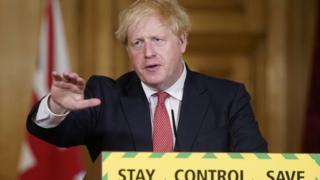
    Coronavirus restrictions will ease further in England under plans for a “significant return to normality” by Christmas, Boris Johnson has announced.

    Under the new guidelines, people may use public transport for journeys immediately, while advice for employers will change from 1 August.

    Companies will have more discretion to bring staff back to workplaces if it is safe to do so, the PM explained.

    Mr Johnson added he was “hoping for the best and planning for the worst”.

    At a news conference at Downing Street, the PM said the roadmap “remains conditional” on the UK pulling together to win its “long fight” against Covid-19.

    “It is my strong and sincere hope that we will be able to review the outstanding restrictions and allow a more significant return to normality from November at the earliest – possibly in time for Christmas,” he said.

    Devolved administrations in Scotland, Wales and Northern Ireland have the power to set their own timings for the easing of restrictions.

    In the announcement, Mr Johnson said that the government was making it clear to people in England they may use public transport now.

    From 1 August, he said: “Instead of government telling people to work from home, we are going to give employers more discretion, and ask them to make decisions about how their staff can work safely.”

    He explained that could mean “continuing to work from home, which is one way of working safely and which has worked for many employers and employees”.

    The government’s current social distancing guidance requires people to stay at least 1m apart with certain precautions.

    On Thursday, the government’s chief scientific adviser, Sir Patrick Vallance, told MPs there was “absolutely no reason” to change the government’s current guidance on working from home.

    The government has advised people to “work from home if you can” since March, and Sir Patrick said home working was still a “perfectly good option” for many.

    The PM said during the news conference that he “totally agrees” with Sir Patrick and that it was not for the government to tell employers where their workforce should be.

    Labour leader Sir Keir Starmer said he will look at the details of the government’s plan to get people back to work but stressed “this can’t be done on a wing on a prayer and requires a credible plan and national leadership”.

    Also from 1 August, Mr Johnson said most remaining leisure settings, such as bowling alleys, skating rinks and casinos, and close-contact services such as beauticians could resume.

    Indoor performances with socially-distanced audiences in theatres, music and performance venues will also be allowed from next month.

    However, soft play areas and nightclubs will remain closed beyond that date, although they “will be kept under review.”

    From October, he said fans could be able to return to sport stadiums. if pilot events go well.

    The upcoming World Snooker Championships in Sheffield, the Glorious Goodwood horse racing festival and two men’s county cricket friendly matches are set to be among the trial sporting fixtures.

    At-a-glance: The latest changes in England

    • From 25 July indoor gyms, pools and other sports facilities can reopen
    • On 1 August the government will update its advice on going to work, asking employers to make decisions about how and where their staff can work safely
    • From the same date, most remaining leisure settings, including bowling, skating rinks, casinos and all close contact services such as beauticians, will be allowed to reopen
    • Live indoor theatre and concerts will be able to resume with socially distanced audiences
    • Wedding receptions for up to 30 people will also be allowed from next month
    • From September, schools, nurseries and colleges will be open for all children and young people on a full-time basis, while universities are also working to reopen as fully as possible
    • From October, the government intends to allow audiences to return to stadiums, while conferences and other business events can recommence, subject to the outcome of pilots

    The PM indicated that social distancing measures could be relaxed further for loved ones.

    He said: “Throughout this period, we will look to allow more close contact between friends and family, where we can.”

    Second wave

    Mr Johnson also confirmed an additional £3bn in funding for the NHS to help it prepare for a potential second wave of infections and to cope with its usual winter pressures.

    An expansion in testing capacity to a target of 500,000 tests a day by the end of October would help identify positive coronavirus cases among people with symptoms of seasonal illnesses, he added.

    In addition to the further easing of lockdown restrictions in England, Mr Johnson unveiled new powers for local authorities to manage outbreaks of the virus in their areas.

    He said local authorities would have the power to close premises, close off public outdoors spaces and cancel events.

    Ministers would also receive clearer guidance on where they can intervene to “close whole sectors or types of premises in an area” and advise people in specific postcodes to stay at home.

    “It has to be right that we take local action in response to local outbreaks – there is no point shutting down a city in one part of the country to contain an outbreak in another part of the country,” Mr Johnson said.

    • YOU, ME AND THE BIG C: Cancer treatment during the pandemic
    • GROUNDED WITH LOUIS THEROUX: The ten most surprising moments from the lockdown podcast


    Do you have any work related issues? Is it safe for you to return to the workplace? Is working from home working for you? Email

    Please include a contact number if you are willing to speak to a BBC journalist.

    • WhatsApp: +44 7756 165803
    • Tweet: @BBC_HaveYourSay
    • Please read our terms & conditions and privacy policy

  • Cadbury accused of ‘shrinkflation’ as packs get smaller

    Cadbury multipacks

    Image copyright
    Mondelez

    All Cadbury chocolate bars sold in multipacks will shrink by the end of 2021 to reduce their calorie count, owner Mondelez has announced.

    Popular treats including Crunchie, Twirl and Wispa bars will contain no more than 200 calories each when sold in a four-pack.

    However, the price will stay the same. Bars sold individually will not change.

    Chocolate fans took to Twitter to denounce the latest example of what has become known as “shrinkflation”.

    That is when food manufacturers reduce the weight of their products without shrinking the price.

    “We must play our part in tackling obesity and are committed to doing so without compromising on consumer choice,” said Louise Stigant, UK managing director at Mondelēz International.

    When asked why “single-serve” bars were unaffected, a spokesperson for Mondelez said the firm believed in “offering consumers different portion sizes for different occasions”.

    The spokesperson confirmed that the list price for multipacks would not change and said pricing was up to retailers.

    ‘Profit or health?’

    Consumers were sceptical, with one tweeting that Cadbury should change the name of its Double Decker bar to Minibus.

    “Cadbury trying to say that the change is for health reasons when it seems painfully obvious it’s for profit margins,” said another disgruntled customer.

    This is not the first time that Mondelez has run into opposition after altering the size of its chocolate bars.

    In 2016, it reduced the weight of its Toblerone bar from 200g to 150g by spacing out its distinctive triangular chunks, but it reversed the change two years later.

  • British Airways retires entire 747 fleet after travel downturn

    British Airways Boeing 747-400 airplane, the large jumbo jet with the nickname Queen of the skies

    Image copyright
    Getty Images

    British Airways has said it will retire all of its Boeing 747s as it suffers from the sharp travel downturn.

    The UK airline is the world’s largest operator of the jumbo jets, with 31 in the fleet.

    “It is with great sadness that we can confirm we are proposing to retire our entire 747 fleet with immediate effect,” a BA spokesman told the BBC.

    Airlines across the world have been hit hard by coronavirus-related travel restrictions.

    “It is unlikely our magnificent ‘queen of the skies’ will ever operate commercial services for British Airways again due to the downturn in travel caused by the Covid-19 global pandemic,” the spokesman added.

    BA, which is owned by International Airlines Group (IAG), said the planes will all be retired with immediate effect. The 747s represent about 10% of BA’s total fleet.

    It had planned on retiring the planes in 2024 but has brought forward the date due to the downturn.

    BA is currently the world’s biggest operator of 747-400s and first took delivery of them in July 1989. Originally, the upper deck contained a lounge which was known as the “club in the sky”.

    Fuel efficient

    The British carrier added it will operate more flights on modern, more fuel-efficient planes such as its new Airbus A350s and Boeing 787 Dreamliners.

    It expects them to help it achieve net-zero carbon emissions by 2050.

    Boeing’s 747 helped democratise global air travel in the 1970s, and marked its 50-year flying anniversary in February 2019.

    US-based Boeing signalled the end of the plane’s production a year ago.

    A wave of restructuring triggered by the virus outbreak is hitting airlines across the world, along with plane-makers and their suppliers. Thousands of job losses and furloughs have been announced in recent weeks.

    Hundreds of BA ground staff face redundancy as the airline slashes costs in the wake of the coronavirus pandemic.

    Boeing’s ‘queen of the skies’

    • The first Boeing 747 flight took place in February 1969
    • It was the first aeroplane dubbed a “jumbo jet”
    • BOAC, British Airways’ predecessor, operated its first 747 flight, flying from London to New York, in 1971
    • At its height, BA had a fleet of 57 747-400s, second only to Japan Air Lines (more than 100)
    • The wings of a 747-400 span 213ft and are big enough to accommodate 50 parked cars

  • UK sees spike in IT job advertisements as lockdown eases

    Despite rising unemployment numbers, some sectors are still seeing a demand for new workers.

  • Coronavirus: How the financial shockwave is affecting jobs and money

    Shopper with a mask outside sale signs

    Image copyright
    Andrew Milligan

    The coronavirus outbreak has sent a shockwave through the finances of millions of people in the UK.

    The effect has not been universal, nor has it been equal. Your age, your job, where you live, and the pre-virus state of your finances will all make a difference to how well you can cope.

    For a start, there has been the effect on income. For those who work, the amount of money coming in depends mostly on their wages.

    Millions of people have taken a pay cut

    More than nine million people have been off work but paid by the state to stay in their jobs – in other words, placed on furlough.

    The government, to date, has paid 80% of someone’s wages. Not every employer can afford to top this up.

    That has meant a 20% pay cut for millions of people. Some may have had bigger cuts, as the scheme pays only the first £2,500 of the monthly wage.

    Workers aged 17, particularly women, are most likely to be in jobs that have been furloughed, data from the UK’s tax authority, HM Revenue and Customs (HMRC), shows.

    Men aged in their 40s and women aged 41 to 58 were least likely to have been put on the scheme.

    Many employers may find it hard to keep on staff as the furlough scheme is gradually removed. The extra cost may prompt them to cut jobs, even though the government has promised a £1,000 bonus in January for each furloughed worker they keep on.

    The self-employed have their own government support, used by 2.7 million people, but again it has meant falling income for many and it will not last beyond the summer.

    Then there are those whose work has dried up or who have lost their jobs. Going into this crisis, many young workers had insecure, temporary jobs. The outlook for them is highly uncertain.

    Young people are worst-affected

    The last recession (a significant downturn in the economy) amid the financial crisis of a decade ago showed that it is young employees who are most at risk of unemployment. Chancellor Rishi Sunak has said the UK is “entering one of the most severe recessions this country has ever seen”, so, as it bites, jobless levels could end up worse than last time.

    Those of working age on low incomes, or who have lost their jobs, have needed to claim benefits. For those claiming for the first time or after a period without benefits, that is likely to be universal credit. As lockdown took hold, so the applications shot up.

    Debt charities argue the amount paid in benefits is insufficient.

    With less money coming in, there is pressure on people’s ability to pay out.

    Again, this is likely to hit the youngest the hardest. They have less in savings and need to spend more of their money on essentials, such as rent.

    Overall, households have saved money during lockdown thanks to not being able to spend on non-essentials, such as holidays and eating out, but it tends to be older households that have saved the most.

    Some people have saved money

    Older people are more likely to be able to spend a bigger proportion of their money on non-essentials, such as eating out and holidays.

    During lockdown, they have simply been unable to do that. The result is that some of this money has been saved.

    On average, this is positive, but the general picture masks the fact that those who really need something to fall back on in a crisis may not have any savings at all. One big question is whether those with extra savings now go out and spend the money.

    The same is true of paying off debts. Figures show a dramatic and sudden repayment of debts such as overdrafts and credit cards – with repayments outstripping new borrowing.

    Why? Many people have been unable to flash their credit cards, with shops, and particularly travel services, closed for business. Some have had holidays cancelled and the money, possibly paid many months ago, has been refunded to their credit-card accounts during lockdown.

    The uncertainty means delving into an overdraft to buy big-ticket items, like a car or a new kitchen, may also have been off the agenda.

    Which bills are not getting paid?

    Facing income pressures, some people have struggled to pay key bills. Many have taken the opportunity to defer their mortgage or rent for a few months, as lenders have offered what is known as a payment holiday.

    Similar breaks have been agreed for other bills, such as gas and electricity.

    That holiday, like a more traditional getaway, will end by the autumn and will have to be paid for.

    Whether people can pick up where they left off by paying those bills, which may well now be a little higher, will be vital in saving them from a financial hole from which it could take years to climb out.

    Production by Daniele Palumbo, Daniel Dunford and David Brown.

  • Netflix warns of slowdown after subscriber surge

    Maitreyi Ramakrishnan, Lee Rodriguez and Ramona Young in Never Have I Ever

    Image copyright
    Netflix

    Image caption

    Never Have I Ever was watched by 40 million households in the first four weeks of its release

    Netflix has seen a surge in sign-ups due to the coronavirus lockdown, but has warned investors that subscriber growth will slow.

    The streaming giant added more than 10 million subscribers in the three months to July, bringing the total of new subscribers to 26 million in 2020.

    In contrast, Netflix saw 28 million new subscribers for the whole of 2019.

    “Growth is slowing as consumers get through the initial shock of coronavirus and social restrictions.”

    Netflix shares dropped in after-hours trading as investors digested the firm’s quarterly update.

    The streaming service’s revenue increased almost 25% to $6.1bn (£4.9bn), while profits rose to $720m in the quarter, up from $271m a year go.

    The subscriber additions were far higher than analysts had expected.

    While, some people might still end up quitting the service, “the pandemic has clearly shown that Netflix is an indispensable part of viewers lives,” said Paolo Pescatore, analyst at PP Foresight.

    Netflix also announced it was promoting chief content officer Ted Sarandos to co-chief executive.

  • Genting Casinos closures put 1,600 jobs at risk

    A roulette wheel at a Genting Casino

    Image copyright
    Genting Casinos

    Genting Casinos says 1,642 employees in the UK could face losing their jobs, despite plans to reopen venues.

    The GMB union said there were also plans to close three clubs in Margate, Torquay and Bristol.

    Genting said the coronavirus lockdown had forced it to make “heartbreaking decisions” about the future of its business.

    Colleagues at risk remain on furlough and it hopes to bring them back “at a later stage”, Genting said.

    The firm said that it has faced “unprecedented challenges and heavy losses” over the past few months, as a result of the coronavirus pandemic.

    “Despite the ongoing uncertainty in relation to when we may be able to open our doors again, we are continuing to prepare for our re-opening – albeit with significant changes being implemented to our physical premises and to our operating model,” said a Genting spokesman.

    “In light of these changes, we are having to make some heart-breaking decisions about the future of the business and it is with huge regret that job losses are simply unavoidable.”

    Genting’s plans to change its business model include ending poker games and hospitality services, according to GMB.

    “This announcement by the company is nothing short of outrageous. It’s a serious slap in the face to loyal and long serving staff – as well as the UK public,” said GMB national officer Mick Rix.

    “Taxpayer’s cash has funded Genting to the tune of millions of pounds during lockdown – now they are making people redundant rather contribute towards the Government furlough scheme from the end of August.”

  • British Gas workers told to sign new contracts or risk jobs

    van

    Image copyright
    Getty Images

    British Gas-owner Centrica has told thousands of staff to accept new working conditions, including no overtime pay, or risk their jobs.

    The firm said if employees don’t sign the contract, there will be a fresh wave of redundancies, although it insists that is a “last resort”.

    Centrica has already outlined 5,000 job cuts as customer numbers tumble.

    Union and workers said they were concerned about the move and criticised the timing amid lockdown.

    “They are using this as an excuse because they know we can’t even have discussions and meetings,” said one British Gas engineer, who has worked for the firm for more than 15 years and spoke to the BBC on condition of anonymity.

    “This really is a divide-and-conquer moment.”

    The company says it must become more competitive to protect jobs in the long term.

    Centrica proposes to fix overtime pay at the same rate as regular hours, according to a presentation seen by the BBC.

    Previously, overtime could attract double the hourly rate, depending on a worker’s contract.

    Engineers who might previously have been asked to work shifts between 08:00 and 20:00 in the busier winter period could be allocated hours any time between 06:00 and 23:00.

    The proposals are all subject to a consultation period with unions, the company said.

    Image copyright
    Getty Images

    Centrica follows British Airways in combining proposed layoffs with new contracts which unions describe as unfavourable. Both companies insist the deal offered is fair.

    ‘Huge slap in the face’

    “What is really painful is that when this coronavirus kicked off, we all rose to the challenge,” said the engineer.

    He and other British Gas workers volunteered to deliver meals for vulnerable people for the Trussell Trust.

    This gave him and his colleagues a sense of purpose, he said, together with continuing to repair broken heating systems during lockdown.

    “We were going into houses. We were feeling proud, as we were key workers,” he said. “It’s a huge slap in the face.”

    Centrica said the changes will not affect base pay or pensions.

    It also said a so-called Section 188 notice, which employers are obliged to give to workers and unions if they are considering large-scale redundancies, was a last resort if workers did not agree the new terms.

    “We’ve been open about the changes we need to make to win back customers, grow our company and protect jobs in the long run,” the company said in a statement.

    Winter deadline

    “Our employees’ base pay and pensions will be protected, but simplifying and modernising their terms is essential if we’re to become more flexible and price competitive. We have over 80 different employee contracts with 7,000 variations of terms, many of which are outdated and stop us delivering for customers,” Centrica said.

    It wants to reach a deal before winter, it said.

    The GMB union said it had started talks with the company on planned changes.

    “It remains to be seen whether the latest leadership of Centrica thinks it too can cut its way out of crisis where its predecessors have failed, or if it has a plan for growth and the ability to negotiate,” national officer Justin Bowden said.

    The company is scrambling to stem the flow of customers from its energy supply business.

    Last month, it began trialling a cheaper, digital-only brand under the name British Gas X.

    It also already plans job cuts at its head office.

    New boss Chris O’Shea said most of the cuts would fall in the UK as the energy giant seeks to slim down its business.

    About half of the jobs to go will be among the company’s leadership, management and corporate staff. This will include half of the senior leadership team of 40, who will leave by the end of August.

    Centrica has about 27,000 employees, with 20,000 of these based in the UK.

  • Coronavirus: Chances of getting a loan or mortgage are squeezed

    Financial worries

    Image copyright
    Getty Images

    Lenders are set to reduce the availability of mortgages, loans and other credit in the coming weeks despite greater demand from consumers.

    Mortgage and loan providers have told the Bank of England that the supply of these products will fall in the summer months owing to coronavirus pressures.

    It comes as the gradual reopening of the economy and the housing market means people will want to borrow more.

    One commentator said the credit squeeze was tighter than a decade ago.

    The financial downturn caused by the crisis in banking back then led to a sharp withdrawal of loans and mortgages, particularly for first-time buyers unable to put down much of a deposit.

    The same is true now, with lenders taking a cautious approach to offering home loans, particularly as many potential borrowers face uncertainty over their jobs and income, and the number of those defaulting on repayments is expected to rise.

    Mortgage slump

    At present, there is only one two-year fixed-rate mortgage available for borrowers offering a 5% deposit, compared with 137 before the coronavirus crisis, according to financial information service Moneyfacts.

    For those able to pay a 10% deposit, the choice is greater, but the cost has been rising.

    • Credit card spending fell 50% at start of lockdown
    • Nationwide offers 90% mortgages to first-time buyers

    Lenders told the Bank of England’s Credit Conditions Survey that demand for new mortgages, remortgaging, loans and credit card borrowing had dropped in the three months to the end of May. Consumers had played safe and much of the UK economy was shut down.

    All were expecting to see a rise in demand now until the end of August, but supply would be squeezed on all of them. For example, the interest-free period on credit cards will be shortened.

    “Since we were hit by the Covid crunch, lending has dried up faster than it did during the financial crisis – and things are only going to get worse,” said Sarah Coles, from investment firm Hargreaves Lansdown.

    “In a world where it’s harder to borrow cheaply to make ends meet, it’s essential to put together a budget to help you balance your income and spending.”

    Commentators also said the demand for those looking to move home or buy a property might not be met by mortgage providers.

    “The property market clearly has some significant challenges ahead. There are still lenders out there who are keen to get money into the market but finding them can be a challenge in itself,” said Andrew Montlake, managing director of mortgage broker Coreco.