Summer property sales in the UK were nearly a third lower than last year despite a pick up since the housing market reopened.
A total of 68,670 residential properties were sold in June, data from HM Revenue and Customs (HMRC) shows.
This was down 31.5% on the same month a year ago, but up 50% on May.
Demand for property has risen and, as housing is a key part of the UK economy, the government has raised the incentives for buyers.
Chancellor Rishi Sunak announced a temporary holiday on stamp duty on the first £500,000 of all property sales in England and Northern Ireland in his summer statement.
But that measure came into force in July – too late to be reflected in the latest sales figures.
Property sales from April to June were the lowest for three months of any year since current HMRC records began in 2005.
The tax authority said this reflected the “impact” of coronavirus on the UK property market.
The sector was effectively closed down during lockdown, with England the first part of the UK to resume viewings and sales in mid-May.
Stamp duty holiday: How will it work?
How the financial shockwave is affecting jobs and money
People reconsidering their domestic set-up during lockdown, the easing of restrictions, and the stamp duty holiday are reported to have boosted demand from potential buyers.
The market will be watching closely to see if this feeds through to actual sales, with some commentators suggesting interest may be short-lived as people feel the financial pressures of job losses and a drop in income.
Paul Stockwell, chief commercial officer at Gatehouse Bank, said: “While the transactions figures have not improved significantly since May, the nature of the property market means people have not had enough time to get through the moving process.
“It will take a bit longer for us to see how much new activity there has been in the market since it reopened in May.”
Almost 900,000 public sector workers are to get an above-inflation pay rise, including doctors, teachers and police officers.
Chancellor Rishi Sunak said he recognised their “vital contribution” during the coronavirus pandemic.
The Treasury said the money for the salary increases of up to 3.1% would come from existing departmental budgets.
Labour said the rise would not make up for years of real-terms cuts.
Nurses are not included in the announcement because they negotiated a three-year deal in 2018.
Not all settlements will be UK-wide.
Teachers in England, and dentists and doctors across the UK, will see the largest increases at 3.1% and 2.8% respectively
Police, prison officers and National Crime Agency staff in England and Wales will be given a 2.5% rise in pay, while members of the armed forces across the UK will get 2%
Members of the judiciary and senior civil servants across the UK will also see their pay topped up by 2%.
Chancellor Rishi Sunak said: “These past months have underlined what we always knew, that our public sector workers make a vital contribution to our country and that we can rely on them when we need them.
“It’s right, therefore, that we follow the recommendations of the independent pay bodies with this set of real-terms pay rises.”
More than 300 NHS workers have died in England alone after contracting coronavirus, many doing so while caring for patients.
Remembering 100 NHS workers who have died
Image copyright Getty Images
But shadow chancellor Anneliese Dodds said the Conservatives had frozen public sector pay for seven years, and the rises they introduced after that failed to plug the gap.
She said the pay rise was “good news” but added that it “won’t make up for a decade of real-term pay cuts” for many front-line workers.
“Many other public sector workers – including those working on the front line in social care – won’t get a pay rise out of this at all because the Tories haven’t made good on their promises to boost local authority funding,” the Labour MP said.
“That’s not fair – and it’s no way to reward those who’ve been at the forefront of fighting this pandemic.”
Analysis
By BBC business correspondent, Dharshini David
After several months of sweating it out on the front line of an unprecedented crisis, this is some welcome news for almost a million key public sector workers.
But economists say that once inflation is stripped out, average pay for public sector workers remains below levels seen in 2010, due to pay freezes, or very modest increases, in the years of austerity that followed.
And departments won’t get extra funding to pay for these rises, a reminder that the government is still having to watch the pennies and pounds as it faces the biggest deficit in its finances in peacetime.
The Treasury claims the pay awards are assessed for affordability; that they shouldn’t affect the provision of public services.
But budgets are already under pressure in some areas – in schools, for example, where extra costs may have arisen and income streams from the likes of clubs may have disappeared. In those cases, these pay rises might well pose some tough questions.
Every year, independent pay review bodies recommend pay rises for sectors, and the government said it had accepted all of their suggestions for 2020-21.
The pay awards for the armed forces, prison officers, senior civil servants and NHS staff will be backdated to April, the Treasury said.
However, the pay rise for police and teachers starts in September due to those professions operating on a different pay schedule running from September to August.
Dr David Wrigley, vice-chairman of the British Medical Association, said doctors would feel “disappointed and let down” by the announcement as pay “has fallen way behind” where it should be and “we were hoping for far better” than the 2.8% increase.
He told BBC Breakfast: “These are the sort of rises we’d expect to see in normal times, not in a time when many of us have not had a day off in six months and have been putting our lives on the line.”
Indian airline IndiGo has become the latest carrier to reveal how hard it has been hit by the collapse in demand for flights due to Covid-19.
The country’s largest airline said it will would shed 10% of its staff as it grapples with a slump in revenues.
Last month, IndiGo said it would cut up to 40 billion rupees ($533m; £420m) in costs.
Airlines across the world have been hit hard by coronavirus-related travel restrictions.
In a letter to investors IndiGo’s chief executive Ronojoy Dutta said: “It is impossible for our company to fly through this economic storm without making some sacrifices, in order to sustain our business operations.”
Airlines warn they may not survive without bailout
How will airlines get flying again?
The airline, which has been grounded for several months as India imposed a strict lockdown, employs around 24,000 people which means some 2,400 jobs are on the line.
According to the company’s own figures it is India’s biggest passenger airline with a market share of 48.9% as of March this year and had been profitable for 10 years in a row.
The latest announcement on airline job cuts comes as carriers around the world are expected to see their worst year on record.
Last month, a global aviation industry body warned that the slump in travel caused by the coronavirus will drive airline losses of more than $84bn (£66bn) this year.
The International Air Transport Association (IATA), which has 290 member airlines, said revenues would drop to $419bn, down 50% compared to last year.
Coronavirus-related cost-saving measures have also led to airlines cutting the planes they operate.
Last week British Airways announced that it would retire its entire fleet of Boeing 747s as it suffers from the sharp travel downturn.
BA, which is owned by International Airlines Group (IAG), said the planes had all been retired with immediate effect. The 747s represented about 10% of BA’s total fleet.
On Wednesday Australia’s flag carrier Qantas last 747 will leave Sydney as it heads for storage in California, ending to an almost five decade-long history.
Qantas has also said it will store its fleet of A380 super jumbos in the Mojave desert until at least 2023 and is cutting 6,000 jobs, while another 15,000 staff will remain furloughed until the end of this year.
Last week, the airline officially removed international flights, other than New Zealand, from its website until the end of March next year.
Image caption
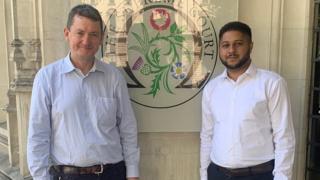
Former Uber drivers James Farrar and Yaseen Aslam
Two former Uber drivers will face the ride-hailing giant in court this week in a case that will decide whether Uber drivers should be classed as workers or self-employed.
“This is our final showdown with Uber but the stakes could not be higher,” says Yaseen Aslam.
He and James Farrar say by classing drivers as contractors, the firm denies them basic rights such as holiday pay.
But Uber said the “vast majority” of its drivers like being freelance.
“Drivers can determine if, when and where they drive, but can also access free AXA insurance to cover sickness or injury, as well as maternity and paternity payments,” said Jamie Heywood, Uber’s regional general Manager for Northern and Eastern Europe.
Why does this matter?
The courts ruled in favour of the drivers in 2016 and Uber lost a subsequent appeal in 2018.
Now the US ride-haling firm has appealed again to the UK’s Supreme Court, whose decision will be binding.
Image copyright Getty Images
Its judgement will affect the working rights of tens of thousands of Uber drivers across the UK, and could leave Uber facing a hefty compensation bill.
Rachel Mathieson, of Bates Wells, the law firm representing the drivers, says there could wider consequences for the so-called gig economy.
“This landmark case will have enormous implications for how well, or badly, workers in the fastest growing sector of the economy are treated.”
What do the drivers say?
Mr Aslam and Mr Farrar argue that as drivers for Uber they should have been classed as employees because the firm had so much control over them.
For example, Uber records passenger details but does not pass them on to drivers; it also stops drivers from providing their contact details to passengers, which drivers would be allowed to do if they were independent contractors.
Uber drivers launch legal battle over ‘favouritism’
Uber loses licence to operate in London
Mr Farrar, who now leads the United Private Hire Drivers’ union, said that by classing drivers as freelancers, Uber avoided having to offer holiday pay, paid rest breaks and the national minimum wage.
“[Working for Uber] we are not in business on our own account. We are in business as part of somebody else’s business,” he told the BBC.
“I don’t control the customer, I don’t control the price. I’m effectively performance managed and I’m penalised. So I am definitely under Uber’s control.”
What does Uber say?
Uber says most drivers like the flexibility of being freelance, and that its working practices have changed since 2016 when the case was first brought.
For example, it says its drivers have more control over their business as they are now able to see a rider’s destination before they choose to accept a trip. They also have no obligation to log on to Uber’s taxi booking app.
Media playback is unsupported on your device
Media captionTwo Uber drivers take opposing views on how the company should treat them
The US firm said that 9,000 UK drivers benefited from its free health insurance in 2019, and a recent Oxford University study showed drivers in London were earning well above minimum wage.
“Over a number of years we’ve made significant changes to our app to offer more benefits with total flexibility,” Mr Heywood said.
What could the outcome be?
If successful in their case, the Uber drivers could be entitled to an average of £12,000 each in compensation, according to law firm Leigh Day.
The firm – which is representing drivers seeking compensation – believes tens of thousands of Uber drivers could be eligible to make a claim.
However, Uber will only be legally required to compensate those who have brought a claim.
Nigel Mackay, a partner in the employment team at Leigh Day, said: “If Uber loses, it will have no other option but to compensate those drivers who have brought claims for failures to provide holiday pay and where the company has paid them below the minimum wage.”
The hearing will last two days but a ruling could take months.
Walmart has restarted discussions about selling a majority stake in Asda, its UK supermarket, after putting the plans on hold to focus on the pandemic.
The US retail giant had said in February that it was in talks with potential investors in the business.
That came after UK regulators blocked Walmart’s plan to merge Asda with Sainsbury’s last year on fears it would raise prices for consumers.
A Walmart spokesman said it was the “right time” to revive the talks.
“Walmart and Asda have restarted conversations with a small number of third-party investors who are interested in acquiring a stake in Asda and partnering with Walmart, following renewed inbound interest,” the spokesman said.
“There is no certainty that a transaction will happen,” he added.
‘Clear strategy’
Walmart, which purchased Leeds-based Asda in 1999, has overhauled its international strategy in recent years, to focus on markets, such as India, where it sees growth and forge alliances with local partners, such as JD.com in China.
In 2018, it announced plans to merge Asda with Sainsbury’s in a deal in which it would retain 42% of the combined business.
After regulators blocked the deal, Walmart said it was considering a stock market flotation for Asda.
Among the top three supermarkets in the UK, Asda claims an estimated 15% of the market. It has faced increased competition from discount chains, especially Germany’s Aldi and Lidl.
In a February survey by consumer group Which?, Asda was ranked worst among supermarkets for customer satisfaction, and behind the German firms when it came to prices.
Asda sales, excluding petrol, increased 3.5% in the three months to 31 March, the company said in May. Including petrol, sales declined.
However, grocery stores such as Walmart have been some of the few retailers to report strong business during the pandemic, as customers focus their spending on essentials.
Walmart said the pandemic had “demonstrated Asda’s resilience and the key role we play in supporting different communities”.
Image caption
Andy Haldane says we have seen a bounceback
The UK economy has “clawed back” about half the fall in output it saw during the peak of the coronavirus lockdown in March and April, according to the Bank of England’s chief economist.
Andy Haldane told MPs there had been a “V” shaped “bounceback”.
Last month, Mr Haldane said the economy was “on track for a quick recovery” – the so-called “V” shape.
However, other economists have expressed doubts about the potential for such a swift recovery in activity.
“Roughly half of the roughly 25% fall in activity during March and April has been clawed back over the period since,” Mr Haldane told members of the Treasury Select Committee. The economy had grown by about 1% per week, he said.
“We have seen a bounceback. So far, it has been a ‘V’. That of course doesn’t tell us about where we might go next,” he added.
UK economy rebounds more slowly than expected
UK economy ‘on track for quick recovery’
The latest economic growth figures for May indicated an increase of 1.8%, but Mr Haldane is known to take into account unofficial real-time data, such as Google searches and credit card receipts.
Commenting on those figures at the time, Thomas Pugh, UK economist at Capital Economics, said the data showed the recovery was “maybe not so V-shaped after all” and that “hopes of a rapid rebound from the lockdown are wide of the mark”.
“Indeed, the path to full economic recovery will probably be much longer than most people anticipate,” he added.
Mr Haldane was speaking at a hearing to reconfirm him as a member of the Bank’s Monetary Policy Committee (MPC).
He was the only member of the nine-strong MPC who last month voted against an expansion of quantitative easing – expanding the asset purchase programme aimed at boosting the economy.
However, he told MPs unemployment was rising fast and was probably about 6% now, compared with 3.9% in the most recent official figures.
He also repeated his fear that unemployment could hit its highest level since the mid-1980s as the long-term effects of the coronavirus pandemic hit demand for staff in retail and hospitality.
Analysis:
Dharshini David, BBC business correspondent
A speedy bounceback to activity, livelihoods and incomes is what we all hope for.
But most economists doubt it’ll be that straightforward or painless to get back to business as usual.
So far the official data hasn’t been encouraging. After losing a quarter of its output in the first six weeks of lockdown, output – or GDP – recouped only 1.8% in May.
Mr Haldane is known to be fond of more up-to-date unofficial data – Google searches, credit card transactions for example. That’s why he’s hopeful we’re halfway back to the previous level of activity.
But even if it is so far so good, the real issue is what happens next.
The Bank of England expects unemployment to jump to 9% – but it’s unusual in assuming that will fall back quickly, with no long-term fallout, or scarring, on prospects and incomes.
It is that risk that most other analysts worry will derail confidence and spending – the underpinnings of any recovery.
So the hoped-for V could look quite different. And that’s even before the possibility of a second wave and shutdown is considered.
Image caption
Nigel Manton from Cheshire says he spent £10,000 on business interruption insurance for nothing
“It’s a bit galling to realise… we’ve spent more than £10,000 on insurance which wasn’t valid,” says Nigel Manton, of the Fresh Skin Clinic, in Cheshire.
His firm is one of hundreds that say they were wrongly denied cover for the virus and could go bust as a result.
A court case to decide whether many businesses receive insurance payouts for damage caused to them by the pandemic begins on Monday.
However, insurers say most business policies simply do not cover pandemics.
A judge will decide on the correct interpretation of 17 so-called business interruption policies, but the ruling could affect up to 370,000 firms.
“All businesses thought they’d inoculated themselves by buying this insurance and they have found that this financial vaccine doesn’t work,” says Mr Manton.
How did we get here?
Following the lockdown, a host of businesses had to close their doors and many looked to insurers to cover their losses through their business interruption policies.
Insurance firms ordered to pay out or explain
However, many insurers disputed these claims, arguing that such policies were never intended for losses caused by unprecedented measures such as government-imposed lockdowns.
About 400 companies have complained to the financial ombudsman, prompting City regulator the Financial Conduct Authority (FCA) to bring this case.
Image copyright Getty Images
It has selected 17 examples from business interruption insurance policies used by 16 insurers, eight of whom were asked to take part in the court case.
These include Hiscox, RSA Group, Arch Insurance, Argenta, Ecclesiastical, MS Amlin, QBE and Zurich, all of whom agreed to take part voluntarily.
The FCA says the case will provide “clarity and certainty for everyone involved in these business interruption disputes, policyholder and insurer alike”.
What do affected businesses say?
The views of Mr Manton are echoed by the many businesses who’ve contacted the BBC over the past few months to express frustration that their business interruption insurance wouldn’t pay out.
After all, their business was indeed interrupted by the coronavirus pandemic, as the lockdown stopped them from using their premises, for example.
Now many are crossing their fingers that the results of this case will mean their policies could pay out in future as many are – in the words of the FCA – “under intense financial strain”.
Image copyright The Pinnacle Climbing Centre
Image caption
Simon Ager fears he could incur £200,000 of losses due to lockdown
Simon Ager told the BBC his climbing company was at risk of being bankrupted because his insurer Hiscox was refusing to cover losses.
According to his policy, the insurer should cover financial losses for any business unable to use their premises following “an occurrence of any human infectious or human contagious disease, an outbreak of which must be notified to the local authority”.
However, citing a separate clause, Hiscox argues that the policy was intended to cover incidents that occur only within a mile of a business
Mr Ager is now part of the Hiscox Action Group, 369 of whose members are owed £47m in uncovered losses. They will give evidence in this week’s case and have begun a separate arbitration claim against the insurer.
Richard Leedham, a senior partner at law firm Mishcon de Reya, which represents the group, said: “We can shed additional light on the matter and explain exactly why these policies should pay out and show the damage this refusal is doing to hundreds if not thousands of British businesses.”
Image copyright Getty Images
What do the insurers say?
The Association of British Insurers says most business policies do not cover pandemics, as the level of risk involved would make premiums unaffordable. Instead the majority focus on property damage.
Huw Evans, director general of the ABI, told the BBC: “This is not a debate about whether these policies were intended to cover pandemics, it is a debate as to whether the wordings of these policies inadvertently cover pandemics.
“It is an argument about whether the wording allows insurers to decline the claim.”
In June, Hiscox said it recognised businesses faced “extremely difficult times” and was committed to “seeking expedited resolution of any contract dispute”.
RSA Group said it continued to “treat claims in line with legal advice, precedent and case law”.
The FCA has said the 17 policies under review in the case are only a “representative sample” and that the test case would provide guidance for the interpretation of “many other” business interruption policies.
However, it has also said all along that most small business insurance policies will only focus on property damage and only have basic cover for business interruption.
As such, it believes “in the majority of cases, insurers are not obliged to pay out in relation to the coronavirus pandemic” and this court case will only focus on the “remainder of policies that could be argued to include cover”.
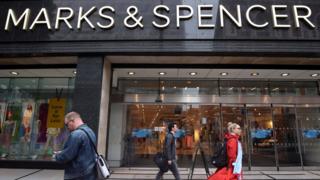
UK High Street stalwart Marks and Spencer is to cut hundreds of jobs as coronavirus continues to hit trading.
The retailer said 950 store management and head office jobs were at risk because it needed to accelerate its restructuring.
A spokesperson said the move marked “an important step” in it becoming a “stronger, leaner” business.
M&S was already undergoing a transformation that included cutting costs and closing some stores.
The firm said that because of the pandemic, those measures would be accelerated under a programme called Never The Same Again. M&S said it now wanted to “make three years’ progress in one”.
Retail sales jump in June – ‘but crisis not over’
John Lewis and Boots to cut 5,300 jobs
M&S said it had started collective consultation with employee representatives and had set out plans to offer voluntary redundancy first to affected staff.
Sacha Berendji, director of retail, operations and property at M&S, said: “Through the crisis, we have seen how we can work faster and more flexibly by empowering store teams and it’s essential that we embed that way of working.
“Our priority now is to support all those affected through the consultation process and beyond.”
Image copyright Getty Images
Image caption
M&S food stores remained open during lockdown, but clothing sales suffered
M&S’s food stores were open throughout the coronavirus lockdown, but trading in other parts of the business was severely affected. Clothing sales fell by 84% year-on-year at the lowest point, the firm said in May, warning that some customer habits had “changed forever”.
M&S was already struggling to adapt to the rise of online shopping and changing customer tastes.
The company had been facing increasing competition from fashion giants such as Primark on the High Street and Asos on the internet.
It is also one of the few big food retailers without its own internet-based delivery service. However, the retailer’s partnership with Ocado starts in September, replacing the online grocer’s existing deal with Waitrose.
In May, M&S chief executive Steve Rowe said that the impact of the virus lockdown had driven “effects and aftershocks” in the retail sector that would “endure for the coming year and beyond”.
Its latest announcement comes after a wave of redundancies on the High Street, with John Lewis, Boots and Debenhams among retailers announcing huge job cuts.
Other lay-offs announced during the pandemic have included:
Up to 5,000 job cuts at Upper Crust owner SSP Group
Up to 12,000 jobs at British Airways
Up to 700 jobs at Harrods
About 600 workers at shirtmaker TM Lewin
1,900 jobs at Café Rouge-owner Casual Dining Group
1,000 jobs at Pret A Manger
1,700 UK jobs at plane-maker Airbus
1,300 crew and 727 pilots at EasyJet
550 jobs are going at Daily Mirror publisher Reach
On Monday, Ted Baker confirmed it could cut about a quarter of its UK workforce after the coronavirus pandemic added to its financial difficulties.
The fashion retailer did not confirm the number of redundancies, but there are reports that 500 store and head office jobs will go.
“We have not taken this decision lightly and would like to thank all our colleagues for their hard work,” a spokesperson said. The move is intended to save about £6m by the end of the year.
Both part-time and full-time roles will be affected. About 200 jobs will go at the Ugly Brown Building, its London headquarters, with the rest from its 46 shops across the UK and Europe, as well as many store concessions.
Ted Baker had also been struggling before the coronavirus pandemic hit the UK. The firm reported a pre-tax loss of £79.9m in the year to 25 January, against a £30.7m profit the previous year.
Are you a Marks and Spencer employee or contractor? Share your experiences by emailing .
Please include a contact number if you are willing to speak to a BBC journalist.
Image caption
Andrew Adams is applying for five jobs a week in Liverpool
More than one in every six young people is now claiming out-of-work benefits in some parts of the UK, BBC analysis of official figures suggests.
The number of people aged 18-24 claiming Universal Credit or Jobseeker’s Allowance doubled in the UK in the last three months.
Parts of Liverpool and Blackpool have been worst hit, with closures of pubs, cafes and restaurants all contributing.
Chancellor Rishi Sunak has announced a £2bn scheme to help young workers.
In the UK, 2.6 million people are currently claiming Universal Credit or Jobseekers’ Allowance and are required to “seek work”.
A fifth of those – 514,770 young people – are aged between 18 and 24.
The number of young new claimants who have signed on between March and June is 276,000 – more than doubling over three months.
The Walton area of Liverpool is among the most deprived parts of the UK. About 7,500 people there are aged between 18 and 24 and its economy is largely dominated by small retail.
But the BBC analysis shows 19% of people in that age bracket are now claiming benefits – making it the worst-hit constituency in the UK.
Andrew Adams, 21, has lived in the city all his life and has a degree in promotional design. Currently, he is sending out between four and five job applications a week with no success.
“At the moment I’m just looking for admin work, warehouse stuff, desk work – nothing to do with my degree at all,” he said.
“I’m just getting no response. It makes me feel kind of hopeless at the moment.
“Once I got my degree I thought it would be smooth sailing, but it isn’t at the moment.”
Andrew is currently taking on extra training from the Merseyside Youth Association, which helps to get the long-term unemployed back to work.
Its chief executive Gill Bainbridge said many in the city had become eligible for Universal Credit because their work hours have been cut.
“Liverpool had a high level of unemployment to start with,” she said. “Its economy is built around visitors and the hospitality industry. A lot of these have been impacted quite directly. The trouble we are having now is it is so competitive.
“If Andrew is finding it tough with those qualifications, imagine what it’s like if you have low-level literacy and come from a difficult background?”
‘It will take a couple years’
In London, Grace Dembowicz, a recent journalism masters graduate, finished a course at the end of June and says she has been applying for jobs throughout lockdown.
The 22-year-old is one of 500,000 young people who will leave education this year and enter a labour market hit by recession and with a shrinking number of apprenticeships available.
“I was offered interviews, but they said it would be on commission as they don’t have money for full-time pay,” she said.
“Being realistic, I finished my masters thinking I would get into a newsroom straight away but it’s becoming more realistic that it will take a couple years to get to that stage.”
Image copyright Grace Dembowicz
Image caption
Grace Dembowicz is one of 500,000 university leavers looking for work
BBC analysis has found there are now nearly 50 constituencies in the UK with more than 15% of their young population claiming out-of-work benefits.
Affluent areas such as South West Surrey, Henley and Windsor have even seen a surge in the number of young claimants under lockdown, though many of these are likely to have become eligible as a result of being furloughed.
According to the Resolution Foundation, one-third of employees aged 18-24 have lost jobs or been furloughed during the pandemic, compared to one-in-six adults above that age.
Another think tank, the Institute for Fiscal Studies, says younger people are more likely to be employed in jobs where they cannot work from home.
Prof Guy Michaels, from the London School of Economics, said the loss of the service industry since March had removed the pathway into employment for swathes of young people.
“It offers people work even if they don’t have a huge amount of experience or completed formal skills,” he said. “This means that young people really lost this stepping stone that they take in the start of their careers.”
Although Prof Michaels has welcomed the government measures, he said they might need to stay in place for years.
He also said the success of the incentives being offered are highly dependent on job vacancies being available in the first place.
“After the last recession it took quite a few years for the youth unemployment to recover,” he said. “It might take three or four years to start coming down in this instance.
“Each recession is different but there is a worry that this isn’t going to go anywhere quickly.”
The rise in young claimants
Number of 18-24-year-olds claiming out-of-work benefits since start of Universal Credit
Laura-Jane Rawlings, chief executive of Youth Employment UK, said the incentive scheme would need to stay in place for a long time to be effective.
Her organisation has seen 400,000 young people apply for career help over the last three months.
“There can be a scarring of individuals that enter at this time. It’s not just about having one or two bad years it can be persistent,” she said.
“The people hit the most are people from disadvantaged backgrounds.”
Last week, the government announced a “kickstart scheme” to pay for six-month work placements for 16 to 24-year-olds on Universal Credit.
The chancellor said the plan was aimed at preventing an entire generation being “left behind”.
A spokesman for the Department for Work and Pensions said the government recognised it was an uncertain time for many young people. As well as the kickstart scheme, it was scaling up training and apprenticeship support, and boosting support from youth employment coaches, the spokesman said.
Image caption
The talks continue to be difficult as leaders struggle to come to an agreement
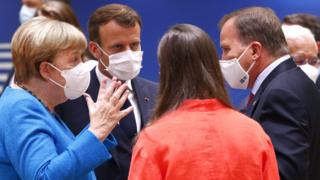
EU talks aimed at reaching an agreement on a huge post-coronavirus recovery fund have stretched into a fourth day.
There are reportedly deep differences between the leaders, who are trying to negotiate the deal at the same time as the bloc’s next long-term budget.
Some member states believe the proposed €750bn ($857bn; £680bn) package is too large and should come as repayable loans, rather than grants.
The talks are reported to have been testy, with tempers flaring at times.
In the early hours of Monday morning, French President Emmanuel Macron reportedly banged his hand on the table and threatened to walk out of the discussions.
And Dutch Prime Minister Mark Rutte has admitted leaders were “close to failure” and talks could still “fall apart”.
Discussions are due to resume at 14:00 GMT on Monday for what is now the longest EU summit since Nice 2000 when talks lasted five days.
President of the European Council Charles Michel reminded the leaders that more than 600,000 people had died of the virus worldwide, and he hoped that the “headline tomorrow is that the EU has accomplished mission impossible”.
On Monday morning, the total number of confirmed cases of coronavirus was almost 14.5 million globally.
What’s hampering compromise?
EU leaders first met on Friday in Brussels to discuss the bloc’s €1tn seven-year budget and the planned stimulus package to help countries recover the pandemic.
It was the first face-to-face meeting between leaders since governments began imposing lockdowns in a bid to stop the spread of the virus in March.
Media playback is unsupported on your device
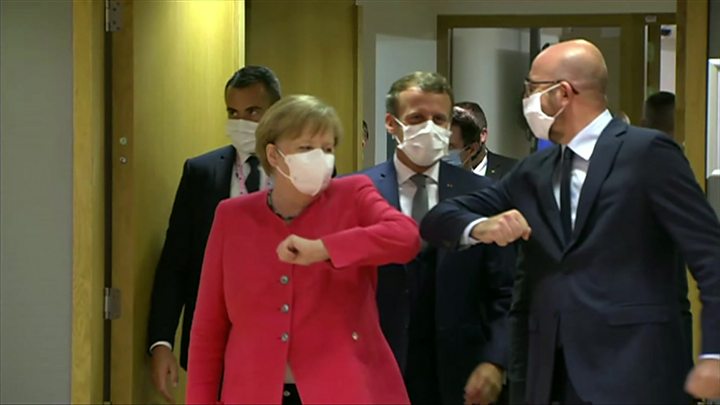
Media captionGerman Chancellor Angela Merkel bumps elbows with EU Council leader Charles Michel
Member states are split between those hit hardest by the outbreak, and those concerned about the costs of the recovery plan.
Some northern nations like the Netherlands and Sweden have balked at the package, arguing it should take the forms of loans not grants.
But nations including Italy and Spain are desperate to revive their shattered economies, and have accused the EU of not doing enough to help countries hit by the pandemic. Italy in particular was one of the earliest European countries to suffer an outbreak and has recorded 35,000 deaths – one of the highest tolls in the world.
Big choices face EU leaders on Covid recovery cash
Are Italians losing faith in the EU?
Italian PM Giuseppe Conte said Europe was “under the blackmail of the ‘frugals’” and described negotiations as “heated”.
Hungarian PM Viktor Orban accused Mr Rutte of a personal vendetta and of trying to link financial help to political issues. Mr Orban, and his ally Poland, have threatened to veto the package if it adopts a policy of withholding funds from nations who do not meet certain democratic principles.
Austrian Chancellor Sebastian Kurz said there was “a way to go”, but that it was possible a deal could be achieved.
Mrs Merkel said: “I still cannot say whether we will find a solution. There is a lot of goodwill but also many different positions.”
Image copyright Getty Images
Image caption
European Council President Charles Michel, left, with Angela Merkel, Emmanuel Macron and European Commission President Ursula von der Leyen, right
Where is Europe at with the virus?
Many European nations have ended lockdown restrictions, but the virus remains a major threat.
Officials are facing localised outbreaks across the continent, with the largest appearing in Spain’s north-eastern region of Catalonia. About four million people in Barcelona, La Noguera and El Segrià have been ordered to stay at home for 15 days.
Among the measures imposed are a ban on public or private meetings of more than 10 people; a ban on visits to nursing homes; and the closure of gyms and nightclubs.
EU budget commissioner Johannes Hahn tweeted a “solemn reminder” on Saturday that the pandemic was “not over”.
“High time to reach an agreement which allows us to provide the urgently needed support for our citizens and economies,” he wrote.
How is the virus spreading elsewhere in the world?
On Saturday the World Health Organization (WHO) recorded the largest single-day increase in cases of the virus globally. The largest increases were in Brazil, India, South Africa and the US.
Florida is currently the epicentre of the US epidemic. The state recorded more than 10,000 new infections and 90 more deaths on Saturday, bringing its total number of cases to more than 337,000 and its death toll to more than 5,000.
In Brazil, where the coronavirus and measures to contain it have been highly politicised, cases continue to surge – although the WHO announced last week that infections were no longer increasing exponentially.
Scientists have also warned that India could still be months away from the peak of its outbreak – despite already having the third-highest number of confirmed cases. Hospitals in the worst-hit cities, including Mumbai and Bangalore, have been overwhelmed with patients.
India recorded another 34,884 infections in a 24-hour period on Saturday, and another 671 deaths linked to coronavirus.
And South Africa, which saw one of the largest single-day rises in cases, has the highest number of confirmed infections on the African continent.