Category: iT news

  • Star Wars: Episode IX is getting a new writer

    Star Wars: The Last Jedi won’t be in theaters until the end of the year, but preparation for the final installment of the Skywalker saga is already underway — and a new writer is jumping on board. According to The Hollywood Reporter, British screenwriter and playwright Jack Thorne will be tackling a rewrite for the as-of-yet untitled Star Wars: Episode IX. Thorne has created UK television shows like The Fades and The Last Panthers, and wrote both the upcoming Julia Roberts film Wonder and an installment of the anthology series Philip K. Dick’s Electric Dreams. His most high-profile work in terms of mainstream fantasy, however, is the play Harry Potter and the Cursed Child.

    Director Colin Trevorrow and screenwriter Derek Connolly had written previous drafts of the Episode IX script, working from an outline by Last Jedi writer-director Rian Johnson. Trevorrow and Connolly had both been behind Jurassic World, and given the production issues that Lucasfilm has faced with the untitled Han Solo film and Rogue One, there might be an inclination to wonder if this change points to issues arising with Episode IX, as well. However, according to Variety’s sources, the move is much more in line with the kind of polishes that blockbuster films routinely receive, rather than a ground-up rewrite. The movie hopes to begin principal photography in January of next year.

    Star Wars: Episode IX is scheduled for release on May 24, 2019.

  • Overwatch is bringing back its Olympics-themed Summer Games event

    Overwatch is getting its second annual Summer Games event starting August 8th, developer Blizzard Games announced today. The timed event, which will last until August 29th, will bring back last year’s coveted Olympics-themed skins at a reduced cost. It will also add new skins and bring backf the soccer-style Lúcioball multiplayer mode, which will arrive with a few design tweaks and a new competitive mode with a ranking system.

    Last year’s event debuted during the Summer Games in Rio de Janeiro, Brazil, and at the time players were not yet allowed to purchase event skins using in-game currency. That left a lot of Overwatch fans upset, as many assumed the event wouldn’t return perhaps for another four years, or in two years in time for the Winter Olympics in 2018. Blizzard has since changed how it handles timed event loot, allowing players to now purchase items using in-game currency earned while playing in the event or stockpiled beforehand.

    Now, Blizzard is bringing back all of those old cosmetic items at a reduced cost. The developer says 2016 Summer Event skins can be purchased for 1,000 credits, while epic skins will cost 250 credits and rare items will cost items 75 credits. For the brand new items, Blizzard is charging the standard rates: 3,000 credits for new legendary skins, 750 for epic ones, and 225 for rare.

    You can of course obtain these items via loot boxes, which can be bought or earned, and Blizzard back in June decided to make a software-side tweak that cut down on the number of duplicates players receive. Overwatch head Jeff Kaplan confirmed in Blizzard’s developers update today that this Summer Games event will be the first ever timed Overwatch event to feature the new loot box system. That means you won’t suffer as much from the unforgiving mercy of the game’s prior randomness. That’s good news if you happen to want to try and collect everything in the short window of time before the event ends.

  • Apple returns to growth as cheaper iPads boost sales

    Apple’s business has been producing record-setting revenues and profits for years now. But in the second quarter of last year its blistering period of growth came to an end. Today the company posted its third quarter earnings, and it’s clear Apple has found a way to restore some of the lost momentum. Revenue grew about 6 percent year over year, and profit was up 12 percent over the same period in 2016.

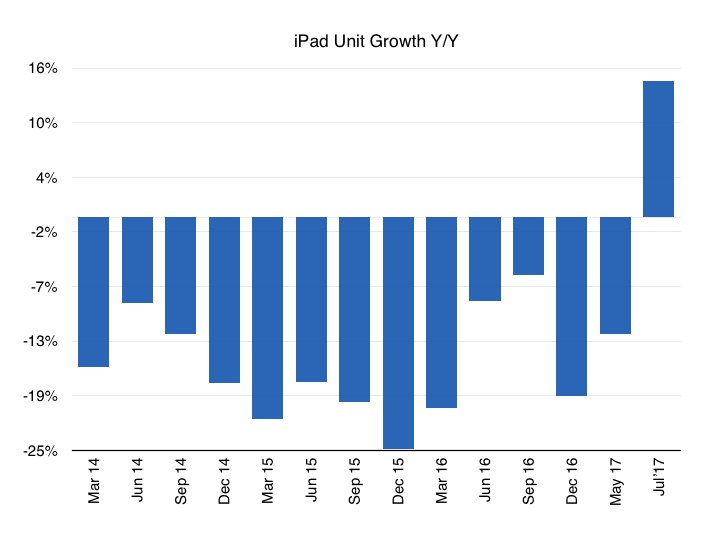
    Leading the way was Apple’s iPad sales, which were up 15 percent from last year. Revenue rose just 2 percent, suggesting sales of cheaper $329 iPads were a bigger driver of the jump in sales than the new models of the iPad Pro. We posted a positive review of the cheaper iPad in April of this year, highlighting the low price as the best feature. Prior to this earnings report, Apple had gone years without an annual increase in the number of iPads sold.

    iPhone and Mac sales were both up modestly on a year-over-year basis. In total, Apple reported $45.4 billion in revenue and $8.7 billion in profit for this quarter. The biggest drivers of growth were from Services and Other Products. Both of those revenue lines grew at more than 20 percent over the same period last year. The App Store, Apple Music, and cloud storage are the big drivers of revenue growth for services. Hardware like the Apple Watch, AirPods, and Beats headphones where the highlights of the Other Products category.

    Finally, China — the region driving Apple growth for the past few years — saw revenue drop from last year as competition from local phone makers increased.

    Chinese consumers might not have to wait long. Apple’s projections for its next quarter of earnings would indicate a big iPhone launch this coming September.

  • Tim Cook justifies removing VPN apps in China, claiming Apple was only following the law

    During today’s quarter three earnings call, Apple CEO Tim Cook clarified that the removal of Virtual Private Network (VPN) apps in China late last week was due to a stronger enforcement of the law by the local Chinese government.

    Cook states that in 2015, China tightened its policy around VPNs which required operators to obtain a license from the government. “Earlier this year, [China] began a renewed effort to enforce that policy,” Cook says. As many of the apps did not comply with the regulations, Apple was required to purge them from the App Store. “We would rather not remove apps, but like we do in other countries we follow the law wherever do we business.”

    Cook also pushed back against comparisons to Apple’s refusal to unlock the iPhone belonging to one of the San Bernandino shooters in 2016, claiming that the US laws supported Apple in that case. In both the US and China’s circumstances, he says the laws were “very clear.”

    Despite the VPN app removals, Cook stressed the company’s stance that it would offer products that are of the “best interest” of local consumers and hopes that China loosen the restrictions over time. “We believe in engaging with governments even when we disagree… because innovation really require freedom to collaborate and communicate,” he says. With China continuing to be a big growth market for Apple, it’s clear that Apple would rather abide by the law to continue operating in the country.

    A number of VPN apps that apparently follow regulations are still available in the App Store in China, Cook adds. The CEO did not specifically call out or commented on a similar ban in Russia, which took place days after China removed the apps.

  • Tim Cook suggests Apple is building autonomous systems for more than cars

    It’s an open secret that Apple is working on autonomous driving systems — the company seems to have even put self-driving vehicles on the road. But now Apple CEO Tim Cook has hinted that the company’s AI work is meant for more than just autonomous cars.

    “[Autonomous] systems can be used in a variety of ways,” Cook said during a call with investors this afternoon. “A vehicle is only one, but there are many different areas of it. And I don’t want to go any further with that.”

    The answer makes it pretty clear that Apple isn’t limiting its AI work to autonomous vehicles. But beyond that, it leaves a lot to speculation. Autonomous systems could be used for drones, shipping, and all kinds of robots, from warehouse assistants, to search robots, down to the machine that disassembles iPhones.

    Apple is certainly not the only company working on these things: there are already several autonomous drones, big ambitions for autonomous factory robots, and even plans for an autonomous delivery robot.

    But expanding Apple’s focus beyond cars opens up a lot more possibilities for the company, since its AI could end up far more markets. Given how many companies are investing in autonomous technologies right now, that certainly seems like the right idea — even if cars still seem to be Apple’s main target.

    “We are very focused on autonomous systems,” Cook said. “We do have a large project going, and are making a big investment in this. From our point of view, autonomy is sort of the mother of all AI projects.”

  • Please do not start calling my home state ‘Wisconn Valley’

    How do you follow up a deal to bring a Foxconn plant to Wisconsin at an estimated government subsidy of $1 million per $54,000 job created?

    If you’re Wisconsin governor Scott Walker, you start calling your state “Wisconn Valley.”

    This probably supposed to be a muddled phonetic approximation of “Silicon Valley,” but it’s pretty hard to read it as anything other than a weak portmanteau of “Wisconsin” and “Foxconn.” And one of Foxconn’s main competitors is named, uh, Wistron, so I’m sure CEO Terry Gou is thoroughly enjoying this taxpayer-funded troll.

    Quartz has a good breakdown of the name and lofty vision of a Midwestern tech boom, but I’m going straight to a plea from the heart: Please, Scott Walker, do not rebrand my home state after a single supplier who signed a massively favorable deal. It is a road to ruin. You are two more iffy tax incentive schemes away from renaming my hometown Racine 4G LTE Touch Presented By Verizon, and we just can’t do that to the people we love.

    I texted some of my friends in Wisconsin to gather their reactions to this renaming scheme, and the responses were bleak. “Wisconn Valley, or as I like to call it, 1,000 acres surrounded by people who didn’t need three-billion dollar incentive packages or exemption from environmental regulations to do business,” replied one.

    “Is there an actual valley in that area? It’s like the flattest part of the state,” noted another.

    “He must have eaten a bad ham and cheese sandwich,” said my friend Barret Van Sicklen, who delightfully agreed to be on the record.

    Anyway, I will at least be here for it when Wiston responds to this situation by renaming it Minnesotron.

  • Apple hints at least one new iPhone is coming this September

    After months of rumors that the next iPhone will be delayed, Apple has given a quiet cue to the contrary. In its earnings release today, Apple said it expects to see anywhere from $49 billion to $52 billion in revenue next quarter — a number high enough to indicate that an iPhone will launch on time. The quarter runs through September 30th, so we should expect to see an early September iPhone event and a launch a week or so thereafter.

    Tim Cook hinted as much during a call discussing the earnings, saying Apple would have “very exciting Fall.”

    That said, this doesn’t necessarily mean the redesigned iPhone that’s been leaking out is what Apple plans to release this September. There’s been some speculation that Apple could split the phone line: release an iPhone 7S in September, and release the redesigned model a few months later. Cook also promised more products “later this year,” but it’s likely we’ll see new iPads and potentially refreshed Macs around then too.

  • Sorry, Mesopotamians didn’t invent the fidget spinner

    For the last month, an interesting photo has been floating around Twitter. It captures a museum piece identified as a “spinning toy with animal heads” from Mesopotamia’s Isin-Larsa Period, produced sometime between 2000 and 1800 BCE. And with its tripartite shape and hole in the center, it looks a whole lot like a modern fidget spinner.

    The comparison has been irresistible. Yesterday, Wired senior associate editor Arielle Pardes jokingly declared it “proof that there are no original ideas anymore” in a massively popular tweet. Back in June, the University of Chicago’s Oriental Institute (home of the “spinning toy”) retweeted someone else making the comparison, and the university quipped that the institute is “always ahead of the curve.” If you were thinking this seemed a little too good to be true, though, you’d be right. In fact, this ancient “fidget spinner” probably isn’t a toy at all.

    Oriental Institute Museum chief curator Jean Evans confirmed to The Verge that this item is located in the institute’s Mesopotamian gallery, where it’s described as a baked clay spinning toy. “It does look like a fidget spinner!” agrees Evans. “However, I don’t think either identification is correct.” Today, the museum thinks it’s actually the head of a mace — similar to the weapon piece shown below, which Evans attached for reference.

    Evans says this artifact was found in the vicinity of a temple, which would support the mace interpretation, since they were considered “weapons of the gods” during that era. “We do have toys that survive from ancient Mesopotamia — baked clay rattles, whistles, animal figurines, and wheeled carts, to name a few,” she says. “But the fact that this ‘spinning toy’ would be a largely singular example of such a toy also suggests to me that it would be more accurate to think of it as a mace head.”


    Oriental Institute mace head

    Photo: The Oriental Institute Museum

    So why, then, did the museum think it was a toy in the first place? “All I can say is that our ideas change over time,” says Evans. “When the ‘spinning toy’ was first published in 1932, the excavators recognized that the object was unique, and they speculated it might be rotated and used in ‘astrological divination.’” Even with this interpretation, that’s pretty far from our present-day fidget spinner.

    Evans says I’m not the only one who’s reached out to the museum about this supposed ancestor of the fidget spinner, so at the very least, a previously unknown historical artifact has gotten some time in the spotlight. But its days as a “spinning toy” are numbered. Evans says the museum is updating all its labels in preparation for the Oriental Institute’s centennial celebration — and when that happens, it’s getting re-shelved in the mace-heads area.

  • A new hack can turn an Echo into a live microphone

    Hackers have figured out how to turn an Amazon Echo into a live microphone. First reported by Wired, the attack requires physical access to the device, is limited to pre-2017 Echoes, and would be difficult to deploy at scale. But when successful, it would allow hackers to pull a live feed of all audio within range of the device, even if the wake word hasn’t been said. The method could also allow hackers to remotely retrieve authentication tokens and other sensitive data from the device.

    Researcher Mark Barnes laid out the attack in a blog post earlier today. In simple terms, Barnes’ method compromises the device by booting from an inserted SD card — similar to a LiveCD — and uses that access to rewrite the Echo’s firmware. Once the firmware is rewritten, the hacked Echo can send all audio captured by the microphone to a third party, remaining compromised even after the SD card is removed.

    “Customer trust is very important to us,” Amazon said in a statement. “To help ensure the latest safeguards are in place, as a general rule, we recommend customers purchase Amazon devices from Amazon or a trusted retailer and that they keep their software up-to-date.”

    Barnes’ attack only works on the 2015 and 2016 versions of the Echo. The 2017 model makes an internal hardware change that prevents an SD card from operating as an SPI peripheral, a crucial element of the hack. Without moving into SPI mode, the Echo can’t boot directly from the SD card, leaving no way to execute the attack.

    While that hardware fix effectively blocks the attack, the nature of the firmware assault makes it very difficult to stop the attack at a software level. Any security patches or other software protections deployed by Amazon would simply be rewritten along with the original firmware. As a result, Echo devices made in 2015 and 2016 are likely to remain vulnerable to the attack indefinitely. Analysts estimate more than 7 million Echo devices were purchased during those years.

    “[The attack] does require physical access, which is a major limitation,” Barnes writes in his post. “However, product developers should not take it for granted that their customers won’t expose their devices to uncontrolled environments such as hotel rooms.”

  • Snap reportedly in talks to acquire maker of selfie-taking drone

    Snap is still trying to get into the drone business. After reportedly buying LA-based drone company Ctrl Me Robotics earlier this year, Snap is now looking at another drone maker: China-based Zero Zero Robotics. The Information reports that Zero Zero contacted Snap when looking for funding. No asking price was provided to the publication, although the drone company had previously raised $25 million. Zero Zero Robotics chief executive Meng Qiu Wang denied the news while Snap declined to comment.

    Zero Zero is best known for its Hover Camera Passport Drone, which uses facial recognition to take photos of users from the air. At the time of its debut in spring of last year, no other drone company had introduced something similar and made it to market. Lily Robotics successfully raised $34 million in preorders for its autonomous drone, only to shut down and halt manufacturing efforts. Now, DJI makes its Spark drone and specifically markets it as a gadget for selfie-taking. That puts Zero Zero Robotics in a tough spot: directly competing against the most well-known consumer drone company.

    How does this fit with Snap? The company was reportedly working on its own drone, as a follow-up to its Snap Spectacles, but we haven’t heard anything since that rumor started going around earlier this year. Since that time, the company has gone public, and its stock dropped in value. Spectacles created $8 million in revenue, as of its last earnings report in May. The company will be hosting another earnings call on August 10th, so it’s possible we’ll learn more about its efforts to make money through hardware.