Category: iT news

  • Game of Thrones unseen episode spoilers leaked

    White walkersImage copyright
    PA

    Image caption

    Scripts and copies of unseen episodes are believed to be in the material placed online

    A summary of an unseen Games of Thrones episode and copies of other HBO shows have been put online by a hacker group that breached the firm’s network.

    The hackers uploaded a text file of the Games of Thrones instalment and an annotated video of the script.

    They also shared three episodes of popular HBO TV shows on a site created to host what they stole.

    The group behind the breach said it managed to grab more than 1.5 terabytes of data from the firm.

    Breach count

    On Monday, when news of the data breach began circulating, HBO confirmed that it had been hit by a “cyber-incident” that had led to the loss of some data.

    “We immediately began investigating the incident and are working with law enforcement and outside cyber-security firms,” it added.

    Some episodes of the HBO shows Ballers and Room 104 were quickly leaked online.

    Added to these now are scripts and summaries for episodes three and four of the seventh season of Game of Thrones.

    Image copyright
    Getty Images

    Image caption

    Netflix shows were stolen in a separate data breach earlier this year

    The script for episode four bears a date of April 2016, suggesting it was an early draft rather than the finished, filmed episode.

    Also made available were two episodes of upcoming HBO comedy show Barry and one of the Insecure show.

    Files containing log-in details for some HBO staff are also believed to have been made available.

    Several other large files were also put online but so far no-one has been able to work out what is in them.

    Panda Security urged people to avoid any website that made the stolen files available for copying.

    “Instead of the new season of a hit show, your system may end up getting infected with malicious software,” it warned.

    The security firm added that the hackers behind the breach, or those that share the files around, were not acting benevolently.

    It said: “They are money driven and would gladly steal your information too without any hesitation.”

    HBO is just the latest in a long list of media firms to be hit by hackers, or who have had data stolen.

    In May, unseen episodes of the Netflix show Orange Is The New Black were put online by a hacker after the media firm refused to pay a ransom for their return.

  • Dual-Lens Camera Revealed in Leaked Note8 Images | Tech Buzz

    By John P. Mello Jr.

    Aug 2, 2017 5:00 AM PT

    Photos posted to Twitter show the next Samsung Note phone will have a dual lens camera.

    Evan Blass, a reporter for VentureBeat, posted a photo of the front of a black Note8 to Twitter on Monday. On Tuesday, he added front and back images of gold and black versions of the phone, as well as a stylus device called the “S Pen.”

    The latest photos show a dual lens camera at the back of the phone. The mobile’s front has an edge-to-edge display across the width of the device and thin bezels at its top and bottom.

    The photos represent early renderings of the phones, Blass tweeted.

    However, it’s noteworthy that his past early renderings have proven to be very accurate.

    Maximized Display Real Estate

    Blass’ photos appear to support other reports on the Note8 build.

    The device is designed to maximize screen real estate on its 6.3-inch QHD+ Super AMOLED Infinity display. The power-lock screen key is on the right side of the phone. On the left are the volume buttons and key for accessing Samsung’s Bixby digital assistant.

    Along with the dual cameras on the back, there’s a dual LED, dual tone flash; fingerprint scanner; and, according to some accounts, a heart-rate scanner.

    Chances are there will be two versions of the device — one with a Snapdragon 835 64-bit octa-core SoC and another with Samsung’s Exynos 8895 64-bit octa-core chip.

    The unit is expected to have 6 GB of RAM, 64 GB or 128 GB of expandable internal storage, and a 3,500-mAh battery. It likely will run Android 7.1.1 Nougat with the customary Samsung UI on top.

    Similar to Galaxy S8

    Although the Note8 is larger than the recently released Galaxy S8, there doesn’t seem to be a lot of physical difference between the devices.

    “There appears to be very little to distinguish the two phones at this stage, beyond the presence of the S Pen,” said James Moar, a research analyst at Juniper Research.

    “The same bezel-less design is evident, as well as a dedicated button for Bixby,” he told TechNewsWorld.

    “The biggest distinguishing feature appears to be the dual camera, which is becoming a standard feature for many current-gen smartphones,” Moar added.

    In the Note8, Samsung may try to address an issue that already has cropped up with the S8 since its release.

    “Feedback from users of the S8 is that when they’re not looking at the phone, they’re putting their finger on the camera’s lens instead of the fingerprint sensor because they’re adjacent,” said Jeff Orr, senior practice director for mobile devices at ABI Research.

    “Maybe that gets remedied on the Note8, because there’s more room on it to move around the camera’s sensors or the fingerprint sensor,” he told TechNewsWorld.

    An Edge in VR

    When the Note8 is released, it can expect some tough competition from phones like the LG V30, Huawei Mate 10, Google Pixel 2, and of course the iPhone 8.

    A key difference between the Note8 and other phones will be its broader support of virtual reality platforms, Juniper’s Moar maintained. The LG and Google models will support the Daydream platform, but the Note8 will support both Daydream and Gear VR platforms.

    “This will be a big draw to both VR early adopters and some industries looking to deploy smartphone VR to their customers,” he pointed out.

    That, along with Samsung’s strong relationships with channel partners, could help the company outsell its competitors — if the price is right, suggested Moar.

    However, there are signs that the price won’t be right. There are reports that Samsung may be getting Apple fever and could price the Note8 at US$1,000 or more.

    “This would put a huge dent in sales, both for the real price hike and the psychological effect of the $1,000 barrier on consumers,” Moar maintained.
    “If priced at over $1,000, the Note8 will fare badly, particularly with the S8 being so close to it in features for $200 or so less.”

    Marketing Muscle

    Pricing may not be a problem in the United States, though.

    “There’s an appetite for higher-end phones here,” said Ramon T. Llamas, a senior research analyst at IDC.

    “There are also plans in place for people to buy high-end phones,” he told TechNewsWorld. “If you tell someone they’ve got to pay $1,000 up front, they’ll probably balk at that. But tell them to put $200 down and $25 a month, and they can deal with that.”

    With the exception of Apple, Samsung has another advantage over its competitors.

    “People don’t know these other brands as well as they know Samsung,” said Jack E. Gold, principal analyst at J. Gold Associates.

    “People know Samsung and feel comfortable with it,” he told TechNewsWorld.

    Samsung also does a better job of marketing its phones than others, added Rob Enderle, principal analyst at the Enderle Group.

    “It’s going to come down to marketing execution,” he told TechNewsWorld. “I have no doubt that they’ll have the budget because they just had a phenomenal quarter.”

    However, there is already speculation about the Note 9, Enderle noted.

    “That could do damage to the Note8 the way iPhone 7 sales were hurt by the expectations that the iPhone 8 would be a very special phone,” he said.

    Weathering Firestorm

    Samsung no doubt hopes that its Note8 launch at the end of the month will not be plagued by the problems that doomed its predecessor, the Note7. That model made headlines with its battery fires and subsequent recalls. After less than 90 days on the market, Samsung stopped producing it.

    It’s not likely that those headlines will impact Note8 sales, however.

    “Not that many people were affected by those problems. I think 95 percent of the people don’t even remember the problems,” Gold said.

    “They appear to have recovered from the problems, and people aren’t avoiding the brand or the product,” Enderle noted.

    “Given the similarities between the Note8 and the S8,” said Moar, “that is likely to have a bigger impact on sales than the Note7 problems.”


    John P. Mello Jr. has been an ECT News Network reporter
    since 2003. His areas of focus include cybersecurity, IT issues, privacy, e-commerce, social media, artificial intelligence, big data and consumer electronics. He has written and edited for numerous publications, including the Boston Business Journal, the
    Boston Phoenix, Megapixel.Net and Government
    Security News
    . Email John.

  • Cardiff billboard offensive images display after hack

    Billboard

    Offensive images have been displayed on a Cardiff city centre billboard, prompting a police investigation.

    Swastikas and far-right images were displayed on the Queen Street screen on Tuesday night after a hacker gained control and selected what was shown.

    Writing in an anonymous online post, the hacker claimed there was a security vulnerability with the screens.

    BlowUP media, which controls the billboard, has been contacted for comment.

    South Wales Police said they had received a number of calls relating to the incident.

    A spokesman added: “We alerted the city council and will investigate any crimes which may have been committed.”

    Cardiff council said it had contacted the company that owns and operates the screen and it was switched off at midnight.

  • Amazon Echo turned into covert microphone

    Amazon EchoImage copyright
    Amazon

    Image caption

    The original Amazon Echo speaker first went on limited release in November 2014

    Amazon’s Echo smart speaker can be hacked to send the audio steam of everything it hears to an attacker, says a researcher.

    Mark Barnes said the attack on some versions of the Echo let him do almost anything he wanted to it.

    Mr Barnes managed to enter the device’s software innards via connections found on its base.

    He said taking over the device was “trivial” once an attacker had access to an Echo.

    Amazon’s Echo uses artificial intelligence (AI) to respond to voice commands from users to carry out many different functions, including answering queries, playing songs and ordering goods from a retailer.

    Getting physical

    The hack started by peeling off the rubber base of the Echo to expose a grid of electrical contacts, wrote the researcher from MWR Security in a blog.

    Connecting to one of the contacts let Mr Barnes watch the Echo’s boot-up procedure and work out how it was configured. Armed with this knowledge Mr Barnes wrote software that, once loaded on a small memory card and connected to one contact pad, gave him control over the device.

    Using this he examined how it handled audio and then created attack code which forwarded everything it heard to a remote server.

    That deep access meant he had complete control over the code the device ran and what it did with customer data, he said.

    Amazon did not comment directly on Mr Barnes’ findings but said in a statement: “Customer trust is very important to us.

    “To help ensure the latest safeguards are in place, as a general rule, we recommend customers purchase Amazon devices from Amazon or a trusted retailer and that they keep their software up-to-date.”

    Image copyright
    Wynn Las Vegas

    Image caption

    Some luxury hotels, like the Wynn, have put Alexa speakers in all their rooms

    The security researcher acknowledged that the requirement to get physical access to the device to carry out the attack was a “major limitation”.

    However, he added, it was possible that Echo owners would take their devices with them on holidays or business trips – situations that could expose them to attack. Second-hand devices may also be compromised in some way.

    The attack was carried out on the versions of the Echo that were released in 2015 and 2016. More recent versions of the Echo are not susceptible to the same attack.

    Mr Barnes recommended that hardware makers start assessing novel gadgets on their ability to resist physical attacks “as early as possible”.

    “Product recalls and modifications can be expensive in post-production, so physical security should be considered throughout the development life cycle,” he said.

  • Google and MIT’s new machine learning algorithms retouch your photos before you take them

    It’s getting harder and harder to squeeze more performance out of your phone’s camera hardware. That’s why companies like Google are turning to computational photography: using algorithms and machine learning to improve your snaps. The latest research from the search giant, conducted with scientists from MIT, takes this work to a new level, producing algorithms that are capable of retouching your photos like a professional photographer in real time, before you take them.

    The researchers used machine learning to create their software, training neural networks on a dataset of 5,000 images created by Adobe and MIT. Each image in this collection has been retouched by five different photographers, and Google and MIT’s algorithms used this data to learn what sort of improvements to make to different photos. This might mean increasing the brightness here, reducing the saturation there, and so on.

    Using machine learning to improve photos has been done before, but the real advance with this research is slimming down the algorithms so that they are small and efficient enough to run on a user’s device without any lag. The software itself is no bigger than a single digital image, and, according to a blog post from MIT, could be equipped “to process images in a range of styles.”


    A composition created by MIT showing the original 12-megapixel image (left) and the retouched version produced by the new algorithm (right).

    This means the neural networks could be trained on new sets of images, and could even learn to reproduce an individual photographer’s particular look, in the same way companies like Facebook and Prisma have created artistic filters that mimic famous painters. Of course, it’s worth pointing out that smartphones and cameras already process imaging data in real time, but these new techniques are more subtle and reactive, responding to the needs of individual images, rather than applying general rules.

    In order to slim down the algorithms, the researchers used a few different techniques. These included turning the changes made to each photo into formulae and using grid-like coordinates to map out the pictures. All this means that the information about how to retouch the photos can be expressed mathematically, rather than as full-scale photos.

    “This technology has the potential to be very useful for real-time image enhancement on mobile platforms,” Google research Jon Barron told MIT. “Using machine learning for computational photography is an exciting prospect but is limited by the severe computational and power constraints of mobile phones. This paper may provide us with a way to sidestep these issues and produce new, compelling, real-time photographic experiences without draining your battery or giving you a laggy viewfinder experience.”

    Will we be seeing these algorithms pop up in one of Google’s future Pixel phones? It’s not unlikely. The company has previously used its HDR+ algorithms to bring out more detail in light and shadow on mobile devices since the Nexus 6. And speaking to The Verge last year, Google’s computational photography lead, Marc Levoy, said that we’re “only beginning to scratch the surface” with this work.

  • Samsung’s massive 88-inch Q9 TV is now at BestBuy for $19,999.99

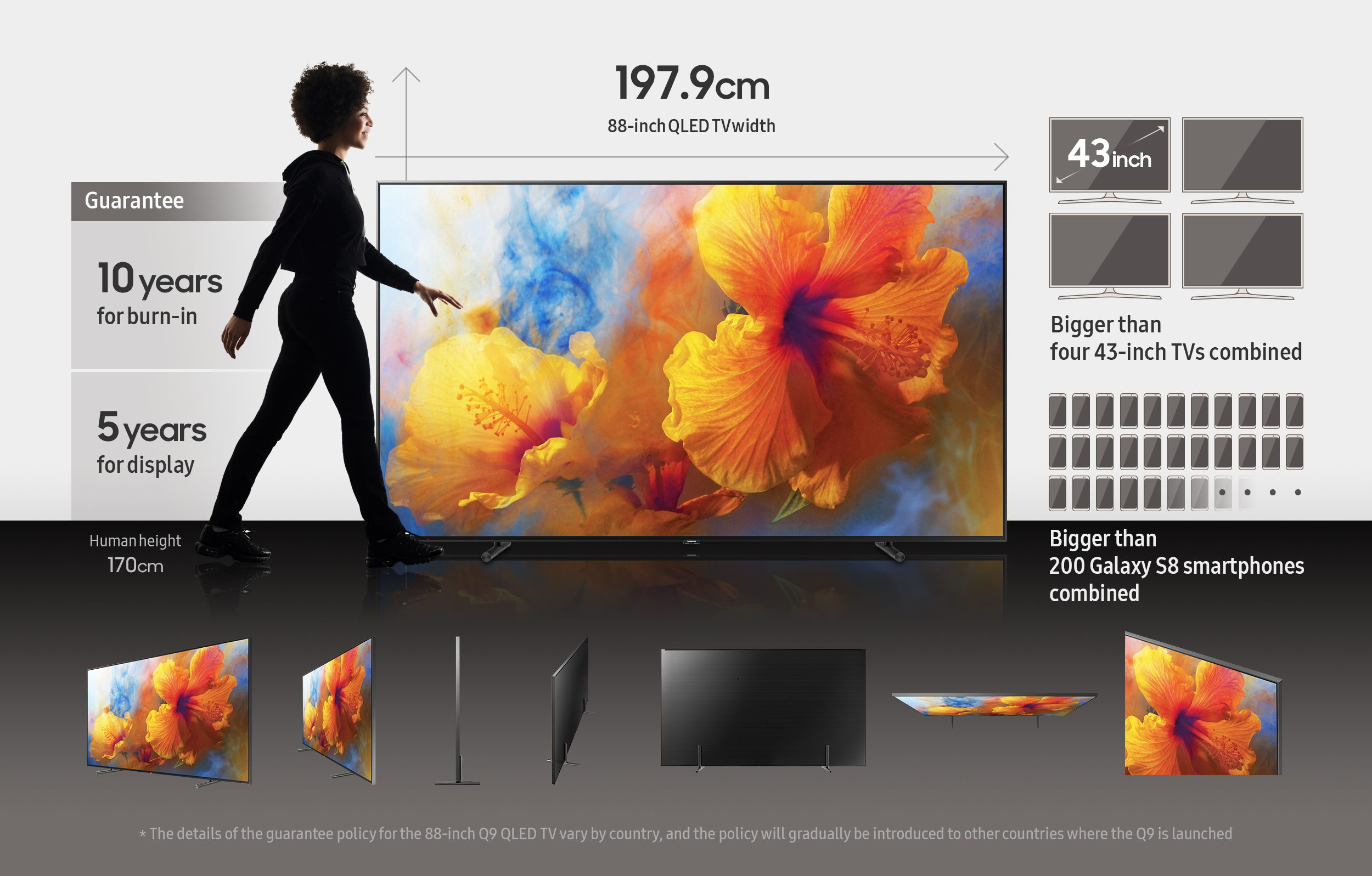
    Samsung’s massive flagship 88-inch Q9 TV is available to purchase at BestBuy for $19,999.99. It’s the first time we’ve been given any indication about the price, and as expected, it’s a huge one. The TV features a 2,160p (4K) resolution, HDR, and built-in Wi-Fi. BestBuy also offers a “geek-squad protection” for a meager $2,099.99, which provides insurance coverage for five years.

    The Q9 is part of Samsung’s new QLED TV series the company announced at CES in January, touting it as the next step in TV evolution. Samsung says the QLEDs are brighter with better color reproduction compared to regular OLEDs. However, in real-world testing, CNET’s David Katzmaier gave the Q7 QLED TV a 3.5 star review, noting that “the expensive Q7’s overall image quality can’t match OLED or the better LED LCD TVs.” The series comes in three models — the Q9, Q8, and Q7, with prices starting from $2,499.99 for the 55-inch Q7F.

    If you’re hesitant in spending $20,000 on a TV, remember that the biggest 4K TV money can buy is the 262-inch C Seed 262, which costs $539,000. Plus if you want it with a “project management package” that’s an additional $38,500. Spare change really.


    Image: Samsung

  • Old TV signals used to plug Monmouthshire broadband gap

    computer generated image of how white space broadband works

    The broadband gap in a part of rural Monmouthshire is set to be plugged by TV broadcast frequencies left over from the digital switchover.

    A pilot scheme will see TV white space used to send a high-speed broadband signal from a standard mast.

    Filmmaker Martin Phillips is taking part and said it would “revolutionise” working from his home in Llanarth.

    But some experts have said more should have been done to deliver fibre broadband to as many homes as possible.

    White space uses the spare spectrum in the UHF band, no longer needed for television broadcasts following the digital switchover.

    Llanarth is the second community to take part in the scheme, which is already up and running on the Isle of Arran in Scotland.

    Domain name registry firm Nominet is partnering with telecoms firm Broadway Partners to roll it out.

    Image caption

    Filmmaker Martin Phillips has signed up to the pilot in Llanarth

    There have been several trials of white space technology (TVWS) in the UK.

    BT ran some on the Isle of Bute and in Sutton, Suffolk, but has since moved its attention to other technologies.

    Like a television signal, broadband delivered in this way can travel up to 10km (six miles) over hills, through buildings and trees direct to people’s homes.

    It has been recognised for some time that it can help plug the gap in coverage in rural areas.

    What is new, according to the companies involved, is that now it is commercially viable and can deliver faster speeds.

    Mr Phillips, who used to struggle to send footage to clients via the internet, said: “It’s the consistency that makes the difference for us.

    “It’s knowing that once you press a button it will work, it will send, and the fact it’s raining or cloudy or windy outside isn’t going to change that.”

    The former chief technical officer of BT, Peter Cochrane, said rural areas had been neglected.

    He said: “All of these stop-gap measures are like a finger in a dyke. They under-provide the band width, they hardly meet today’s needs let alone tomorrow’s.

    “We’re wasting billions betting on things that can’t possibly meet our needs in the future. ”

    The UK’s broadband infrastructure is run by Openreach, which agreed a split from BT following concerns from the regulator Ofcom.

    An Openreach spokesman said 80,000 internet exchange boxes had been installed across the country to connect fibre broadband to properties.

    He added: “The rural roll-out is accelerating at pace and we will find the gaps are being closed.”

  • Black Hat: The conference teaching hacking skills

    The courses at this year’s Black Hat information security conference taught more than 3,500 people how to hack.

    “The good guys have got to learn it because the bad guys already do,” says Dan Haagman, co-founder of Not So Secure, which ran one of the training courses at last week’s event.

    BBC Click sent security researcher Scott Helme on one of the courses held in Las Vegas to find out more.

    See more at Click’s website and @BBCClick.

  • Cracks are still spreading where that massive Antarctic iceberg broke free

    Cracks continue to spread on the Antarctic ice shelf where a trillion-ton iceberg roughly the size of Delaware broke free in July, scientists say. If these new cracks manage to shake loose key, stabilizing parts of the ice shelf, it’s possible that the ice shelf could collapse. That could speed the flow of Antarctic ice to the sea and cause sea levels to rise.

    On July 12th, 2017, a deep fissure cleaved a 2,500-square-mile iceberg off of the Larsen-C ice shelf in Antarctica. Satellite images show the iceberg has drifted about three miles since it broke free, and smaller ice chunks have crumbled from both the ice shelf and the iceberg. Now, scientists Anna Hogg at the University of Leeds and Hilmar Gudmundsson from the British Antarctic Survey want to know what losing such a massive chunk of ice will mean for the rest of the Larsen-C ice shelf. So they’re keeping watch via satellite, spelling out their next steps in an article published today in the journal Nature Climate Change.


    The Copernicus Sentinel-1 satellite snapped this picture of the A68 iceberg on July 30th, 2017.

    The Copernicus Sentinel-1 satellite snapped this picture of the A68 iceberg on July 30th, 2017.
    Photo: A. Fleming, British Antarctic Survey.

    Ice shelves form when a land-based ice sheet dips into very cold ocean waters. Glaciers flowing off the landmass keep adding to the ice shelf, pushing it away from land until the ice wedges up against an underwater bump or ridge. That anchors the floating ice shelf, and turns it into a kind of cork that prevents the ice behind it from flowing into the ocean, Hogg told The Verge.

    Sometimes, parts of the ice shelf break off to form icebergs — a process known as calving that’s a perfectly normal part of an ice sheet’s life cycle. Icebergs don’t contribute to sea level rise because they’re already floating on the ocean’s surface. But occasionally, when an iceberg calves, it might loosen the ice shelf’s connection with its anchor — essentially popping that frozen cork and letting the ice flow more freely from land into the sea. That’s what boosts sea levels, Hogg says. “That will be the thing that changes this from a natural event that’s occurring all the time into something that has real implications for people living in other parts of the globe.”

    Scientists don’t know yet whether this massive iceberg was the cork for the Larsen-C ice shelf — and it’s too early to say that the iceberg’s calving is cause for concern. “One iceberg coming off an ice shelf doesn’t mean that ice shelf is about to collapse,” says Helen Fricker, a geophysicist at the Scripps Institution of Oceanography. “But what are the effects of the calving event on the ice shelf that’s left behind? That’s a really important thing to look at,” Fricker says.

    That’s why Hogg and her colleagues plan to take satellite images of the ice sheet that capture ripples and creases in the ice’s surface. By measuring how quickly these crevasses move towards the water’s edge, the scientists can calculate how quickly the ice is flowing. “So, if you were to animate it, it literally does look like a river flowing — but we’re just doing it over a longer period of time,” Hogg says. If the ice sped up after the iceberg broke away, that could mean the massive iceberg had been important for anchoring the ice shelf.

    But, Hogg adds, it’s also possible that the cork is still in place — but the cracks spreading along the edge of the ice shelf could yet dislodge it. “Although this one iceberg has calved off, the story might not be over,” she says. “So we’ll be constantly looking at ice speeds over the next months to years to really appreciate the picture that’s constantly evolving on Larsen-C.”

  • IBM scientists have captured 330TB of uncompressed data into a tiny cartridge

    In a new world record, scientists at IBM have captured 330 terabytes of uncompressed data — or the equivalent of 330 million books — into a cartridge that can fit into the palm of your hand. The record of 201 gigabits per square inch on prototype sputtered magnetic tape is more than 20 times the areal density currently used in commercial tape drives. Areal recording density is the amount of information that can be stored on a given area of surface.

    Tape drives were invented over 60 years ago and were traditionally used for archiving tax documents and health care records. IBM’s first tape unit used reels of half-inch-wide tape that could only hold about 2 megabytes.


    A cross section of the prototype sputtered magnetic tape.
    Image: Sony

    The magnetic tape was developed by Sony Storage Media Solutions, and the milestone indicates the viability of continuing to scale up storage on tapes for another decade, IBM said.

    “Tape has traditionally been used for video archives, back-up files, replicas for disaster recovery and retention of information on premise, but the industry is also expanding to off-premise applications in the cloud,” said IBM fellow Evangelos Eleftheriou in a statement. “While sputtered tape is expected to cost a little more to manufacture than current commercial tape, the potential for very high capacity will make the cost per terabyte very attractive, making this technology practical for cold storage in the cloud.”

    In order for researchers to achieve the 201 gigabits per square inch, IBM researchers had to develop several new technologies. IBM worked closely with Sony for several years, particularly on enabling increased areal recording densities. “The results of this collaboration have led to various improvements in the media technology, such as advanced roll-to-roll technology for long sputtered tape fabrication and better lubricant technology, which stabilizes the functionality of the magnetic tape.”


    Image: IBM