Image caption
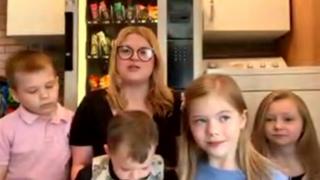
Sarah Balsdon, her children, and the vending machine at home
With four children at home, a list of chores, and a secondhand vending machine – one mum may have discovered the perfect lockdown life lesson.
Northumberland nurse Sarah Balsdon, 29, was getting so fed up with her children’s “constant arguments” over sugary snacks, she and husband Kyle devised a plan.
She spent £100 on the vending machine being thrown out by a shop that had closed down, and filled it with the family’s favourite sweets and drinks.
Then she told her four children – Shannon, aged nine, Lucy, eight, Jack, five, and Elijah, two – that they would be paid to do their schoolwork and help with chores around the house.
‘I get pop’
While healthy snacks were free, they could spend their housework income in the vending machine. Their initial reluctance disappeared as the treats began to topple down.
“At first I didn’t like it,” Shannon told BBC Breakfast. “But now I do because I get pop.”
Image copyright Getty Images
Image caption
Money lessons do not always need something as unusual in the home as a vending machine
Sarah may have landed on a perfect pocket money management course.
By working for their cash, saving it, then spending it on their favourite snack, the youngsters have been taught a vital lesson in delayed gratification.
Budgeting experts say such a policy would suit many adults too, to avoid getting caught up in a buy now, pay later culture.
With Sarah and Kyle also doing chores for their snacks, the family have thrown a bit of competition into the mix as well.
Image caption
Will Carmichael says children typically receive less than £5 a week in pocket money
Extra time at home offers the perfect opportunity for others to join the Balsdon family in learning more about money, according to Will Carmichael, chief executive of pocket money app RoosterMoney.
“Creating a system to help kids earn their money and having tangible visual goals for them to aim at is a brilliant way to help kids focus on a target and learn the value of money,” he said.
“Varying the sizes of the prizes, a brand new Lego set for example, would be a great way to really get them thinking about what they want and what they value.”
Pocket money tips
Get children started with money as young as possible
Don’t worry how much to give in pocket money, or how often
Parents who have no money at the end of the week should still talk to their children about the financial choices they make
For those parents who no longer carry cash – get some coins, just so children have the opportunity to interact with them.
Source: Money and Pensions Service
His company’s research on lockdown pocket money suggests children already have some healthy financial habits.
Some 40% of pocket money is saved, its survey of 24,000 children suggested. On average, children aged four to 14 receive £4.60 a week.
Many have to work for their money, with 70% of chores involving cleaning around the house, topped by cleaning a bedroom, making the bed, and doing the laundry.
When they come to spend it, the most goes on digital games platform Roblox, followed by computer game Fortnite, then books and magazines, Lego, and sweets and chocolates.
Research by the Money and Pensions Service found that many money habits are formed by the age of seven.
Parents carry the biggest influence. Pocket money is one, but not the only, tool they can use in money lessons, especially with most children at home at the moment, according to one financial commentator.
Sarah Coles, from investment platform Hargreaves Lansdown, said: “There are a plenty of ways of introducing money ideas to the kids that can keep them entertained at the same time – and don’t require you to have endless reserves of time, patience and creativity.”
Some of her ideas include:
Encouraging children to run an imaginary restaurant, shop, or cinema
Watching films or TV programmes with money as the central subject
Asking grandparents to reminisce about how much money they had during different times in their lives
For those who can afford it, offering to double any money they save can also help them learn about value or saving towards a goal.
In the end, that may prove to be more practical than trying to buy a vending machine.
Image caption
Juukan Gorge cave site: Rio Tinto got permission to expand its mining in 2013
Mining giant Rio Tinto has apologised for blowing up 46,000-year-old Aboriginal caves in Western Australia dating back to the last Ice Age.
The Juukan Gorge caves, in the Pilbara region, were destroyed last Sunday as Rio Tinto expanded an iron ore project agreed with the authorities.
Many prehistoric artefacts have been found at the remote heritage site.
“We are sorry for the distress we have caused,” said Chris Salisbury, the firm’s iron ore chief executive.
“We pay our respects to the Puutu Kunti Kurrama and Pinikura People (PKKP),” he said. The PKKP are the traditional owners of the site.
“We will continue to work with the PKKP to learn from what has taken place and strengthen our partnership. As a matter of urgency, we are reviewing the plans of all other sites in the Juukan Gorge area.”
Artefacts found there include a belt made from human hair, analysis of which showed a direct link going back 4,000 years between the PKKP and the prehistoric cave-dwellers.
‘Devastating blow’
“Today we also recognise that a review is needed in relation to the management of heritage in Western Australia more broadly,” Mr Salisbury said.
Besides iron ore, the Anglo-Australian giant has many mining interests in Australia, including bauxite for aluminium, diamonds and uranium.
Last week a PKKP representative, John Ashburton, said losing the site was a “devastating blow”.
“There are less than a handful of known Aboriginal sites in Australia that are as old as this one… its importance cannot be underestimated,” Reuters news agency quoted him as saying.
“Our people are deeply troubled and saddened by the destruction of these rock shelters and are grieving the loss of connection to our ancestors as well as our land.”
Australian Minister for Indigenous Affairs Ken Wyatt, who is Aboriginal, said it was “incomprehensible” that the blast had gone ahead, but added that it appeared to be a “genuine mistake”. State laws had failed in this instance, he said.
Image copyright AFP
Image caption
Juukan Gorge cave site: Top – before mining (2 June 2013); Bottom: just before destruction (15 May 2020)
Microsoft is to replace dozens of contract journalists on its MSN website and use automated systems to select news stories, US and UK media report.
The curating of stories from news organisations and selection of headlines and pictures for the MSN site is currently done by journalists.
Artificial intelligence will perform these news production tasks, sources told the Seattle Times.
Microsoft said it was part of an evaluation of its business.
The US tech giant said in a statement: “Like all companies, we evaluate our business on a regular basis. This can result in increased investment in some places and, from time to time, redeployment in others. These decisions are not the result of the current pandemic.”
Microsoft, like some other tech companies, pays news organisations to use their content on its website.
But it employs journalists to decide which stories to display and how they are presented.
Around 50 contract news producers will lose their jobs at the end of June, the Seattle Times reports, but a team of full-time journalists will remain.
Google funds automated news project
“It’s demoralising to think machines can replace us but there you go,” one of those facing redundancy told the paper.
Some sacked journalists warned that artificial intelligence may not be fully familiar with strict editorial guidelines, and could end up letting through inappropriate stories.
Twenty-seven of those losing their jobs are employed by the UK’s PA Media, the Guardian reports.
One journalist quoted in the paper said: “I spend all my time reading about how automation and AI is going to take all our jobs – now it’s taken mine.”
Microsoft is one of many tech companies experimenting with forms of so-called robot journalism to cut costs. Google is also investing in projects to understand how it might work.
Amazon has blamed a “bad actor” for racist abuse that appeared on multiple listings on its UK website.
The abuse, now removed, appeared when users searched the online shop for Apple AirPods and similar products.
It was unclear how long the racist language remained on the site, but it sparked outrage on Twitter and the sharing of screenshots and video grabs.
“We are removing the images in question and have taken action on the bad actor,” Amazon told the BBC.
The company did not elaborate on the “bad actor”, nor give details of how many products were defaced and how long the abuse was visible on the listings.
Nadine White, a journalist for the Huffington Post, tweeted that the abuse “needs to be acknowledged, removed, explained, apologised for asap. Being Black right now is hard enough; we don’t need to be called the N- word while shopping online, to boot”.
Another Twitter user said Amazon should have been able to remove the offending messages in minutes. “They’re still on Amazon UK. Extraordinarily poor site administration,” he said during early hours of Sunday.
Amazon also allows third-party retailers to sell goods through its website, with the company making about half its retail revenues from this.
But the Amazon Marketplace platform has come under scrutiny.
There has been concern about counterfeit goods appearing in the listings, and during the coronavirus pandemic Amazon was criticised for not doing enough to stop sellers inflating prices.
In April, several of Amazon’s foreign websites, including the UK domain, were added to the US trade regulator’s “notorious markets” report on marketplaces known for counterfeiting and piracy concerns.
Amazon strongly disagreed with the report at that time, describing it as a “purely political act”.
Image caption
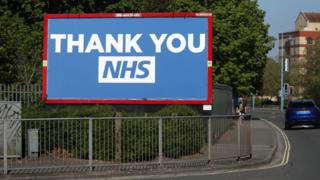
Adverts praising the NHS have sprung up on UK billboards that may otherwise have been empty
The first rule of advertising is that your adverts have to be seen to have any effect.
This is why if you have managed to get out of the house recently in the UK you might have noticed that there are an awful lot of adverts supporting the National Health Service, and key workers on billboards and bus stops.
As Anja Lambrecht, professor of marketing at the London Business School, explains, it is one of the signs that the advertising industry is struggling.
“It is most obvious outdoors with billboards – no-one is driving past them, so no commercial firms are advertising,” she says. “That is why they all have adverts for the NHS.”
On TV an ever-growing number of us are increasingly watching streaming services such as Netflix and Amazon Prime, which don’t have any adverts. Meanwhile on traditional commercial TV channels, there are lots of advertising breaks with very few adverts in them.
Image copyright Getty Images
Image caption
TV revenues are down on both sides of the Atlantic, with Fox one of those affected in the US
In the UK, ITV’s advertising revenue was down 42% in April, while Fox in the US has seen revenues halve. It is a similar picture in other markets, because there are many products that are just not selling at the moment. So why advertise them?
Take the car industry – sales in the UK in April fell 97%, and are at the lowest level since 1946. They also fell by almost 50% in the same month in the US.
It may seem obvious therefore that car advertising is a waste of money. But cars are still being advertised – albeit to a lesser extent – on TV, on social media, and even on some billboards.
That is because the advertising and marketing industries have long memories, and worry that their customers don’t. Companies with brands that have been around for decades, and which are worth billions, don’t let them die in a recession.
“Brands are reminding people that they exist,” says Andrew Stephen, L’Oréal professor of marketing at Oxford University’s Saïd Business School. “Research shows time and time again in a crisis that turning off advertising altogether slows down the recovery.”
So some businesses will always maintain advertising, no matter how bad things get, as Prof Lambrecht explains. “During the 2008 recession, Procter and Gamble and other similar companies kept their advertising constant. Firms try to stay in the consumer’s mind, even if consumer spending falls. It pays to keep your brand in the consumer’s eye.”
Image copyright Getty Images
Image caption
The Financial Times has seen sales and advertising revenues fall sharply
In this respect, some companies are treating this pandemic as an economic shock like others they have been through in the past. But in other ways it is different. For a start, advertisers have to work out where to spend what money they do have.
There has long been a move away from traditional outlets such as TV, radio and newspapers, as the advertising industry realised they were no longer reaching their target audiences. The money instead has been spent where audiences and especially young audiences go – online and especially on social media.
But lockdowns also mean we are staying in and watching more TV, so which way should the industry jump? Matteo Montecchi, a fellow in marketing at King’s Business School, seems fairly sure.
“Using digital and social media to get information out there, especially to the younger generation, was already a trend before the pandemic,” he says. “This situation has just exacerbated that trend.”
Image copyright London Business School/Mark Mather
Image caption
Anja Lambrecht says that UK firms have, in the main, stopped advertising on billboards
Which means that advertising executives are now working out where to spend their limited budgets online – not easy when the explosive growth in apps like TikTok means there are more and more places to spend what money they have.
But there is one added bonus – it seems likely that older generations have used the lockdown to increase their use of the internet, and can therefore be targeted more effectively online.
The downside is that some industries that are very dependent on advertising income are in a real bind. Newspaper revenue, for example, is falling dramatically.
Global Trade
More from the BBC’s series taking an international perspective on trade:
Not only have sales slumped, the Financial Times’ print sales fell 39% in April, but advertising revenue has as well. Not least because many firms don’t want to put their ads next to stories about the pandemic – rather difficult when that is the biggest story around.
Mr Montecchi believes local press in particular is in a bad way. “Local papers will really suffer and may not survive,” he says.
Finally, what of the advertising firms themselves?
All those creative types who usually write catchy slogans, film the latest supermodel’s makeup range, and sell multinational industry huge marketing campaigns that will reach every corner of the world.
Now, like almost every other industry they have had to dramatically cut back, work from home, furlough staff, and put their plans on hold. It is pretty difficult to film ads at the moment, even if there is anyone out there willing to spend money on new ones.
And that isn’t going to end overnight, we are in the middle of one of the greatest economic shocks imaginable. And although firms want to keep their brands in the public eye, marketing and advertising budgets are going to take a hit for years to come.
Image copyright Getty Images
Image caption
The advertising industry was already increasing the amount spent on social media
But for the “creatives” there is a longer-term worry: their business model has been to produce top quality advertising with the highest production values – exotic locations, famous names, brilliant film work, masterful special effects and seamless editing.
The problem, says Oxford University’s Prof Stephen, is that when you look at the audience’s reaction to lower production values, “research shows consumers don’t really care, especially on digital channels”.
To be blunt, if you can get the same result by spending less, why wouldn’t you do that?
This pandemic and lockdown will have dramatic effects on all aspects of marketing and advertising, from those dependent on its spending, like newspapers and TV channels, to the companies that make the adverts themselves.
Not least because it has helped to accelerate the change from advertising in mainstream media to digital, which means the industry has had to react ever more quickly to a changing landscape in the middle of an economic catastrophe.
Image caption
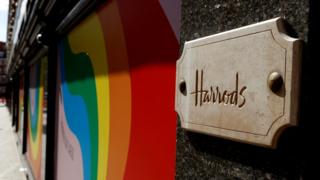
Harrods closed the doors of its Knightsbridge store in March
Harrods, the upmarket department store, is opening a second outlet in a nearby shopping mall to stop congestion when trading resumes.
The new Shepherd’s Bush ‘concept’ store will effectively host Harrods’ summer sale across two floors of the Westfield shopping centre from July.
“Harrods Outlet allows us to enable better social-distancing across a larger footprint,” it said
Harrods closed its doors in March but plans to re-open on 15 June.
The company said it will put “significant social-distancing measures in place” at its department store in London’s Knightsbridge.
It will use footfall monitoring technology to limit capacity with specific doors designated for entering and leaving the shop.
When will shops open and what will the rules be?
But Harrods said the Grade II listed building – built in the 1880s – offered limited flexibility in the light of the crowds expected at its annual summer sale in July.
It has therefore developed the new Harrods Outlet concept and will move the majority of the sale items there.
‘Stock overhang’
Harrods’ managing director Michael Ward, said: “In the new world in which we find ourselves, the economy needs businesses willing to look at its business model and current operations and think differently to enable growth, while protecting its customers and employees.”
The concept store – which will only be open temporarily – will sell stock left over from the “existing season”, Harrods said.
“This move is about capacity,” said analyst Richard Lim, chief executive of Retail Economics.
Image copyright EPA
Image caption
Harrods’ grade II listed building offers limited flexibility for the expected summer sales crowd
“With social-distancing in place Harrods won’t be able to get enough footfall in its Knightbridge store to clear the overhang of stock they have built up during lockdown.”
The 80,000 sq ft two-storey space will give the retailer the opportunity to start with a blank canvas and retro-fit the store with appropriate social-distancing measures, he pointed out.
“The economics of running a store have changed but the move shows that there are obviously opportunities for retailers to drive a hard bargain with landlords, even for a short-term let,” he said.
Earlier this year Harrods announced plans to take its core business out of Knightsbridge for the first time, although it has agreed licences for shops at airport terminals and cruise liners in the past.
It is launching an H Beauty concept in Lakeside later this year as well as extending its Harrods personal shopping experience in Shanghai at ‘The Residence’.
In other retail news, sandwich and coffee chain Pret A Manger will re-open more than 200 sites for takeaway and delivery from Monday.
It will mean the chain will have re-opened more than 300 stores since lockdown started, although they will offer a limited menu for the moment.
Shops will reopen for the first time in towns and cities such as Bath, Bournemouth, Newcastle, Exeter and Liverpool.
My Money is a series looking at how people spend their money – and the sometimes tough decisions they have to make. Here Alyssa Hulme from Heber City in Utah, US, takes us through a week in her life during the coronavirus pandemic.
Alyssa, 31, is a freelance writer and educational consultant. She and her husband Randy have four children: Ellie, eight, Max, seven, Amethyst, four and Josie, one. She has been homeschooling her children for a year, months before the pandemic started.
She says her week started out mundane but ended up awesome! She had no idea on Monday where she would be by Sunday.
Over to Alyssa….
I started the day nursing my one-year-old, passed her off to her dad for breakfast and settled down for a solid 45 minutes of private time before spending the rest of the day homeschooling three kids and caring for a baby. After prayer, meditation, and setting my To-Dos for the day, I purchased a course, the 30-day Money Cure with Carol Tuttle for $297 (£242). The course is on gaining financial affluence by clearing out limiting belief systems that don’t serve me and replacing them with healthy practices. I have been looking forward to this course for months and have set aside money for this specific purpose.
After that I moved on to begin my day with my family and set everyone to their beginning tasks of piano, chores, and math. We’ve been homeschooling for a year now, so it’s been a pretty typical day. But at lunchtime instead of transitioning to a play date, my husband took our eldest out for one-on-one time to help supplement the loss of activities and outings that has come with Covid-19 lockdowns.
We’ve been isolating since the end of February and the loss of friends is wearing on us all. During our midday quiet time I taught two online vocal training lessons virtually to students who live in town. Typically they’d come to my home, but we are all still isolating. After that we settled into our evening routine: I made dinner, we ate together and then held our weekly “family night” – an evening of talent shows, games, treats and fun.
Total spend: $297 (£242)
Image copyright Alyssa Hulme
I continued with the money course. I am starting up a homeschool consulting business and really want to get on the correct and mentally healthy track for the sake of my business. The course has helped me identify several limiting beliefs I can clear up to allow space for more growth. Then, as every weekday for months, we did homeschool, lunch and quiet time in the afternoon.
During quiet time I had a virtual occupational therapy appointment for my one-year-old in order to evaluate her for possible gross motor delays. This is free through our state. Next I had a virtual appointment with my therapist. This costs $110 after insurance and is withdrawn from my Health Saving Account, an account we pay into monthly through my husband’s pay check and is tax free. Therapy always really takes it out of me and today it was compounded by some new business issues I’m working through, so my husband picked up dinner from a fastfood Chinese restaurant for $40. It ended up being a lot of food and will last a good two and a half meals for the six of us.
I took the evening to work more on my business and work on my personal goals. Normally I’d go out with friends or go to the gym, but everything is closed, so I get to save more money and get to know my bed a little better.
Total spend: $150 (£122)
Our big outing today was a trip up the canyon near our home. We spent two hours hiking in the woods, building fairy houses and crossing streams.
Image copyright Alyssa Hulme
Later in the evening I started making plans for next year’s homeschool and bought some notebooks and stationery through Target.com. I really dislike online shopping, especially for something as personal as a notebook. As a writer, the size, weight and binding of a notebook really matters to me, so buying from an online shop is very disorienting.
I also bought a summer dress through Target.com, something I can easily nurse in and hope to be able to wear out and about someday here soon when the quarantine is lifted. Our county just moved to a low-risk status, so hopefully my husband and I can start up our weekly date nights soon.
Total spend: $110.52 (£90)
Late last night my husband discovered that he will not be returning to work in his office until the end of 2020. We discussed buying a motorhome, living in it for the next six months, renting out our home, and working and doing homeschool on the go. This has been a dream of ours for 10 years, but it never worked out with our careers. Now is the time.
Today we decided to rent an RV (recreational vehicle) – $1,160 for four nights – and start testing out different configurations and living quarters. We decided to head for Yellowstone National Park. Two of the four entrances are now open! I found an RV site and started packing up.
I normally would have gone grocery shopping last night but our travel plans halted that. As a result we were out of food today, so I grabbed lunch from a local shop for $33.50 and dinner from a restaurant for $45. This is not a normal thing for us to just pick up and drop a ton of money on travel, but we have now been in isolation since the end of February and we are all so ready to have a new experience.
Image copyright Alyssa Hulme
This money is coming from the allotment my husband and I had set aside to celebrate our 10 year anniversary tomorrow, but all our kid-free-for-the-first-time-in-five-years international travel plans were squashed by the virus. This will be an interesting substitute.
We parked the RV along our path to Yellowstone at a Walmart. Anyone can park there overnight for free, so it’s a great backup to have in mind when travelling.
Total spend: $1,238.50 (£1,005)
Image copyright Alyssa Hulme
Happy 10 year anniversary to my husband and me! We celebrate the day by first getting groceries from Walmart and starting the trek to Yellowstone. I bought groceries for the week for $233. Not too bad for a family of six with limited fridge and cupboard space. We stopped to fill up the RV with gas for $213. After several hours of driving, we arrived at the spot I had reserved online yesterday for two nights, a total of $180, including water and electricity plug-ins. It’s a little high for an RV site, but it’s the closest I could find to the park entrance online and we decided to value time in the park over the cost of the campsite. (All the sites inside the park are closed due to Covid-19.)
Total spend: $626 (£510)
Image copyright Alyssa Hulme
My Money
More blogs from the BBC’s My Money Series:
We woke early and headed to the park today, but it was closed due to a snowstorm. The road ended up getting 12 inches of snow in some places! Instead of exploring the park we explored the National Forest just outside.
Total spend: $0
Image copyright Alyssa Hulme
Image copyright Alyssa Hulme
We got up early again and were able to enter the park! We used our National Parks Pass to get in, so no cost today. We did everything that was open in the park, the big attractions for us being the Upper and Lower falls outlooks, the Grand Prismatic Spring, and Old Faithful.
We saw so much wildlife on this trip, far more than my husband or I even saw here as children. We drove by and hiked next to elk, bison, deer, egrets, and even several bears including a baby and mama bear. We attribute this expanse of wildlife to conservation efforts in the park as well as the closure of the park over the last several months.
The snow also allowed us to see all the animal tracks throughout the park which our kids loved! Old Faithful had the largest crowd, but still very small even for this time of year. We watched with a small, social distancing crowd for the big event, and then headed out. We were tempted to get take-out from the lodge near Old Faithful, but decided to continue eating the food we’d already purchased knowing the lodge food prices are really marked up.
We packed up and exited the park through the South Entrance and drove through Grand Tetons National Park and got gas in Jackson Hole for $176. Wyoming has lots of open land for free parking, but with a new vehicle and dark terrain, we decided to stay overnight in a National Forest campsite a half hour away for $15 for the night. We pulled in about 23:00, paid via cash in a drop box, and enjoyed sleeping next to a river and under a blanket of stars.
Total spend: $191 (£156)
Total spent this week: $2,613.02 (£2,125)
How does Alyssa feel about her week?
Thanks for coming with me on my 10 year wedding anniversary trip! This is not the trip we’d planned, but it’s been wonderful for our family. We’ve seen two more National Parks, taken a break from quarantine in a way that feels safe for us, and enjoyed our beautiful nation.
This is an unusually high week for us because we went on our trip. But considering $2,000 of that was spent on our trip and only $613.02 spent on our normal life, I feel good about that. We had $2,000+ saved for months now to go to Barbados later this summer, but we have given up all international travel until the virus settles down. All in, I feel like this was a successful trip. We would not be moving forward with purchasing an RV had we not had the real life experience of travelling in one for an extended period of time.
The remaining $613.02 also reflects an unusual cost in the money course I am taking. I haven’t purchased class tuition in probably five years, but being home all the time has me under-stimulated and needing a project.
I think like many families these days, our spending in many areas has decreased (no extracurriculars, less shopping and self-care purchases, almost no gas purchases), but in other ways expanded. I don’t bring my kids into any grocery stores anymore, so when my husband is too busy at work to be with them and we run out of food, I get take-out meals. When our mental health is being run down by monotony, we rent RVs, buy our kids bikes, and online shop for anything to help the kids make it through the day. This is survival for us.
I feel very privileged to be financially secure and have a very stable income. While the world is in chaos we will continue to use money as a tool to support our mental wellbeing and try to take advantage of the new opportunities opening up to us.
Image copyright Alyssa Hulme
We’re looking for more people to share what they spend their money on. If you’re interested, please email or get in touch via our My Money (World) Facebook group, or if you live in the UK, please join our My Money (UK) Facebook group and we’ll aim to contact you.
Image caption
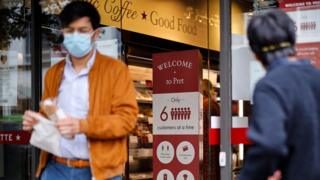
Many of Pret’s stores have already reopened with stores adapted for social distancing
Sandwich chain Pret a Manger has called in consultants to help renegotiate its rents as it attempts to avoid store closures during the coronavirus epidemic.
More than 300 of its 400 stores will have reopened as of next week.
But the chain is expecting reduced footfall as office workers continue to work from home.
Chief executive Pano Christou said Pret, like others, had been “radically” adapting its business model.
“Reduced footfall, combined with high rental costs, have placed substantial pressure on our business,” he said.
Can hospitality take social distancing?
Mr Christou said the company was putting together a “clear plan” to address the issues and making good progress.
“While Pret may look and feel a bit different in the short term, if we take the right steps today, we’ll make sure that Pret can thrive in the future,” he said.
It comes after industry body UK Hospitality urged the government to find a solution to the rental problems facing many businesses in the struggling hospitality sector.
Image caption
Workers are being urged to self-isolate when called by tracers
Workers self-isolating under the new test and trace systems could be pushed into hardship, union warnings claim.
The programmes, newly launched in England and Scotland, risked being ineffective unless these people were helped financially, the TUC said.
Employees could be told to stay at home for 14 days on multiple occasions and face an income drop on sick pay.
Those receiving £95 a week or even ineligible for statutory sick pay may feel forced to work, the TUC said.
“That will put them, their workmates and their local community at risk, and undermine the entire test and trace programme,” the union body’s general secretary, Frances O’Grady, said.
How test and trace works
Under the new systems, tracers will text, email or call people who test positive with coronavirus and ask who they have had contact with.
Any of those contacts deemed at risk of infection will be told to isolate for 14 days, even if they are not sick and if they have already had the virus.
While some employers will pay wages in full to those who are self-isolating, and some staff will request to take the time as their fully-paid holiday entitlement. some bosses will give people statutory sick pay of £95.85 a week. Guidance from the government says this should be paid from day one of isolation.
Employers with fewer than 250 members of staff are now able to claim that cost back from the government, under a separate scheme launched earlier in the week.
But some workers, often women working part-time, are ineligible for statutory sick pay as they do not earn an average of £120 a week, or are self-employed.
They may have to fall back on the benefits system, or any self-employment support scheme, while off work.
“The government must extend statutory sick pay to everyone – no matter what they’re paid – and raise it to the level of the real Living Wage, £260 per week,” Ms O’Grady said.
“And the self-employed income support scheme must remain in place as a source of financial support for those forced to self-isolate.”
Image copyright Getty Images
The view was echoed by charity Citizens Advice, which said long-standing problems with statutory sick pay meant millions were ineligible or found the payment insufficient to cover essential costs.
“People need enough to live on, so they can self-isolate if asked to without fear of being pushed into hardship,” said Gillian Guy, Citizens Advice chief executive.
There have been fears that people told to self-isolate, or who are shielding, could face pressure to return to work by unscrupulous employers.
“We’ve already seen upsetting cases where vulnerable workers have faced the impossible choice of safeguarding their health or continuing to work because they have been denied furlough. We fear that those who need to self-isolate could face similar pressure,” Ms Guy said.
Health Secretary Matt Hancock said he was confident that the “vast majority of people” would participate in the voluntary system.
“In this war on the virus, ultimately we are all on the same side and we’ve all got a part that we can play,” he said.
Northern Ireland has its own version of the test and trace programme already and the scheme in Wales is due to start in early June.
Image caption
The company has donated over a quarter of a million litres of sanitiser to the NHS, police forces and other key workers
A company that can trace its roots back to the makers of a medicine Florence Nightingale used to treat soldiers in the Crimean War is manufacturing sanitiser to donate to frontline workers.
Cardiff-based BCB International have been supplying hospitals with everything from furniture to medical equipment for over half a century.
But it was the man they take their name from who first put them on the map, 172 years ago.
Dr John Collis Browne was serving as an army doctor in India in 1848, when he came up with Brown’s Cough Bottle (marketed without an ‘e’), in response to a cholera outbreak among the troops.
It contained many ingredients which might raise an eyebrow today, including laudanum, which is an alcoholic solution of opium, chloroform and cannabis.
Nevertheless, as Janey Howell from BCB International explains, six years later during the Crimean War, BCB proved something of a cure-all.
“The war threw up all sorts of injuries and illnesses which the medical knowledge of the time couldn’t adequately deal with.
“It might not be how we’d treat them today, but BCB turned out to be the go-to medicine in dealing with a range of symptoms, from the pain of battle wounds, as a sedative, and for dealing with the ubiquitous diarrhoea and cholera.”
Image copyright BCB International Limited
Image caption
Dr Brown’s Cough Bottle contained an alcoholic solution of opium, chloroform and cannabis
But she said its marketing as a cough syrup was not quite accurate: “It should more accurately have been described as ‘Brown’s Compound’ or ‘Chlorodyne’, as it was far more powerful than a mere cough remedy.”
Indeed, Brown’s Cough Bottle’s reputation suffered when it became available to the general public, away from close medical control.
It was frequently linked with both deliberate and accidental overdoses, and through the late 19th Century its popularity declined as its compound was gradually altered to reduce the more addictive elements.
Collis Browne, who was also involved in inventions around his love of yachting, died in Kent in 1884.
The brand passed to the current owners, the Howells family of pharmacists, in the 1950s.
Image copyright BCB International
Image caption
The sanitiser is produced in Llanelli, Carmarthenshire
Although now produced by a separate company, the modern recipe lives on in the much safer “J Collis Browne’s Mixture for the relief of coughs and diarrhoea”.
Today BCB International is better-known for Collis Browne’s love of yachting and outdoor pursuits.
As well as supplying emergency packs for lifeboats around the world, the company produces equipment for use in war zones and peace-keeping operations including shark repellent and ballistic protective underwear dubbed ‘blast boxers’.
However Mrs Howell says it is their solid bioethanol fuel blocks that have allowed them to switch so quickly to helping the key services:
“Everything was already in place to switch production in our Llanelli plant to alcohol sanitiser,” she said.
In a nod to their founder, Mrs Howell said they had named the product Dr Browne’s Hand Sanitiser.
Image copyright BCB International
Image caption
Janey Howell from BCB International says Brown’s Cough Bottle proved to be a a cure-all during the Crimean War
The company has donated over a quarter of a million litres of the sanitiser to the NHS, police forces and other key workers.
It is also in the process of converting lines to produce portable PPE packs more compact than those used in hospital settings, to be used when key workers unexpectedly encounter potentially infectious situations.