Category: Business News

  • Ex-Volkswagen executive pleads guilty in emissions case

    Volkswagen carsImage copyright
    Getty Images

    A former Volkswagen executive has pleaded guilty for his role in the German automaker’s scheme to cheat US emissions requirements for diesel cars.

    Oliver Schmidt, a former head of VW’s engineering and environmental office in the US, admitted to participating in an attempted cover-up after regulators raised questions the “defeat devices”.

    He faces up to seven years in prison, and up to $400,000 (£306,000) in fines.

    The scandal has cost Volkswagen as much as $25bn.

    US prosecutors say Volkswagen installed special software in certain diesel vehicles that allowed them to perform better during emissions tests than they did under normal driving conditions.

    The emissions were sometimes 30 times higher than permitted under US rules.

    Volkwagen sold almost 600,000 vehicles with the devices in the US between 2006 and 2015, and about 11 million globally. The allegations have also prompted probes in other countries.

    Volkswagen: The scandal explained

    VW papers shed light on emissions scandal

    Diesel cars: What’s all the fuss about?

    Mr Schmidt was informed that the devices had been installed in 2015, after a nonprofit in the US exposed discrepancies and regulators confronted the company, according to court filings.

    Mr Schmidt, who was arrested while travelling in Miami, was one of six people charged related to the scheme in January. The others live in Germany.

    The US also charged a former manager at Audi – which is part of Volkswagen – in July.

    A Volkswagen engineer last year pleaded guilty on related charges. His sentencing is expected later this month.

    Mr Schmidt, who admitted to conspiring to defraud the US and violating the Clear Air Act, is scheduled to be sentenced in December.

    In exchange for Ms Schmidt’s guilty plea, US prosecutors dropped a charge of wire fraud. Mr Schmidt also agreed to deportation after his release.

    Volkswagen has agreed to pay more than $4bn in fines in the US and to spend up to $25bn to satisfy claims from owners and others.

    The emissions scandal in the US contributed to a wider backlash against diesel-powered cars, which were once believed to be more environmentally friendly. Four major cities have moved to ban such vehicles by 2025.

    Volkswagen was also recently accused of teaming up with other carmakers in a breach of EU cartel rules.

  • Standard Chartered expects $20m Brexit relocation cost

    Standard Chartered's London office in 2012Image copyright
    Getty Images

    Standard Chartered is set to spend about $20m (£15.4m) to turn its Frankfurt office into a European base due to Brexit.

    The bank plans to create a subsidiary at its German branch to maintain access to the European market after Britain withdraws from the European Union.

    German’s strong credit rating informed the bank’s location choice, said chief executive Bill Winters.

    Standard Chartered has about 100 staff in Frankfurt currently.

    The bank, which employs more than 86,000 globally, said in May it was in talks with German regulators about the move.

    The firm has about 1,700 staff in London, where it opened an office in 1853.

    Standard Chartered is the latest financial institution to discuss its planning for Brexit.

    Barclays and JP Morgan are looking at expanding Dublin operations and RBS is looking at Amsterdam.

    Deutsche Bank warned in April that it might move up to 4,000 jobs – or half of its UK workforce – out of the UK.

    HSBC has said it could move 1,000 jobs to Paris, while UBS has said about 1,000 of its 5,000 London jobs could be hit by Brexit.

  • Having Trouble Saying What You Want to Say? 7 Ways to Cut Your Twitter Characters.

    Have you ever tried to tell a whole story in 140 characters or less? That’s how short a tweet on Twitter must be (with recent changes) if you want to leave room for others to share and comment.

    Related: Without Twitter’s 140 Character Limit Brevity Is No Longer the Soul of Wit

    Now, I have no problem speaking for an hour with zero preparation, and when I do, I get rave reviews from audiences. But when I delivered a 15 minute TEDx talk, I spent two months preparing and still didn’t deliver as well as I’d wanted. Delivering an effective message that will influence others in 140 characters is tough work. This is especially true when the products and services you offer are complicated. Take business accounting services, for example.

    “Accounting is not known for its simplicity,” Brad Hanks, VP of growth at accounting software startup, ZipBooks, told me. “Debits and credits can get messy, and content marketing is hard to master in general, let alone when [you’re] trying to reach potential clients on Twitter.”

    For those of you trying to shrink your tweets, or tighten any other writing you do, here are some tips to help you get your point across in short order.

    1. Say it once.

    Redundancy in writing is a common problem, but it’s easy to fix. Here’s an example:

    Original tweet: We put your data in the cloud, so you can access it online whenever you want.

    Revised tweet: We put your data in the cloud, so you can access it whenever you want.

    Comment: We already know the cloud is online, so remove “online” to conserve precious characters.

    Related: Twitter Might Be Expanding Its 140 Character Limit – Sort Of

    2. Get to the point.

    Simplicity keeps your sentences short and clear. Here’s how the former governor of California, Arnold Schwarzenegger, tweeted his support of the Paris Agreement.

    Original tweet: So much for the idea that protecting the environment kills jobs. CA leads in job growth, pumping up the US economy.

    Comment: For someone nicknamed “The Terminator,, this goes on far too long. He could have gotten the same point across faster and better:

    Revised tweet: Protecting the environment creates job. CA leads growth in jobs AND regulations.

    3. Get rid of intensifiers.

    Adverbial intensifiers, like “very,” add emphasis to an adjective. Stephen King (whose book On Writing is a must-read for writers, even if you don’t like anything else King has written) said, “The road to hell is paved with adjectives,” so let’s get rid of those as well while we’re at it. I admire the work of expert writer Darren Rowse over at @problogger, so I dug through Rowse’s Twitter feed to test a hypothesis. As I suspected there was not an intensifier to be found.

    4. Cut filler words.

    Including such phrases as “it is,” “there are,” etc., adds no meaning. See how a small tweak can jazz up a tweet from @SteveKrak (formerly of CNN and TheBlaze):

    Original tweet: BREAKING: Comey statement confirms whatever it is you personally believed about President Trump before the statement was released.

    Revised tweet: BREAKING: Comey statement confirms what you believed about President Trump before the statement was released.

    William Zinsser, the author of On Writing Well, wrote, “Look for the clutter in your writing and prune it ruthlessly. Be grateful for everything you can throw away.”

    5. Don’t “think,” don’t “believe.” Just say it.

    Avoid phrases like “I think,” “I believe,” etc. These words are unnecessary. If you’re saying it, people assume that you’ve thought about it and that you believe it, unless, of course, you’re a politician.

    6. Stay active.

    Active voice keeps your tweets short and sweet because it’s clear right away who’s doing what. Keeping verbs active is a great way to communicate the same amount of information with fewer characters.

    Original tweet: Customers with questions can be helped by Mary.

    Revised tweet: Mary can help customers with questions.

    In the second version, Mary is actively helping customers with questions. Mary is active. So, be like Mary.

    7. Use contraction subtraction.

    Even if you save only a couple of characters by using contractions, you’ll have that much more room to respond and retweet your tweets. If it fits your brand, you can also use shorteners, like “w/” instead of “with” and “&” instead of “and.”

    Original tweet: The Cleveland Cavaliers are not out of the running yet!

    Revised tweet: The Cleveland Cavaliers aren’t out of the running yet!

    Related: 10 Quick Tips for Better Business Writing

    If you want to have an outsized influence on others, learn to be concise. Albert Einstein said, “If you can’t explain it simply, you don’t understand it well enough.” Brevity is difficult, yet with the limited space on social media, it’s more important than ever that you hook your audience in the few seconds — and characters — you have.

  • 6 Entrepreneurs Share the Best and Worst Advice They’ve Received

    The women behind Away luggage, iFundWomen.comnicepipesCaravan Stylist Studio and Face Chairs share the best and worst advice they have been given, and what they want aspiring entrepreneurs to know, with Jessica Abo.

    Related: How One Ad Exec Is Changing Her Industry

    Watch more videos from Jessica Abo on her YouTube channel here.

    Entrepreneur Network is a premium video network providing entertainment, education and inspiration from successful entrepreneurs and thought leaders. We provide expertise and opportunities to accelerate brand growth and effectively monetize video and audio content distributed across all digital platforms for the business genre.

    EN is partnered with hundreds of top YouTube channels in the business vertical. Watch video from our network partners on demand on Amazon FireRokuApple TV and the Entrepreneur App available on iOS and Android devices.

    Click here to become a part of this growing video network.

  • ‘Pharma bro’ Martin Shkreli convicted of fraud

    Shkreli with his lawyerImage copyright
    Getty Images

    Image caption

    Shkreli’s lawyer sought to portray him as a troubled genius

    Former pharmaceutical chief executive Martin Shkreli has been found guilty of three counts of securities fraud.

    A New York City jury cleared him on five other counts after five days of deliberations.

    He was on trial in relation to a drug company he previously headed, Retrophin, and a hedge fund he managed.

    Shkreli, 34, was branded “the most hated man in America” in 2015 when his firm hiked the price of a medication used by Aids patients.

    Despite facing prison after being convicted of two counts of securities fraud and conspiracy to commit securities fraud, Shkreli professed himself pleased with the outcome.

    Standing outside the court in Brooklyn, he said: “This was a witch hunt of epic proportions.

    “And maybe they found one or two broomsticks but at the end of the day we’ve been acquitted of the most important charges in this case and I’m delighted to report that.”

    Who is Martin Shkreli – ‘the most hated man in America’?

    Martin Shkreli’s trial shines light on US healthcare debate

    Shkreli rocketed to notoriety in 2015 after raising the price of a lifesaving anti-parasite drug called Daraprim by 5,000% upon acquiring rights to the medication.

    Overnight, the price of the drug soared from $13.50 to $750 per dose.

    Over the course of a five-week trial, jurors heard how Shkreli lied to investors about the performance of two hedge funds, MSMB Capital and MSMB Healthcare.

    He then stole from Retrophin, his pharmaceutical company, to pay investors back, prosecutors said.

    “Martin is a brilliant young man,” his lawyer, Benjamin Brafman, said after Friday’s ruling.

    “Sometimes, people’s skills don’t translate well,” he told reporters, adding that his client suffers from “an image issue”.

    During the trial, the attorney portrayed his client as a misunderstood “nerd” who turned up at work wearing a doctor’s “stethoscope and bunny slippers”.

    The so-called “pharma bro” often vented his spleen on social media, eventually getting himself banned from Twitter after harassing a female journalist.

    He often appeared to relish in the negative publicity he received.

    Shkreli was also admonished after refusing to answer questions during testimony to congressmen, whom he later called “imbeciles”.

  • Delphi Diesel Systems plant in Sudbury to close

    Delphi, Sudbury

    Image caption

    Delphi is one of Sudbury’s biggest employers

    An engineering firm is to close a plant in Suffolk with the loss of 520 jobs by mid-2020.

    Delphi Diesel Systems has confirmed it will gradually wind down manufacturing operations at its Sudbury site as a “result of predicted falls in the demand for diesel vehicles”.

    The US-owned company makes diesel fuel injectors and filters for commercial vehicles at the plant.

    The Unite union said it understood the owners plan to move work to Romania.

    In 2015, the company cut 176 jobs in Sudbury and moved the work to eastern Europe.

    ‘Low-cost country’

    A statement from the firm said: “Delphi is sensitive to the implications of this gradual wind down and will work closely with worker representatives to minimise the social impact from this decision.

    “A programme will be put in place to help employees find alternative employment in the region or to relocate to other Delphi facilities.”

    Image caption

    Delphi is based off Newton Road in Sudbury in Suffolk

    Unite said the Sudbury plant makes a “healthy six-figure profit each month” but that the work is going to move to a country where labour costs are generally cheaper.

    The union’s assistant general secretary for manufacturing, Tony Burke, said: “The news reinforces the need for a strong and robust industrial strategy to be activated immediately to secure these highly-skilled manufacturing jobs so they remain in the UK rather than move to a low-cost country.

    “It is time for the Business Secretary Greg Clark to translate the rhetoric of an industrial strategy into practical action to secure essential UK manufacturing jobs, especially in rural Suffolk where such skilled industrial jobs are thin on the ground.”

    A government spokesman said: “This is clearly a worrying time for workers at Delphi in Sudbury and their families. Jobcentre Plus will stand ready to help people get back into work as quickly as possible.

    “The government’s industrial strategy aims to build on our strengths as a country while addressing the long-term challenges we face.

    “Later this year we will deliver an industrial strategy white paper that will help to build an economy that works for all.”

  • Help to Buy report hits housebuilder shares

    Market trader (file picture)Image copyright
    Getty Images

    Housebuilders were the biggest fallers on the 100 share index throughout Friday after a report raised the prospect of the government’s Help to Buy scheme being wound down early.

    The scheme – which aims to help first-time buyers – is to be reviewed, according to a report in Property Week.

    Among the housebuilders on the FTSE 100, Barratt fell almost 5% and Persimmon and Taylor Wimpey about 4%.

    The FTSE 100 index closed up 36.94 at 7,547.63 points.

    Shares in Merlin Entertainments were the best riser, closing up 6%, despite the firm – which owns the London Eye. Legoland and Madame Tussauds – saying recent terror attacks had led to fewer visitors to its city centre sites.

    The company reported half-year profits of £50m, unchanged from a year earlier, although it said full-year profits were still set to meet expectations.

    RBS shares rose 2% after the bank reported its first half-year profits for three years.

    It made a profit of £939m in the first six months of the year, a big turnaround from the £2bn loss in the same period of 2016.

    On the currency markets, the pound reversed gear against the dollar after the US jobs report came in stronger than expected, it ended in London down 0.78% at $1.3037.

    After flirting with new nine-month lows against the euro around 1 euro 10, it ended up 0.26% at 1.1097 euros.

  • What to Use, What to Ignore

    Entrepreneurs are inundated with advice, suggestions and feedback. Without a clear process in place for tracking and synthesizing this feedback — in the form of advice from mentors, investors, coaches, friends, family and other entrepreneurs — business owners can quickly become overwhelmed.

    Related: 6 Tips for Hearing Tough Feedback

    So, how do you decide what’s useful and what to ignore? How can you stay true to your founding vision, especially if you’re creating a whole new industry or disrupting an existing one with an idea no one believes will actually work?

    Recently, I sat down with entrepreneur Armen Gharabegian to discuss the best ways to track and manage startup feedback. As the CEO and founder of California robotic company ShadeCraft, Gharabegian is no stranger to being inundated with advice, especially given the technology underlying his company:

    Founded in 2013, ShadeCraft incorporates artificial intelligence and internet of things technology into otherwise ordinary outdoor consumer products, like an outdoor parasol. Its Sunflower product is touted as being the first solar-powered robotic shading system that integrates people with their natural surroundings.

    To date, ShadeCraft has raised $2 million and is entering its Series A with strong investment backing — but it hasn’t always been like this. “Innovative ideas by default will be scrutinized until they become the norm,” Gharabegian told me. “I remember a meeting two years ago with a well-known investor who asked me why we need intelligent objects outdoors. I told him I would give him ten reasons — as soon as he explained to me why we needed intelligent toilets.”

    Proving the Naysayers Wrong

    Gharabegian said that most of the feedback he received while developing Sunflower was well intentioned but missed the mark. Like many entrepreneurs, he got used to hearing that his “timing was off,” “the market was terrible” or his idea simply “wasn’t practical.” While it’s always satisfying to prove the naysayers wrong, Gharabegian knew that not all this feedback was irrelevant or off base. So, his challenge was to distinguish the pearls of wisdom from the background noise.

    “We are more connected to information today than we ever have been,” Gharabegian said. “Sometimes, information bogs down your process and strategy, because you get locked into a particular cycle. In order to think outside of the box, you have to think of ways to come up with solutions without necessarily being affected by the norm.”

    Related: How Listening to All Customer Feedback Could Destroy Your Product

    Struggling to synthesize feedback for your own startup? Keep the following in mind:

    Track, record and organize. Put processes in place to track your feedback. Log the conversation date, name of the person you spoke with and what advice was offered. Categorize feedback (e.g. fundraising, product development, marketing, leadership, growth strategy, etc.) to make it easier to review at a later date.

    After all, a piece of advice might not be relevant now but could have a huge impact six or 12 months down the line, depending on your product cycle and company growth. Look for patterns: Are investors consistently concerned about the same problem? That doesn’t mean you need to change course; but you may need to shift your communication strategy to ensure you address this concern in future pitches.

    Carve out personal time to reflect. It’s hard to “listen to your gut” if you’re so busy that you don’t know what your gut is saying! Gharabegian called himself a firm believer in carving out personal time to think, be that a morning bike ride, a midday yoga class or simply a walk around the block when things get hectic.

    “In today’s climate, we don’t realize how much time is wasted in dealing with day-to-day correspondence,” says Gharabegian. “Taking time for yourself allows you to clear your mind and step away from distractions.”

    Watch out for echo chambers. Living inside a “founder’s bubble” where nothing ever goes wrong can be just as pernicious as listening to naysayers. While naysayers convince you that your idea will never work, a founder’s bubble is different: You become so convinced that your way is the right way that you can’t see the obvious problems. The solution: Surround yourself with a team that believes in your vision but whose members aren’t afraid to speak up or challenge your direction.

    “To be successful, you need to focus on working smart as well as working hard,” said Gharabegian. “Working smart means building a team that believes in your vision and complements your skillset. One of the greatest lessons I learned early on as an entrepreneur was to choose [my] partners wisely. They need to align with your vision and believe in you and your goal. Nothing is more time consuming than trying to defend your ideas when you believe in them and your partners don’t.”

    Related: Advice From the Greats: Deciding When to Retire a Product

    Bottom line:

    Not everyone will believe in your idea, and that’s okay. Resist the tendency to dismiss critical advice outright. Take time to reflect on the feedback and your mission. After all, sometimes listening to the naysayers can actually make your startup stronger and help you develop a better product.

  • Why Leaders Should Rethink a Business Culture in Which Everyone Is Always ‘Busy’

    Think about your day-to-day interactions in the workplace: Specifically, how do you react to the question, “How are things going?” We bet that, more often than not, your response is, “I’m so busy” — or words to that effect.

    Related: 4 Ways to Reignite the Flame With Burned Out Employees

    In fact, society has reached a point at which saying “I’m so busy!” is the standard response and has even become a kind of badge or symbol of importance — “Of course I’m busy; I’m important!”

    This is not a healthy trend, especially considering how an emphasis on being “busy” has trickled down from company leadership to general staff. Today, all levels are displaying this behavior: Employees who rank lower and earn less are just as fixated as executives on staying busy — or at least appearing to be.

    There is some science behind this observation: A March 2017 study published in the Journal of Consumer Research looked at how signaling busyness in the workplace impacts one’s status. The researchers found that in the United States, having leisure time is actually no longer considered prestigious. Instead, that kind of status is achieved only when people are perceived as being overworked and constantly busy.

    Clearly, leaders and employees alike need to rethink this mentality.

    The fallacy of praising “busyness”

    If a company’s culture is plagued with this rewriting of what constitutes status, that organization will suffer. The reason: There are implications for a company culture when its people are obsessed with being busy.

    Related: Feeling Overwhelmed? Here’s How These Entrepreneurs Stay Productive.

    For instance, employees may become run down. Job satisfaction may drop. Turnover may rise. Absenteeism may increase. And, despite the appearance that work is getting done, overall productivity and performance will suffer.

    Let’s look at the specifics of what valuing busyness really says about a company’s culture:

    Being overworked is rewarded.

    For a long time, people who have worked overtime have been viewed as valuable employees. Because of this, people who work long hours are rewarded with promotions and higher pay. But think about the last person at your company who earned a promotion. What was his or her typical day like? Did managers see this individual working late and think, “That’s a great team player”?

    Did all those extra hours of work earn this person points toward management’s decision to promote him/her?

    Chances are, the answer is yes. While logically it makes sense to reward those who work the hardest, this scenario can lead employees to unnecessarily work themselves to the bone. A Staples 2016 study reflected this risk, reporting that a whopping 40 percent of employees polled said they felt burned-out at work. The top contributing factors that were reported to be causing this burnout were workload, time pressures, manager pressures and not taking breaks.

    Not only does burnout damage morale, but it also negatively impacts true productivity and performance.

    Time-management skills aren’t considered important.

    When leaders maintain a level of busyness, they are more likely to appear overwhelmed. Others then think — validly or not — that those leaders have poor time-management skills.

    That’s a problem because leaders who manage their time well handle their workloads and complete tasks efficiently. However, if a company’s culture celebrates the overwhelmed and hurried worker, younger professionals think that those overwhelmed leaders are doing just fine — that time-management skills are not particularly important.

    In short, leadership has a direct impact on company culture. So, it’s not enough to just accept the busyness fallacy as the way things should be.

    How to reverse this trend

    Lead by example. Employees usually respect leaders in their company and follow their behaviors and actions. If companies allow leaders to skip breaks and vacations, employees will do the same. In fact, these people will become work martyrs. They’ll feel guilty for using their PTO and think that they need to show complete dedication to their company and job by refusing to step away.

    Unfortunately, this is a common mindset many employees strive for. A survey by Project Time Off found in 2015 that 39 percent of employees surveyed said they wanted to be seen as a work martyr by their boss.

    And this is another fallacy. Such employees may build their image by putting in long hours in the office, but that doesn’t mean they’re the most productive or the best employee. Plus, this behavior is linked to dissatisfaction. The Project: Time Off study also revealed that 47 percent of employees surveyed who were unhappy with their jobs and 46 percent of employees who were unhappy with their companies thought that it was actually good for their boss to see them as a work martyr.

    Clearly, leaders need to discourage this behavior through “leading by example.” Companies should encourage managers to use their vacation time to get out of the office. That way, employees will see that enjoying their own PTO and taking regular breaks, instead of working longer hours, is the criterion for a good worker.

    So, how can leaders lead by example?

    Set clear boundaries. If leaders and managers are sending out emails at all hours, then employees will feel pressured to work. It’s hard for employees to understand when they’re truly “off” and when they’re expected to be working.

    By setting policies about when managers may email employees, a company shows that it values its employees’ free time. This keeps everyone from feeling overworked or overly busy.

    Be aware of remote workers hours. Establishing a work-life balance that is healthy is especially difficult for people who work from home. Because they work in the same place that they experience home life, finding that dividing line between work time and home time requires some direction from leadership.

    Make sure remote workers know how long they are expected to work. It can also be helpful to have them track how many hours they put in during the day. That way, they don’t end up working longer than a typical office worker.

    Change the conversation. Instead of focusing on being busy, companies should be focusing on getting results. When the shift moves from a cycle in which employees feel continually overwhelmed with “busyness” to one that focuses on results, the conversations change from “I am so overwhelmed” to sharing ideas and improving productivity. Interactions move from “I’ve got to run” to “this is what I am working on; do you have any insight?”

    Related: 5 Ways to Stop Being Busy and Start Being Effective

    A person who is overwhelmed by busyness should be viewed as having poor time management, delegation and project-management skills. Culturally, when companies move from rewarding busyness to rewarding results, people feel less stressed.

    Employees will still be working as hard as they were when they were “busy”; but, now, more expansive conversations and behaviors, plus a mental shift, will have occurred.

    And that will mean there’ll be more time for success.

  • Taoiseach Leo Varadkar ‘does not want economic border’

    Media playback is unsupported on your device

    Media captionIrish PM: “Every single aspect” of life in Northern Ireland could be affected by the outcome of Brexit

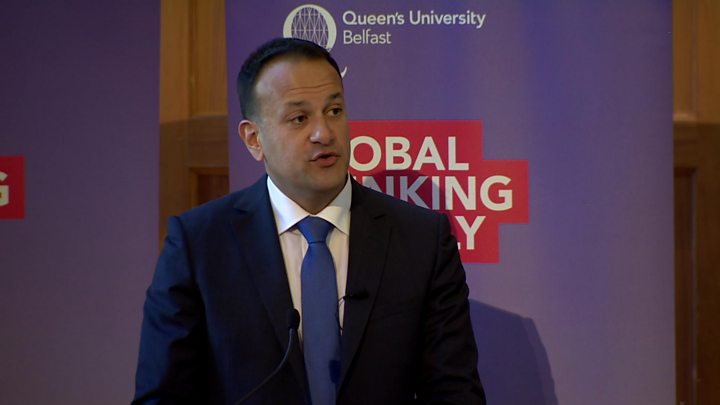
    Irish Prime Minister Leo Varadkar has called for “unique solutions” to preserve the relationship between the UK and the European Union after Brexit.

    Speaking in Belfast during his first official visit to Northern Ireland, he raised the possibility of a bilateral UK-EU customs union.

    The taoiseach described Brexit as “the challenge of this generation”.

    “Every single aspect of life in Northern Ireland could be affected by Brexit,” he told an invited audience.

    Those who favour a hard Brexit have already had 14 months to come up with a plan, he warned.

    “If they cannot, and I believe they cannot, we can then talk meaningfully about solutions that might work for all of us,” he said.

    Mr Varadkar offered two of his own suggestions:

    • The possibility of an EU-UK customs union if the UK wants to remain in the customs union
    • A “deep free trade agreement” with the EU if the UK does not want to stay in the single market, with the possibility of its rejoining EFTA (European Free Trade Association)

    The taoiseach referred to the lack of input into the Brexit debate from Northern Ireland due to the collapse of the Stormont executive.

    “We need an answer to the question of who we – and others in Europe – talk to in Belfast,” he said. “Who will speak for Northern Ireland and her 1.8 million people?”

    He was speaking at the city’s Queen’s University on the future of north-south relations, and is due to meet the Northern Ireland parties.

    On Saturday, Mr Varadkar, who is the Republic of Ireland’s first openly gay taoiseach, will attend an event as part of Belfast’s gay pride festival.

    Image copyright
    Reuters

    Image caption

    Leo Varadkar and DUP Arlene Foster met in Dublin on 16 June

    Mr Varadkar said: “It will come as no surprise to anyone here that I do not want there to be an economic border on our island, nor do I want one between Ireland and Britain.

    “By economic border, I am not talking about currency or variation in tax rates. I am talking about a barrier to free trade and commerce.”

    Mr Varadkar also urged politicians to do a deal to restore power-sharing in Northern Ireland.

    The taoiseach is to meet the DUP, Sinn Féin, the SDLP and the Alliance Party later on Friday. He will not be meeting the Ulster Unionist Party as its leadership was not available.

    His meeting with DUP leader Arlene Foster will come days after a row between the party and the taoiseach over the Irish border post-Brexit.

    Mr Varadkar had said he would not design a border for Brexiteers but DUP MP Jeffrey Donaldson said that “megaphone diplomacy from Dublin” would not sort out the border issue.

    Media playback is unsupported on your device

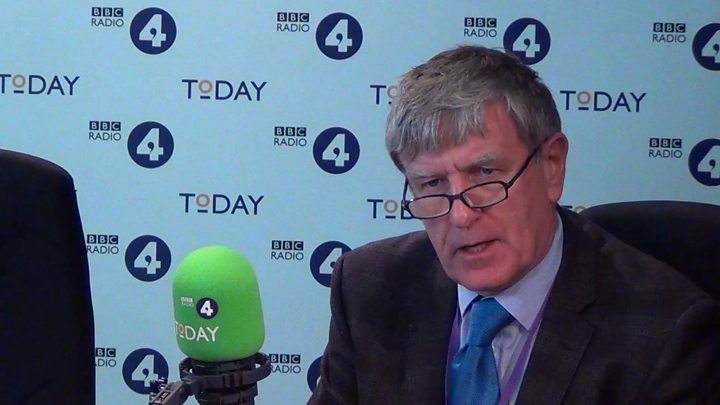
    Media captionA hard Irish border is ‘not feasible’, Outgoing Irish ambassador to the UK Daniel Mulhall told the Today programme

    Speaking on Good Morning Ulster on Friday, Sir Jeffrey said his party welcomed the opportunity to sit down with the taoiseach.

    “It is better to have dialogue than what we’ve seen in recent weeks which is the Irish government making statements about a border in the Irish Sea which is totally impractical and a non starter,” he said.

    Image copyright
    Pacemaker

    Image caption

    Leo Varadkar went to Queen’s University for his first engagement in Northern Ireland

    “We have to negotiate our way through this.

    On the same programme, Sinn Féin MLA Conor Murphy said the taoiseach was “acting in the interests of the people of Ireland when he makes these remarks and these approaches to the European Union”.

    “We have to ensure that our interests are up there. The fact that we are Irish citizens and European citizens and we have rights to be protected, needs to be front and centre. And we look to the taoiseach to defend our interests,” he said.

    On Thursday, former taoiseach John Bruton, a former leader of Mr Varadkar’s Fine Gael party, said that the DUP is in a position to answer questions over Brexit because of its Westminster pact with the Conservative Party.

    In a call with Mr Varadkar in July, Scottish First Minister Nicola Sturgeon outlined a plan to keep Scotland in the Single Market and Customs Union.