Category: Business News

  • Will Asian fruit and veg home deliveries take off?

    Asian fruit and vegetablesImage copyright
    i-DlePix

    Image caption

    Now you can get more specialist Asian fruit and veg delivered to your door

    Asian groceries used to be available only through specialist supermarkets, but now home delivery services are bringing foods such as raw turmeric and Alphonso mangoes to a wider audience.

    You can order pretty much anything online these days – and now that includes bitter gourds and fresh bunches of fenugreek.

    Before, you’d have to travel to a grocery store specialising in ethnic foods to buy your typically Asian ingredients.

    But in the last few years, a handful of online retail start-ups founded by British Asians have entered the market, enabling shoppers in the UK and Europe to buy small aubergines and okra from the comfort of their own homes.

    Working mum Jyoti Patel began setting up her online Indian grocery company Red Rickshaw five years ago in West London.

    “Having a city job, then coming home and trying to create an Asian dish from scratch – as well as finding the time to go to an Asian store to get all the ingredients” was tiring and time-consuming, she says.

    “Especially on a weekend when you’d rather lie in!”

    She thought there must be a better way.

    Image caption

    Red Rickshaw founder Jyoti Patel wants to bring Asian flavours to a wider audience

    With a product range of around 5,000 items, ranging from organic spices, lentils, rice, halal meat and ghees to fresh fruit and vegetables, they now reach thousands of customers across the UK from their West London warehouse.

    Most customers, like mother-of-two Joyce Tiwari from Harrow, north-west London, are from the Asian community.

    “To be honest, I don’t have time to go and pick vegetables. The thing we order most is a ready-made idli dosa [lentil pancake] batter mix, which saves me a lot of time,” she says.

    But increasingly, non-Asian customers seeking out more unusual cooking ingredients are using the online shopping platform as well.

    Nick O’Farrell, who lives in Lincolnshire and enjoys Indian cooking, was searching for bitter melon – called karela – after trying it in an Indian restaurant in Huddersfield.

    “I just did an online search and Red Rickshaw came up… accessibility of any ingredients is a challenge in rural Lincolnshire,” he says.

    Another recent player in the online Asian grocery market is Sabadda.com, which was set up in June 2016 by a group of South Indian IT professionals living in different parts of the UK.

    Image copyright
    Sabadda

    Image caption

    Around two-fifths of Sabadda’s customers are non-Asian

    It offers Asian grocery delivery via a mobile app service.

    “We had to travel a fair distance to shop for our Indian groceries to get the food which we’re used to…even then, we could not find everything we needed,” says co-founder Kalyan Chandra Varma Samanthapudi.

    While they had originally intended to reach customers from within their own community, 40% of their customers are non-Asian, he says.

    It’s a trend Jyoti Patel is keen to capitalise on, too.

    She’s soon launching a new line of Asian meal-kit recipe boxes that include raw ingredients and recipes.

    “One of the greatest barriers to having Asian food at home is know-how and access to ingredients, so we’re hoping to address both of those problems,” she says.

    About 14% of the UK population now does all of its grocery shopping online, according to retail analyst Mintel, up from 7% in 2014.

    It says services have come to market in the last year to help smaller food distribution businesses sell online, which means we’re likely to see more specialist groceries available on the internet in the coming years.

    “The barriers for specialist grocers – who’ve always needed a local demographic interested in those products – are broken down online; you can reach anyone at any time,” says Nick Carroll, senior retail analyst at Mintel.

    Image copyright
    Red Rickshaw

    Image caption

    Mangoes are particularly popular with online shoppers

    “The issue for them is that it’s quite expensive from a business perspective, because it requires refrigerated trucks to get products to consumers.”

    The other big challenge – one that Jyoti Patel is well aware of – is resistance among traditional shoppers in Asian-populated areas like Southall and Wembley in London.

    These traditionalists simply don’t like the idea of having their Asian fruit and vegetables selected for them.

    Certain highly sought-after items, such as Indian and Pakistani mangoes, can attract large crowds at Asian grocery stores when they’re in season.

    Radio 4’s You and Yours programme canvassed shoppers in Harrow, north-west London – an area with a large Asian population.

    “I would never shop for my Asian groceries online, especially mangoes,” says shopper Smita.

    “I have to feel fruit and vegetables before I buy.”

    Another shopper, Sukaina, says her reluctance to shop for Asian groceries online is less about the perceived extra cost of doing so, and more to do with her scepticism over the freshness of home-delivered ingredients.

    “I think you could probably get more deals online, but for me it’s just the freshness factor,” she says.

    Asian online grocery delivery companies say they offer competitive prices and ensure the quality of their fresh produce.

    But Jyoti Patel admits there’s more work to do in persuading people that the time saved choosing home delivery outweighs the benefit of choosing your own groceries by hand.

    To hear more on this, check out BBC Radio 4’s You and Yours programme here

  • UK ‘must prepare a Brexit fallback’

    Mervyn KingImage copyright
    PA

    The UK needs a “credible fallback” in case no EU trade deal is reached during Brexit negotiations, former Bank of England governor Mervyn King has said.

    Lord King said British negotiators needed to show Brussels the country has an alternative over a bad trade deal post-Brexit.

    The former governor, who served between 2003 and 2013, said no deal was “not the first preference of anybody”.

    He said the government “probably wasted a year” on its contingency plans.

    The first round of Brexit negotiations at the European Commission ended in July.

    Brexit Secretary David Davis said Brussels might delay trade talks due to a lack of progress on the cost of the UK’s “divorce” settlement.

    Brexit: All you need to know

    Brexit: What is at stake in EU-UK talks?

    The people who will negotiate Brexit

    Speaking to BBC Radio 4’s Today programme, Lord King said: “We are where we are, and we are in a negotiation and it’s important that the negotiation succeeds.

    “But it cannot succeed without a credible fallback position and that is something which I think is a practical thing that the civil service ought to be taking a lead on.”

    Previously Prime Minister Theresa May has said: “No deal is better than a bad deal.”

    If the UK left the EU without a trade deal with the 27 other nations it would rely on World Trade Organisation rules, and trade agreements between Europe and other countries may not be available to Britain.

    Media playback is unsupported on your device

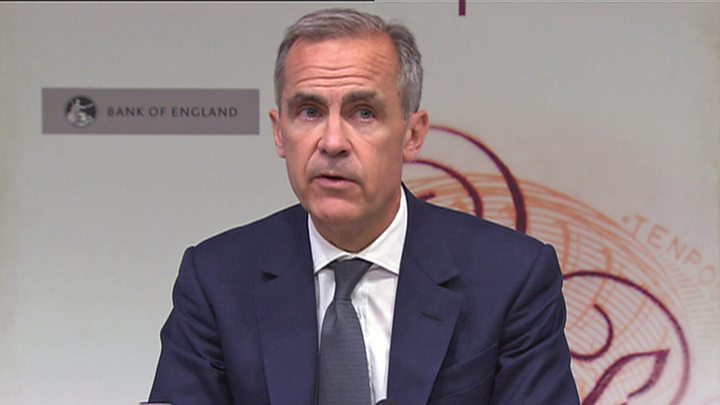
    Media captionHouseholds have cut spending since Brexit, says Bank of England’s Mark Carney

    On Thursday current governor of the Bank of England Mark Carney announced that uncertainty over Brexit was reducing growth in the British economy.

    As a result the bank lowered this year’s growth forecast from 1.9% to 1.7%.

    Mr Carney said: “Uncertainties about the [UK’s] eventual relationship [with Europe] are weighing on the decisions of some businesses.”

    Lord King said: “I don’t know what the economic consequences of Brexit will be, that’s the only honest answer.”

    Previously, Brexit minister Steve Baker said the government was preparing for all possible outcomes over Brexit talks, but added a no-deal with Brussels was unlikely.

  • What 2 Horses, up Close and Personal, Taught Me About Leadership

    A few months ago, I found myself on a ranch in Northern California working with horses in a round bullpen. I’ve always admired the equine species, but usually from afar. Suddenly, there I was, up close and personal: I’d come to this ranch to take part in an equine-therapy program in order to better understand my behavioral patterns as a business leader and an individual (yes, really!).

    Related: Managing Your Mental Health as an Entrepreneur

    Here’s what I found: Working with horses can provide a mirror into your real-life interactions in a very non-judgmental way. 

    On that first day, for instance, my task was to greet a dark brown horse named Billy Comanche. Just greeting a horse sounds simple enough, but it was anything but. As I walked up to meet my charge, my mind was flooded with bits and pieces of analysis: What was the horse thinking? Was I walking too fast? Why wasn’t the horse greeting me? Why was the horse approaching other people rather than me…

    This inner monologue of analysis and worry prevented me from being truly present in the moment. I was thinking more about myself than the horse. To put it simply, I was taking things way too personally. 

    Horses as a metaphor

    I see now how that initial meeting was a perfect metaphor for my behavior as a CEO and individual. I have no doubt that my passion and determination have led to my success as a business owner. However, before my horse encounter, I’d also became too wrapped up in my business. I’d taken every action personally and let the tiniest issues derail me.

    I’d frequently get upset and make rash decisions. The way I ran my business wasn’t a healthy one. Hence, the horse-therapy program. 

    After that first, intense program of one-on-one therapy and psychodrama workshops, I returned for another session in the bullpen. This time, I presented myself to a horse named Ginger. This time, my task was to greet Ginger and lead her around the ring several times. As I went to greet her, I was immediately taken in by her. I felt an instant connection, and all that self-absorbed inner analysis just disappeared.

    However, I wasn’t done learning about myself. As I led Ginger around the ring the first time, I was constantly looking back to check on her. I was supposed to be the leader, but with my constant need to check in on the horse’s well-being, I was doing anything but leading.

    I began to reflect on my life. And, as I did so, I realized that I’ve always been more focused on everyone around me than myself. Whether as a CEO, friend, mother or wife, I typically try to make everyone else happy but often neglect to take care of myself. And while kindness and generosity are admirable attributes (ones we could use more of in the world today), I’ve learned that these characteristics can also be a form of co-dependence and in the long run result in resentment and passive -aggressiveness. 

    Related: How I Put My Mental Health First (and How You Can Too)

    Meeting Ginger again

    I was asked to lead Ginger one more time — and this time I was not to look back. I took the reins but kept my gaze firmly ahead and walked. And, guess what? Ginger seemed more secure. Me? I felt happy, confident and free.  

    While much of this experience has been highly personal, I do believe that many of the lessons I learned can apply to other entrepreneurs as well. In particular, some of the therapy sessions were rooted in the Four Agreements from spiritual teacher Don Miguel Ruiz, which ask us to reflect on who we are, what we feel and how we behave:

    1. Be impeccable with your word. As entrepreneurs, our word is our brand and reputation. I learned that on my first day in the ring, I was trying too hard, to the point of being inauthentic (and the horse knew it!). I needed, and need, to be present in the moment, speak with integrity and be transparent about my feelings. 

    2. Don’t take anything personally. In the therapy sessions, I would get upset that the horse wasn’t coming to greet me, and took it as a personal affront. As business leaders, we’re constantly hearing feedback, whether it’s from customers, investors, press, colleagues or employees. However, we simply can’t see each critique as a personal attack, and respond in anger. Feedback often provides an important opportunity for growth and improvement. 

    3. Don’t make assumptions. I made assumptions about the horses and their behavior rather than just asking the coach what was going on. As entrepreneurs, we need to summon the courage to ask questions and express what we want. It’s imperative that we communicate clearly with others to avoid misunderstandings and drama. 

    4. Always do your best. This last agreement is a simple commitment to give 100 percent of yourself. As long as you’re always doing your best, you can cast aside any self-judgment and self-abuse. Be happy with your progress and live without any regrets.  

    Finally, if you’re feeling overwhelmed with anxiety, fear or depression, find a therapist or other mental health professional. It’s not something we talk about enough in the business world. But there is no shame in asking for help. Everyone — and I mean everyone — has some kind of struggle in his or her life. 

    Related: This Employee Took Off Work for Mental Health Reasons, and Her Boss Thanked Her

    I’m the first to admit that I am a work in progress, both as an individual and a business leader. I gained important insights from my experiences in horse therapy, but now the real work begins, in how I apply those revelations in the months and years ahead. I don’t have all the answers. But I am trying to grow every day, and most importantly, to enjoy the journey. 

  • How do you food shop for the end of the world?

    How do you food shop for Armageddon?

    The Food Chain meets the man selling food to people who fear for the future. Surfer-turned-survivalist Lincoln Miles runs the Preppers Shop UK, stocking everything from tinned food to NBC (nuclear, biological, chemical) suits.

    For the full story, visit BBC Food Chain: What Will You Eat if the Apocalypse Comes?

    Film produced by Marie Keyworth, Emily Thomas and Dhruti Shah

  • Trump hails $1.6bn US investment by Toyota and Mazda

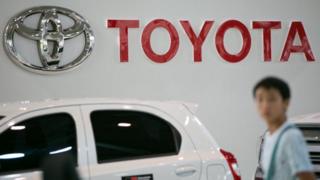
    Toyota signImage copyright
    EPA

    Japanese car giants Toyota and Mazda have teamed up to invest $1.6bn in a new car plant in the US.

    The new factory aims to produce 300,000 vehicles a year and expects to employ about 4,000 people.

    President Donald Trump tweeted the decision was “a great investment” in US manufacturing.

    The two carmakers have also agreed to join forces to develop electric car technology, and Toyota is to take a 5% stake in Mazda.

    Change of plan

    Earlier this year, Mr Trump said Toyota would face hefty tariffs on cars built in Mexico for the US market if they were made south of the border.

    He campaigned on promises to increase manufacturing and expand employment for American car workers.

    Toyota had initially been planning to produce Corollas at its new $1bn plant currently under construction in Mexico, but this will now shift to the US.

    A new Mazda SUV crossover will also be made at the new US factory, with the two companies hoping production will begin in 2021.

    Toyota’s Mexico plant will produce its Tacoma truck instead.

    Consolidating research

    The co-operation between Toyota and Mazda on developing electric vehicles comes as the industry adapts to the tightening of global emissions regulations.

    Toyota has set a goal for all of its vehicles to be zero emission by 2050.

    More carmakers are facing large research costs as they look to improve battery-powered cars.

    Image copyright
    EPA

    Image caption

    The two carmakers will invest in each other as part of the tie-up

    Toyota and Mazda also plan to work together on developing in-car information technologies and automated driving functions, as competition intensifies over the development of self-driving vehicles.

    As well as Toyota taking a 5% stake in Mazda, the tie-up will also see Mazda take a small stake in its larger rival.

    Toyota, Japan’s biggest carmaker, has been forging alliances with smaller Japanese rivals for several years.

    It already owns a 16.5% stake in Subaru, where it has a development partnership.

    Toyota is also seeking some form of research and parts supply deal with Suzuki in an attempt to tap into its expertise in emerging Asian markets.

    Chris Richter, managing director of investment company CLSA, said: “By buying a 5% stake (in Mazda), Toyota takes Mazda off the table rather than having it sit out there like a free agent which could someday be used against them.”

    Mazda also stands to gain a production stake in the US, which is its biggest market. At the moment it ships all vehicles sold in the US from its plants in Japan and Mexico.

    It, along with other Japanese rivals, also lacks the funds to develop electric cars on its own.

    Janet Lewis, head of Asia transportation research at Macquarie Securities, said: “Mazda needs electrification technology.

    “In the past they’ve pooh-poohed electric vehicles, they’ve felt that they can make internal combustion engines more efficient, but the bottom line is that globally you need to have this technology.”

  • OnTheMarket plans to join stock market to rival Rightmove

    OnTheMarket website page

    The UK’s third biggest property portal, OnTheMarket.com, plans to raise £50m by issuing shares on the stock market.

    It will use the money to help it compete against its larger rivals Zoopla and Rightmove, which currently dominate the market.

    OnTheMarket.com is owned by over 2000 estate agents, including Savills, Knight Frank and Strutt & Parker.

    It has previously accused Zoopla and Rightmove of charging too much for advertising properties on the internet.

    “For consumers and agents alike, we are committed to creating a genuine agent-controlled alternative challenger business and brand to the two leading incumbent portals,” said Ian Springett, chief executive of the parent company Agents’ Mutual.

    The money will be spent on a “heavyweight” advertising campaign on television, and in digital and print media.

    OnTheMarket’s members will vote on 6 September whether to go ahead with the float, which if successful would value the company at between £200m and £250m.

    The offer will be open to institutional investors only.

  • Aldi pulls eggs from German stores over fipronil poison fear

    Eggs being destroyed at a poultry farm in Onstwedde, the Netherlands, 03 August 2017Image copyright
    EPA

    Image caption

    Contaminated eggs are destroyed at a farm in the Netherlands

    Supermarket giant Aldi has withdrawn all eggs from sale from its stores in Germany as they may have been contaminated by insecticide.

    Tests showed that the chemical fipronil, which can harm people’s kidneys, liver and thyroid glands, was found in eggs from the Netherlands.

    Fipronil is used to treat lice and ticks in chickens.

    One German official said up to 10 million of the contaminated eggs may have been sold in Germany.

    Christian Meyer, the agriculture minister for Lower Saxony, told German television that there was a risk to children if they ate two of the eggs a day.

    About 180 poultry farms in the Netherlands have been temporarily shut in recent days while investigations are held.

    Marieke van der Molen, of the Dutch public prosecutor’s office, said a criminal investigation was under way to find the source of the contamination.

    Meanwhile, European supermarkets have moved to halt the distribution of eggs from the affected batches.

    However, Aldi – which has close to 4,000 stores in Germany – is the first retailer to stop selling all eggs as a precaution.

    “This is merely a precaution, there is no reason to assume there are any health risks,” Aldi said in a statement.

    A spokeswoman for Aldi UK told the BBC its eggs were all British and were not affected by the contamination.

    Reuters reports that investigators believe the chemical may have originated in contaminated detergent used to clean barns.

    Poultry World reported that fipronil may have been deliberately added to an existing insecticide to improve its effectiveness.

    The Netherlands is Europe’s largest exporter of eggs and egg products, and one of the biggest in the world. It exports an estimated 65% of the 10 billion eggs it produces every year.

  • Egg vending machine installed on farm to tackle thieves

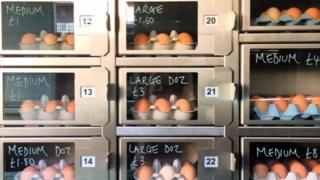
    Egg vending machine.Image copyright
    Annabel Barber

    Image caption

    Individual vending machine boxes containing packs of eggs are unlocked after payment

    A family-run egg farm has installed a vending machine because so many people were abusing its honesty box system.

    Cavick House Farm in Wymondham, Norfolk, had been relying on the good will of customers to pay the correct amount for their eggs.

    David and Julie Barber keep 16,000 hens and decided to sell eggs direct to the public to boost the income they get from supplying supermarkets.

    But they were losing about £150 a week in stolen eggs.

    Mrs Barber said it was “a shame” so many people were choosing not to pay.

    She said: “We ran the honesty box for about seven years in our little egg shed but in the last couple of years the figures haven’t been adding up.

    “We were seriously thinking about stopping the sales altogether but we decided to keep selling to our loyal customers.”

    Previously, customers were invited to help themselves to eggs and leave the appropriate amount of money in the box, but an estimated 40% of the produce was not being paid for.

    Packs of eggs are now kept in individual vending machine boxes which are only unlocked after payment.

    Image copyright
    Annabel Barber

    Image caption

    Customers were previously able to help themselves to eggs but some were not paying

  • Ta-Ta Towel: Why the world has gone mad for a towel bra

    A woman poses in a black Ta-Ta Towel and black leggingsImage copyright
    Tatatowel.com

    Image caption

    Behold the Ta-Ta Towel, which some call genius, and others “kinda ugly”

    Bum-enhancing leggings! Light-up phone cases for better selfies! A stick-on bra to “give your girls a lift!”

    These are just a few of the products tech-savvy companies have launched into women’s social media feeds in recent months, in pursuit of viral marketing campaigns.

    Now we have the Ta-Ta Towel, which at first glance is the most ridiculous yet. Variously described as “a bizarre boob hammock” and “the breast accessory you didn’t know you needed,” it’s an absorbent towel for women that only covers their breasts.

    It resembles a halter-neck bikini top that wraps around the wearer’s neck – but made out of towel fabric.

    At time of writing, a social media frenzy surrounds this product. On one side, the haters: It’s pointless – ugly – “so goofy”.

    On the other, Team Ta-Ta: It’s fun – it’s hurting no-one – and according to breast-feeding mothers, it’s a lifeline for reasons some detractors may have missed.

    Image copyright
    Facebook

    Why does it matter?

    Well, traditionally capitalist Western society sexualises breasts in a bid to sell merchandise. Billions of dollars have been made from this strategy. But if there’s one thing most people can agree on, it’s that the Ta-Ta Towel is not the most sexually enticing boob-covering available.

    More than likely, social media will soon be flooded with mischievous, consciously unflattering pictures of women posing in – might we call it? – the TTT. Facebook and Instagram aren’t only for narcissists, after all – not when there’s a new seam of shared comedy to mine.

    The world has discovered a funny-looking boob-holder, and people are delighted. And when bra design changes so little as the years go by, perhaps it’s no surprise.

    This is a case of an innovative woman taking ownership of a female issue, and finding a solution.

    Ta-Ta Towel creator Erin Robertson was living in Los Angeles with a broken air-conditioning unit, and got sweaty under her breasts the minute she stepped out of the shower.

    She writes on her website: “I tried everything: I tucked wash cloths under my breasts, I tried dumping baby powder all over me, I even put a t-shirt on and tucked it under my boobs. But the wash cloths looked ridiculous, the baby powder made me look more like dough, and the t-shirt was making me sweat even more.”

    It’s not pretty, but it’s a fact – especially in summer, and for women with a larger bra size.


    You might also like:


    That brings us to another novelty – the women advertising this product are much bigger than standard models. The denizens of the runway are rarely among nature’s most buxom, and the Ta-Ta Towel is only available from a C to an H cup. It’s an unusual sight, because women with more than an inch to pinch are rarely employed to sell mass-market products. Especially where they’ll have to be scantily clad.

    And for mothers, there’s another bonus to the Ta-Ta furore: It’s raised tricky discussions about breast-feeding which would usually only happen in baby groups or on Mumsnet.

    On her babycenter blog, mum Sara McGinnis wrote about struggling with night-time leakage while breast-feeding, and how she had stuffed hand towels down the front of her t-shirt every night.

    Certainly, not everyone with a view on the Ta-Ta Towel will go through that experience. But it’s encouraging honest, empathetic discussions about what happens to women in their first months of motherhood – and making people smile in the process.

  • ‘Cash is trash’: Tough times for savers

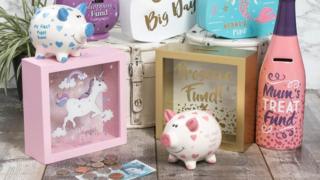
    Money boxes and piggy banksImage copyright
    Lesser and Pavey

    Our savings habit has never been so weak since data was first collected in 1963. Notes and coins have been overtaken by card and digital payments. Interest rates are still at a record low.

    The current situation has prompted one financial expert to declare that “cash is trash”.

    So pity Jonny Greves, a buyer at Lesser and Pavey, whose job it is to import money boxes and piggy banks. Actually, he says, save your sympathy.

    “Last year we noticed a rise in sales of money boxes which has continued into this year. It seems that no matter what the current market is like, a nice, themed money box always makes a good gift,” he says.

    “No matter how old someone is, they could be saving for something so a money box with the right design makes it easy.”

    While we might be turning to our digital devices and cards to pay for things, he says the jam jar savings habit remains healthy.

    “As much as we are getting towards a cashless society, and I’m the worst for it, people are always going to have a few pounds in their pocket and when times are hard sometimes this is all people can afford to save, so there is no other place than a money box,” he says.

    Image copyright
    Lesser and Pavey

    Yet, when the money box fills up, or bigger sums need to be set aside, data suggests the UK is less keen to put money into a bank account.

    The saving ratio – which measures the outgoings and incomings that affect households and shows the percentage of disposable income that is saved – has been falling sharply for more than a year.

    The Office for National Statistics (ONS) said the ratio stood at 1.7% from January to March, down from 3.3% in the previous quarter, and the lowest since records began.

    While the Bank of England suggests that it could pick up again, it also warned this week that households with large savings may start to save less or run down their savings as household purchasing power falls.

    A survey for the Bank showed that 60% of those who plan to keep spending the same in real terms had more than £15,000 of savings.

    Those with higher debts, and less in savings, may need to reduce spending more quickly in order to continue to meet their debt repayments.

    That is because prices are rising faster than wages which means, in real terms, that many people are worse off.

    Household income is being squeezed, and borrowing is cheap. Interest rates on a £10,000 personal loan are close to record lows and the average interest-free period on credit card balance transfers has doubled since 2011, the Bank says.

    Meanwhile, the rate of return on easy access savings accounts are as low as 0.01% a year – creating little incentive to save.

    Analysts were particularly gloomy about the plight of savers after the eight members of the Bank’s Monetary Policy Committee voted 6-2 to keep interest rates on hold at 0.25%. They have been at that level since August last year.

    Tom Stevenson, investment director for personal investing at Fidelity International, says: “At the risk of sounding like a cracked record, cash remains trash in today’s environment. With this in mind, anyone with savings still sitting in cash will continue to struggle to generate a real return.”

    Ross Andrews, director of fixed rate bond provider Minerva Lending, is equally pessimistic. “The struggle for people to keep their savings real has no obvious end in sight,” he says.

    “In this negative climate, more needs to be done to raise awareness of the savings risk, which is eroding people’s savings pots in real terms.”

    Image copyright
    Getty Images

    So why bother to save money, when the rising cost of living and lower rates of return mean it will actually be worth less than it is now?

    Andrew Johnson, of the government-backed Money Advice Service, says that, whatever the rates, saving for a rainy day – such as when the boiler breaks down – still makes sense. He has three reasons to save:

    • Having a healthy savings buffer in an instant access account will give you peace of mind and can act as a cushion against unexpected financial shocks
    • Taking out a loan or other forms of credit can be expensive if used to pay for special purchases. Saving a little and often can make them more affordable when the time comes and helps reach long-term goals such as owning a home
    • Saving in a pension has a number of tax advantages as well as helping you achieve your income goals in retirement

    There is another glimmer of hope for savers. Things are not as bad as they were, says Anna Bowes, director at independent savings advice website savingschampion.co.uk.

    “The good news for savers is that competition – primarily between some key challenger banks – has been rife so far in 2017. Since the end of last year, the best easy access rate available has risen by 25% and fixed rate bonds have risen even more,” she says.

    “If you are sitting in a poor paying high street bank account, you don’t need to wait for a base rate rise to see a marked improvement in the interest you can earn.”

    Interest rates on easy access savings accounts can be as low as 0.01% or as “high” as 1.2%. For anyone with savings or inheritance of £50,000 that means earning either £5 gross per year, or £600.

    So, shopping around may pay. Some current accounts are paying rates of up to 5%, although only on smaller balances and with lots of terms and conditions to adhere too, she says. Longer term fixed rate bonds are paying up to 2.5% – but locking your money away for up to five years might not be the best option for many.

    Time then to find a suitable home for your savings – or maybe just to dust off that old piggy bank.


    Do you have an unusual home for your loose change? E-mail us at

    You can also contact us in the following ways: