Half the number of residential properties were sold in May compared with a year ago amid coronavirus lockdown measures.
A total of 46,230 property transactions were completed during the month, down 52% on the same month last year, HM Revenue and Customs data shows.
There was a slight pick-up on the previous month, reflecting the lifting of housing market restrictions in England in mid-May.
Estate agents say demand is now high.
Figures show that buyer interest is bouncing back, as housing markets in the other parts of the UK have begun to open too.
However, commentators say this may be short-lived as the sharp economic downturn puts pressure on household spending.
Spring is usually a busy period for the property market, but the coronavirus lockdown all but halted activity.
The number of property transactions fell to a record low of 37,000 in April, and despite a slight pick-up in May, sales were clearly suppressed during that month.
Since then, there has been interest from potential buyers, many of whom have changed their priorities. Gardens and space to work from home have become more popular owing to people’s experiences during recent months.
Others are likely to be more guarded owing to worries about jobs and incomes in the longer term.
“We have concerns that most of the demand is for smaller family houses rather than smaller flats as aspiring first-time buyers remain concerned over future employment prospects post-furlough,” said north London estate agent Jeremy Leaf.
Intu, which owns some of the UK’s biggest shopping centres, has appointed administrators as a “contingency” in case financial rescue talks fail.
In March, the owner of the Trafford Centre and Lakeside said it was in talks with lenders about new funding.
Intu had been struggling before coronavirus to fill outlets within some centres sites, and had heavy debts.
On Tuesday, Intu said “notwithstanding the progress made” it had appointed KPMG to plan for administration.
Since the coronavirus lockdown Intu’s centres have been partially shut, with only essential stores remaining open.
The company had about 60% of shopping centre staff and about 20% of head office employees on furlough.
The firm’s financial woes include making a loss of £2bn in 2019, failing earlier this year to raise £1bn in new funding, and having debts of £5bn.
The collapse and contraction of High Street retailers in the face of rising costs and the seemingly ever-increasing online shopping trend had already seen retailers closing outlets, leaving a number of landlords, such as Intu, struggling to fill empty space.
Many of its tenants were behind with their rents already, and its latest update on rent collection said it had received only 40% of rental and service charge income for the first quarter of the year. It had moved from quarterly rent collection to more flexible arrangements with shop owners.
Intu has been attempting to sell shopping centres to raise cash and has sold off its outlet in Zaragoza, in Spain.
The UK car industry’s trade body says one in six jobs are at risk of redundancy without help from the government in restarting production.
The Society of Motor Manufacturers and Traders (SMMT) said emergency funding, permanent short-time working, business rate holidays, and VAT cuts are needed to stem the flow of job losses.
Showrooms are reopening and production lines are restarting, it said.
But more than 6,000 jobs have been lost in the automotive sector this month.
In common with many manufacturers, carmakers have high fixed costs to pay, such as rent, during a period where sales are sharply down.
And many workers remain furloughed as companies work out how to operate while allowing for social distancing.
Image copyright Getty Images
“A third of our workforce remains furloughed, and we want those staff coming back to work, not into redundancy,” said Mike Hawes, SMMT chief executive.
“Government’s intervention has been unprecedented,” he added. “But the job isn’t done yet. Just as we have seen in other countries, we need a package of support to restart; to build demand, volumes and growth, and keep the UK at the forefront of the global automotive industry.”
The lobby group estimates the impact of lockdown will cut annual car and light commercial vehicle production by one-third to 920,000 vehicles this year.
As well as assistance to restart production, the industry is anxious about securing a trade deal with the European Union (EU).
Lower output
The UK left the EU on 31 January but remains in the single market and customs union until 31 December, while the two sides try to hammer out a trade agreement.
“Certainty that a full, zero-tariff deal will be in place by the end of the transition period will give businesses on both sides chance to prepare, and help drive investment into the new skills, facilities and technologies that will be integral to delivering a zero-carbon future for the UK,” the lobby group said.
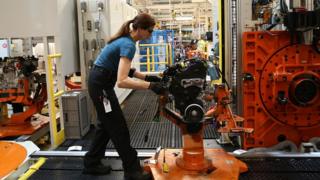
British car manufacturing came to a screeching halt in April, down 99.7% against the same month last year.
It was the lowest output since the Second World War. Just 197 premium and luxury sports vehicles rolled off factory lines, with 45 of those sent to UK customers.
Some plants refocused to make 711,495 items of personal protective equipment for health workers.
The loss of 400,000 cars that would normally have been made is expected to cost the British car industry up to £12.5bn in revenues.
In April, there were 830 new car engines made at UK plants, 781 of which were exported. This level was down 99.5% on the year before.
Image caption
President Trump has made a tough immigration stance a key part of his campaign
US President Donald Trump has extended a pause on some green cards and suspended visas for other foreign workers until the end of 2020.
High-skilled tech workers, non-agricultural seasonal helpers, au pairs and top executives will be affected.
The White House said the move will create jobs for Americans hurting economically due to the pandemic.
But critics say the White House is exploiting the coronavirus pandemic to tighten up immigration laws.
Who’s affected?
In a briefing for reporters, the administration said the freeze, in place through the end of the year, would impact about 525,000 people.
That includes an estimated 170,000 people blocked by the decision to extend a ban on some new green cards – which grants permanent residence to foreigners. The White House first announced it was halting those visas in April, an order that had been set to expire on Monday.
Trump signs immigration green card suspension
Existing visa holders are not expected to be affected under the new restrictions announced on Monday.
The order also applies to H-1B visas, which are often granted to Indian tech workers and their families. Critics say these visas have allowed Silicon Valley companies to outsource American jobs to lower-paid foreign employees. H-1B visas are currently distributed via a lottery, but the Trump administration is proposing they instead be awarded by highest salary. Last year, there were about 225,000 applications competing for 85,000 spots available through the H1-B visa programme.
The order will suspend most H-2B visas for seasonal workers, including those in the hospitality industry, except those in agriculture, the food processing industry and healthcare professionals.
The order will restrict J-1 short-term exchange visas, a category that includes university students and foreign au pairs who provide childcare. Professors and scholars are not included in the order. There will be a provision to request exemptions.
L visas for managers and other key employees of multinational corporations will also be suspended.
What’s the reaction?
The aim is to get “the best and the brightest” and “the most value for our economy,” a senior official said on the background call.
Mark Krikorian, executive director of the Center for Immigration Studies, which favours restrictions, told AP news agency: “This is a bold move by the Trump administration to protect American jobs.”
But the American Civil Liberties Union said: “It’s the exploitation of a pandemic to reshape immigration law, while superseding Congress.”
The new policy is also opposed by many businesses, which rely on foreign workers.
“As the economy rebounds, American businesses will need assurances that they can meet all their workforce needs,” the Chamber of Commerce wrote in a letter this month warning against new restrictions.
“To that end, it is crucial that they have access to talent both domestically and from around the world.”
The UK’s biggest household energy supplier, British Gas, will soon face competition from a new, cheaper supplier from its own stable.
Parent Centrica has been trialling a digital-only “challenger” brand under the name British Gas X amid the highly competitive world of energy supply.
The company has been shedding customers and this month said it would cut 5,000 jobs.
Centrica would not comment but is expected to give more details in July.
A test website for British Gas X is already up and running. It says the service is designed for “digitally savvy” customers, with everything done online.
It also says customers can “switch at any time with no exit fees” and that the energy they use will be offset from “100% renewable” sources.
Centrica plans to base its new no-frills service on this platform, however a final name has yet to be decided.
Evolving landscape
British Gas, once the sole supplier of gas to the country, is still the dominant force in energy supply with more than seven million customers, but it faces tough competition. Last year alone it lost almost 290,000 customers.
Energy regulator Ofgem says there are currently around 60 suppliers operating around the country, and the landscape continues to evolve.
Until recently supply was dominated by a “Big Six” but that is breaking down. Incomer Ovo recently bought major supplier SSE, and medium-sized players such as Shell-backed First Utility are making inroads.
Meanwhile, a clutch of smaller entrants have tried and failed to make money in this market, with more than 20 going under in the past year.
Job cuts
Centrica’s jobs shake-up was ordered by its new chief executive, Chris O’Shea. He said the company had more than 80 different employee contracts, “each with multiple variants, with many of the agreements dating back over 35 years”, which, he said, needed to be modernised.
Centrica currently has about 27,000 employees, with 20,000 of these based in the UK.
In February, the firm blamed a big loss in 2019 on falling gas prices and the energy price cap.
The price cap on electricity and gas bills came into effect in January 2019 and was a flagship policy of former prime minister Theresa May to end what she called “rip-off” prices.
A number of energy companies have said the policy has affected their business and profits. Centrica made a loss of £849m in the last calendar year compared with a £987m profit in 2018.
Image caption
Tim Cook said it was a “historic day for the Mac”
Apple has confirmed it will transition its Mac laptop and desktop computers to its own ARM-based processors.
The move means that Macs will run on the same type of chips as the firm’s iPhones and iPads, rather than Intel’s.
Intel had faced problems manufacturing its own designs, leading it to issue a public apology to computer-makers.
Apple’s challenge will be to carry off the transition smoothly and convince third-party developers to update their apps accordingly.
“We expect to ship our first Mac with Apple silicon by the end of the year,” said chief executive Tim Cook, adding that it would likely be two years before its full product line had made the jump.
The firm said the move would allow it to offer new features and improved performance as well as making it easier for developers to “write and optimise software for the entire Apple ecosystem”.
“Apple’s motivations for doing this include reducing its dependence on Intel, cutting the cost and boosting the performance of its silicon, and giving itself more flexibility and agility when it comes to future products,” commented Geoff Blaber from the consultancy CCS Insight.
“Embracing ARM and making its hardware more consistent across the iPhone, iPad and Mac ranges is a strategic necessity, but there will be inevitable bumps along the road.”
Image copyright APple
Image caption
Apple showed a version of MacOS running on the current iPad Pro chip
Apple said it had already developed native versions of several of its own apps, including Final Cut Pro X and Logic Pro. iPhone and iPad apps will also be able to be run on the computers.
Apple said that Microsoft was working on an optimised version of Office, and Adobe was developing a version of Photoshop.
Other developers should be able to recompile their apps to get a version running “in just a matter of days,” said the company’s software chief Craig Federighi. He added that old apps would automatically be translated at point of installation to run, although they would not work as well.
To mark the significance of the move, MacOS will move to version 11. Since 2001, it had only moved from 10.0 to 10.15.
Apple silicon
Apple successfully made the switch from IBM-Motorola’s PowerPC processors to Intel’s x86 family in 2006.
However, some software was never updated and cannot easily be run on today’s Mac computers. Apple dropped support for running older software under emulation in the 2011 release of its Mac operating system.
Microsoft already allows Windows 10 to be run on both Intel and ARM-based processors and looks set to continue supporting both chip architectures.
Apple has not stated how long it will do the same.
As a result, some people considering buying one of its laptop or desktop computers may decide to postpone a purchase until its first ARM-based computers go on sale.
This could hit sales both at Apple and the development studios that make software for the platform.
ARM-based chips are based on the designs of the UK-based company, which is headquartered in Cambridge. Other companies then adapt these to add capabilities of their own.
Samsung, Qualcomm and Huawei are among the many other companies to do so.
Apple is the fourth-largest PC vendor, according to market research firm Gartner, coming behind Lenovo, HP, and Dell.
The company has said that it has more than 100 million active Mac users. Back in June 2005, when it first announced the move to Intel chips, the figure was about 12.5 million.
“Apple is approximately 4.5% of the laptop market and 2.6% of the desktop market, so the financial impact to Intel will not be significant,” commented Gartner’s Jon Erensen.
“However, this transition… could give momentum to Microsoft’s current efforts to run Windows on Qualcomm’s Snapdragon processors.”
Image copyright APple
Image caption
The new version of MacOS, “Big Sur”, was shown off with design tweaks
Existing Mac owners will see changes to the next MacOS operating system – called Big Sur – which Apple said marked its biggest redesign to date.
Analysis by James Clayton, North America technology reporter
The best way to describe a processor is the brain of the computer.
Hardly surprising then that the processor in your computer is kind of important. Changing it is no small thing – and Apple hasn’t decided this lightly.
The big question though – and the one that if you’re reading this you’re probably more interested in – is what will this do for Macs in general?
The prevailing view in Silicon Valley is moving to Apple silicon will make for more powerful Macs.
Bringing it in-house could create cheaper processors – so in theory you could have cheaper Macs (that’s if Apple wanted to pass on savings to the consumer).
But there are risks too.
The first is that Apple still has Intel-based Macs yet to come out. Will people simply wait for Apple’s new processor to go live before choosing to buy a new computer?
And – considering how well Mac products sell there will be a nervousness about changing a formula that has worked very well for Apple for the last 15 years.
Privacy notices
Other announcements at WWDC included the ability to use an iPhone as a substitute for a car key by transmitting an NFC (near-field communication) signal to unlock doors and start the motor.
This will initially be limited to some new BMWs, but the firm said it intended to expand to other models in time.
App developers will also have to provide more information about the data they gather about users, so that Apple can display a summary to them before they install the software.
Skip Twitter post by @BenBajarin
By surfacing apps wanting your location or to track you, Apple is educating consumers and heightening their awareness of the situation. Creates more interest and desire for their privacy stance.
— Ben Bajarin (@BenBajarin) June 22, 2020
End of Twitter post by @BenBajarin
One of the biggest changes to the iPhone’s iOS14 operating system will be a shake-up of the home screen.
Apps can now be automatically organised into folders containing:
suggested apps, which are based on past habits
recently downloaded items
themed downloads, for example games
In addition, the firm is updating its “widgets” – blocks that display a stripped-down, small app window – so that they can be placed among the icons for other programs. Examples included weather forecasts, news briefings, and calendar meetings. Android already has something similar.
Another Android-like new feature is the introduction of App Clips, which allow part of a program to be downloaded quickly. These must be less than 10 megabytes in size and will be able to be triggered via an NFC-transmission or by scanning a QR code.
Suggested uses included the ability to order a drink in a cafe or to pay for a car-parking space.
Image copyright APple
Image caption
“App Clips” are lightweight apps that can be launched easily, without installing, for immediate functionality
Apple is also releasing a new app called Translate that carries out language translations offline, offering an alternative to Google Translate.
It will support 11 languages to begin with including English, Mandarin, French, German, and Arabic.
For the first time, users will be able to set third-party email and web browser apps as the default in iOS, rather than Apple’s own software.
The UK and Ireland will be among countries given access to an overhauled version of its Maps app, which provides more detailed views of roads and paths than before – as well as new cycling directions and routes for electric cars that pass charging stations.
And its MeMoji cartoon-like characters now feature new styling options, including the addition of protective face masks.
Apple’s tablet operating system iPadOS will also benefit from several enhancements to its Pencil stylus.
These include:
conversion of scribbled words and numbers into typed text
detection of both Chinese and English-language characters, with the ability to convert both appropriately within the same scribbled line
automatic tidying-up of drawings
The next version of WatchOS adds sleep-tracking functionality to the firm’s smartwatch – which will be based on a user’s movements in bed.
It also adds the ability to determine when the owner is washing their hands, in order to confirm whether they have done so for long enough to help protect against Covid-19.
In addition, the wearable will allow third-party “curated” watch faces to be shared and installed. The Activity app – which is now renamed Fitness – will track calories used for various dance styles.
Image copyright APple
Image caption
Apple Watch receives new customisation options – and the ability to share customised watch faces
Apple’s AirPod Pro earphones will gain spatial audio to recreate a cinema-style surround sound experience.
And its Apple TV will allow third-party video doorbells to gain face recognition when the video feed is sent to the set-top box.
Image copyright APple
Image caption
The company said Homekit-compatible security cameras will now offer facial recognition when viewed on an Apple TV
This will only work with members of the owner’s family and friends who have been tagged in advance.
Image caption
It is a momentous day for Atiq Rahman and four of his children, who are making a surprise trip to see his mother for the first time in months
Service stations are the multiple beating hearts of the nation’s road system. On the first Monday since the coronavirus alert level was downgraded, the BBC visited the UK’s first motorway services to test its pulse and to find out where its visitors were heading to.
When Watford Gap opened as the humble Blue Boar cafe 60 years ago, it became the UK’s first motorway service station.
For many villagers living nearby, it became a destination in and of itself. It had a futuristic and even sophisticated air, with its cafe run by uniformed service staff.
Six decades on and what became known as the Watford Gap services, on the M1 in Northamptonshire, is a different beast altogether, with newsagents, various food outlets and even a clothing store.
It might be far emptier than normal but even the slightest scratch beneath the surface reveals some remarkable – and, in some cases, incredibly poignant – personal stories.
Image caption
Numbers of people visiting Watford Gap have dropped dramatically
Take father-of-10 Atiq Rahman, a 41-year-old Royal Mail HGV driver, for example.
Sitting with four of his children enjoying a picnic outside the services, Mr Rahman is stopping off on his way from Leicester to Peckham in London.
His family has formed a social bubble with his mother in London, whom he has not seen in five months. It is to her home that the five Rahmans are travelling.
Image caption
Atiq Rahman stopped off on his way from Leicester to Peckham in south London
“She knows nothing about it,” he says. “It’s a surprise trip.” (If you’re reading this and know Mr Rahman, please don’t spoil the surprise!)
“I’m a hugger and the first thing I’m going to do when I see my mum is hug her.
“I can’t wait. It’s such an emotional trip, I’m so excited to see her I have a lump in my throat just thinking about it.
“We have video calls every week but to see her in person makes all the difference.
“We’ll just sit in the garden and catch up.”
Watford Gap facts
Between Junctions 16 and 17 of the M1, both northbound and southbound
Opened on 2 November 1959 – the same day as the M1 motorway
Oldest motorway services in the UK
Often jocularly referred to as where the south of England ends (or begins, depending on your direction of travel)
It has been a stopping point for some of the world’s most famous musicians including The Beatles, The Rolling Stones and Dusty Springfield
Roy Harper wrote an uncomplimentary song called Watford Gap on his 1977 album Bullinamingvase (EMI)
In 2009, BBC Northampton celebrated Watford Gap’s 50th birthday with a video production called Watford Gap the Musical
Source: Roadchef/BBC
Image caption
Thomas Despositos, a German national, is making an eight-hour journey with wife Julia Turrell and daughter Isabella, for a 15-minute appointment at the German embassy in London
Higher education teacher Thomas Despositos, a German national, is making an eight-hour journey with wife Julia Turrell and daughter Isabella for a 15-minute appointment at the German embassy in London.
Travelling from Rochdale, they are making the trip to get Isabella a German passport, which Mr Despositos said needed to be done urgently before she turns 18.
“This is my first trip out since the lockdown,” he said, “other than going to the supermarket, and I hope it’ll be the last until Christmas when hopefully there’ll be a vaccine.
“I’m very concerned about catching the virus. If I get it at my age then I might not survive.
“We’re not even seeing friends in London.
“We’re going there and back in a day because it’s an essential trip. Otherwise we wouldn’t be doing it. I try to entirely avoid travelling.”
Image caption
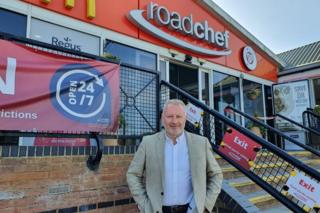
“It looked like a service station under construction it was so empty,” says Mark Fox, chief executive of Roadchef
The past few weeks have been a worrying and surreal experience for those involved at the services.
“At the start of lockdown, this site was painful to see,” says Mark Fox, chief executive of Roadchef, which runs Watford Gap. “It looked like a service station under construction it was so empty.
“Staff told us the worst part was the silence and lack of people. I’d never seen it so quiet.”
Image caption
Sally Gilling says working at the services is “massively different and so strange”
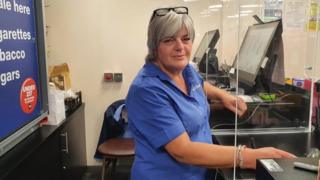
Grandmother Sally Gilling has been a staff member at Watford Gap’s WH Smith for the past 10 months.
“It’s massively different and so strange,” she said of her current working life. Most customers have been understanding, she said, although there has been some inconsiderateness.
“One man leant over me as I was restocking the shelves. I reminded him to keep a 2m distance and he said, ‘but I need to get a sandwich’.”
Image caption
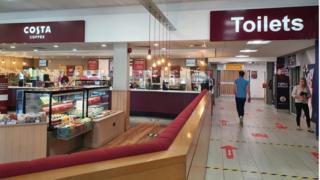
The Watford Gap Costa Coffee is one of the busiest on the nation’s road network
The Watford Gap Costa Coffee is one of the busiest on the nation’s road network.
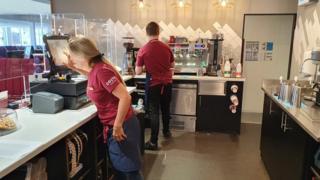
“We usually have six or seven people serving but now it’s just two or three,” said manager Tanis Johnson. “It’s extremely quiet.
“People are generally understanding and stick to the rules.
“It can be difficult to hear customers though, with the machines going and when they’re wearing masks.”
You might also be interested in:
The time people currently spend at the Watford Gap services has roughly halved since before lockdown – from about 25 minutes to between 10 and 12 minutes.
Image caption
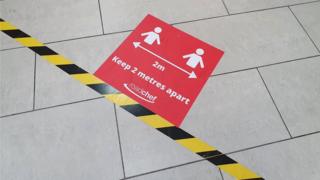
In the past six weeks Roadchef has spent £350,000 on signs, barriers, screens and outdoor furniture across its 30 sites nationally
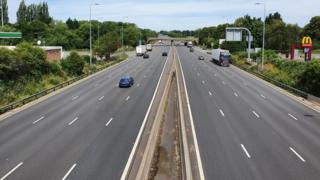
Roadchef boss Mr Fox said road traffic at the start of lockdown was down 93%. It has since increased and is 35% down on what might usually be expected.
Along with the dramatic reduction in visitors, and therefore spending, there have been areas of necessary extra expenditure.
In the past six weeks Roadchef has spent £350,000 on signs, barriers, screens and outdoor furniture across its 30 sites nationally.
Mr Fox has two main hopes – a “staycation” boom in July and August and a reduction in the social distancing rule from 2m (about 6ft) to 1m. The latter, he said “would significantly increase our ability to serve customers, like the rest of the hospitality industry”.
Image caption
Suzanne Iliniec giving her puppy Bella a convenience stop before continuing on their journey to Southampton
Of all those at Watford Gap, there was a visitor who had very little interest in any social distancing rules.
Her name is Bella, a four month-old rottweiler heading from Chesterfield to Southampton to live with her new family.
For Suzanne Iliniec, collecting Bella has marked her first car trip since lockdown began in March.
“It’s been OK,” she said. “I feel safe when I’m out and about.
“As long as you keep a two-metre distance, I don’t think there’s much to worry about. And hopefully the end is in sight and we’re over the worst.”
Find BBC News: East of England on Facebook, Instagram and Twitter. If you have a story suggestion email
A leaked video revealing how sales have plunged at Pret a Manger during the coronavirus crisis has raised fears about job cuts at the sandwich chain.
Boss Pano Christou told staff in a recent online meeting that an announcement about the “job situation” would be made on 8 July.
He said Pret’s global weekly takings had fallen to £3m, just 15% of what they would normally be.
A Pret spokeswoman said staff would be the “first to hear about any changes”.
Pret stores in the UK, the US and France have been hit hard by lockdowns as office workers stayed in their homes.
In May, Pret called in consultants to help renegotiate its rents as it attempted to avoid store closures, and said it was putting a “clear plan” in place to deal with reduced footfall.
That plan could involve job cuts.
In a recent video call to staff, which was leaked and shared on Twitter, Mr Christou discussed the “job situation”:
“What will be the case is, on 8 July, we’ll be doing a broader communication to the teams, just talking through the initial work that’s been done on this, so things will start to become clearer from 8 July,” he said.
A Pret spokeswoman said: “As we have already confirmed, at the end of May we appointed advisers to help Pret develop a comprehensive transformation plan to adapt to the new retail environment.”
“Transparency is very important in our business and we will make sure that Pret’s team members are the first to hear about any changes. We will update our team members in early July once the plan has been finalised.”
Image copyright Getty Images
Restaurants and food chains have been hit hard by coronavirus lockdown measures.
Last week bosses at restaurant and food chains including Wagamama and Pizza Hut warned Prime Minister Boris Johnson that the sector faces mass job cuts without more help.
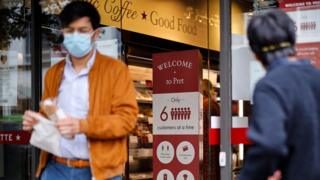
Although Pret has re-opened more than 300 stores in the UK, they are only offering takeaway or delivery services. The firm is trialling a click-and-collect service so customers can avoid queuing when demand returns.
The video call indicated that sales were substantially down compared with normal figures, although improving as lockdown restrictions lift.
‘Intense negotiations’
When asked what sales Pret needed to make for the company to stop losing money, he said: “I think globally we’ll need our sales to get to about 60% [of pre-crisis levels] to break even.”
“We’re trying to aim to the month of September to get to that 60% but clearly there is a lot of work going into that from the team, but at the same time we’re so dependent on footfall coming back into the cities to drive our sales up.”
Mr Christou said the chain’s US stores took close to $100,000 in sales in one week recently, a 98% drop from pre-crisis levels.
In the same video, Pret’s UK managing director, Clare Clough, said UK sales were down almost 90%. “We’re creeping up point by point, but we’re still sitting around -86% in the UK,” she said.
In the meeting, Ms Clough said the company is engaging in “quite intense negotiations” with more than 300 individual landlords to deal with property costs.
She encouraged staff to drive up sales, saying: “We want to make sure that we are the winners as people come back onto the High Street.”
Industry body UK Hospitality has urged the government to find a solution to the rental problems facing many businesses in the struggling hospitality sector.
The coronavirus pandemic has triggered changes in how we work, with many people now working from home.
But as companies redesign offices and prepare for some employees to return, firms are also being urged to make a different kind of change in how they operate.
Arianna Huffington, the author, businesswoman and founder of wellbeing consultancy Thrive Global, told the BBC what advice she has been giving companies during the coronavirus crisis.
She spoke to Sharanjit Leyl for a special edition of Talking Business Asia: Future of Work.
Image caption
Boris Johnson will announce his plans in Parliament on Tuesday
Boris Johnson is expected to announce on Tuesday if the hospitality sector can reopen on 4 July and if the 2m distancing rule in England can be relaxed.
Non-essential shops have reopened in England already, with retail resuming in Wales from today.
Health Secretary Matt Hancock earlier said England is “clearly on track” to further ease lockdown restrictions.
But No 10 warned the moves would be reversed if they led to a virus surge.
The PM will discuss England’s approach to the changes with the Covid-19 Strategy Committee on Monday.
Mr Johnson will give an update on the next stage of lockdown easing in Parliament on Tuesday. He is also expected to reveal the outcome of a review into the 2m social distancing rule.
Labour MPs have called for ministers to be transparent on the review’s findings.
On Sunday shadow health secretary Jon Ashworth said opposition support would depend on other mitigations being introduced on face-shielding, and testing and tracing.
Science ‘has evolved’
Security Minister James Brokenshire said the 2m rule review would be informed by scientific evidence but also “experience around the world as well”.
He told BBC Breakfast it was also important to recognise the importance of other factors on safety, such as whether people are indoors or outside, or whether they are wearing face coverings.
He added that the review would also take into account the latest understanding of how the virus is transmitted, which “has evolved over the last number of weeks”.
Mr Hancock has suggested that customers may have to register when entering pubs and bars so they can easily be traced if they come into contact with a coronavirus case.
Asked on Sunday about plans for registration and ordering drinks through smartphone apps, he said: “I wouldn’t rule it out. It isn’t a decision we’ve taken yet, but there are other countries in the world that take that approach.”
He added that he “very much hoped” the 2m rule can be lowered, with “mitigations” to cut the risk of transmission.
The government has come under pressure from the hospitality sector to lower the rule, with many saying it would be impossible to trade under the current restrictions.
Mr Johnson said the government was “sticking like glue” to the roadmap it announced for England in May.
In phase two, at the start of June, the plan allowed the opening of non-essential retail and the return of more pupils to school.
When the PM announced the roadmap, he said phase three would allow for some pubs, restaurants, cinemas and other hospitality venues to reopen at the start of July “at the earliest”.
Media playback is unsupported on your device
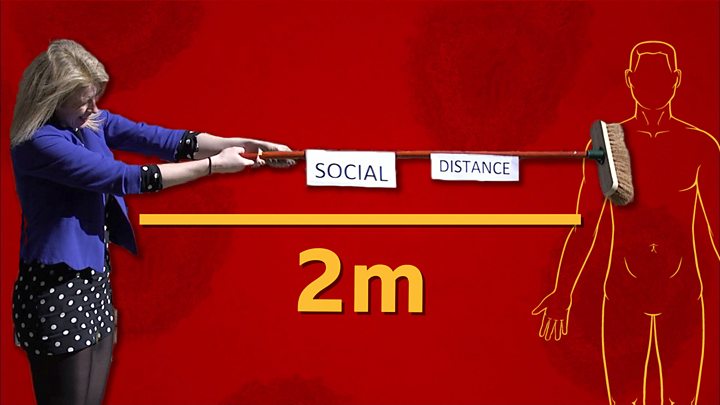
Media captionThe UK government is advising us to stay two metres apart – but what does that look like?
2m or not 2m?
Some Tory MPs and members of the hospitality sector have been appealing to the government to lower the 2m rule to 1m, as many venues say they would be unable to open otherwise.
The World Health Organization recommends a distance of at least 1m (just over 3ft), but the UK government’s scientific advisers say that distance carries up to 10 times the risk of being 2m apart.
The other nations of the UK are yet to announce any plans to change the 2m distance rule.
No 10 said “detailed guidance” would be published for each sector “so businesses that do open can be Covid-secure” as part of any announcement.
Media playback is unsupported on your device
Media captionBoris Johnson said the government was “sticking like glue” to its roadmap
In his speech on Tuesday, the PM is expected to warn the public they must continue to follow social distancing guidelines to “keep the coronavirus under control”.
He will also reiterate pledges to use the NHS Test and Trace system to detect and control local outbreaks through “targeted lockdowns”.
A No 10 spokesman said: “The reason we are able to move forward this week is because the vast majority of people have taken steps to contain the virus.
“The more we open up, the more important it is that everyone follows the social distancing rules.
“We will not hesitate to put the handbrake on to stop the virus running out of control.”
THE NEXT MUST-SEE DRAMA IN LOCKDOWN: The Salisbury Poisonings
ONLINE REHEARSALS: Tennant and Sheen continue rehearsals at home
How have you been affected by coronavirus? Share your experiences by emailing .
Please include a contact number if you are willing to speak to a BBC journalist. You can also contact us in the following ways: