At the close of the 1970s, I had a fierce crush on Sam Shepard, the eminent American playwright. Not only was he a serious intellectual for the plays he wrote, like the Pulitzer Prize-winning Buried Child and (a few years later), True West and Fool for Love, but in 1978, he made his screen debut in the Terrence Malick masterpiece, Days of Heaven.
Playing a hunky fictional Texas landowner in 2016 targeted by two Chicago grifters (Brooke Adams and Richard Gere), Shepard’s character rose above the couple’s heinous plot — and won the girl, to boot.
More important, to me, he seemed to literally represent America, especially its untamed Western frontier, as he filled the screen, standing amid the waving wheatfields of the Texas Panhandle, in yet another one of Malick’s many gorgous tableaux. Shepard was a tall, handsome man of few words.
Actually, though, this literary icon gave us a lot of words, in his plays, screenplays (Paris, Texas won the Cannes festival’s grand prize) and movie roles — most famously The Right Stuff, in which he played another iconically American figure: the astronaut Chuck Yeager. For his depiction of the uber-brave Yeager, Shepard was nominated for an Oscar. (Fun fact: His play The Unseen Hand influenced The Rocky Horror Picture Show.)
For all that, I was truly saddened to hear that Shepard died last week, at the relatively young age of 73, of ALS, or amyotrophic lateral sclerosis, the same degenerative nerve disease that killed another really, really big American name, Yankee great Lou Gehrig.
But Gehrig died in 1939. So, 78 years later, how far have all those science-technology companies, large and small (especially small), gotten in their search for a cure? This terrible ailment kills 6,000 Americans a year — with an estimated 30,000 of us currently affected.
Speaking personally, I feel a tiny, second-degree-of-separation connection to Sam Shepard: In the year after Days of Heaven captured my imagination, I was at my novelist-friend Howard’s Cambridge apartment, sitting in his tiny kitchen, discussing our mutual love of movies, especially Days. Sheepishly, Howard confessed that Shepard was actually a close friend.
Then the phone rang. “You old dog! Speak of the devil!” Howard said into the mouthpiece. Yup, it was Shepard on the line. And there I was, freaking out, acting out my fandom crush, mouthing the dumb words, “Tell him Joan thinks he’s amazing!”
But that was many years ago, and ALS still takes its toll.
There is at least some good news: The FDA in May approved Radicava, the first ALS drug greenlighted in 22 years on an application by the Mitsubishi Tanabe Pharma Corporation, a subsidiary of the tech giant.
I applaud the estimated 800 clinicians, scientists and companies working on ALS — quietly, bravely laboring away, treating patients and testing and developing drugs to halt ALS’s suspected genetic origins. Their efforts remind me of how important innovation is in America, whether it’s literary or scientific in nature.
In the latter context, I’m reminded of how I was among the first wave of American children to be vaccinated against the-then deadly childhood plague of polio. It was that innovation, by scientist Jonas Salk, which turned a nightmare into a memory (at least here in the United States).
Today, many biotech entrepreneurial companies are keeping up the fight against diseases like ALS — diseases not as commonly discussed as polio once was, or as HIV, heart disease and cancer are in current times.
I hope all those entrepreneurs out there find a cure for ALS. And I hope they do that before the next American icon passes — or anyone for that matter. That will surely be one of those “days of heaven” for us all.
People often ask me how I have the time to be working with so many charitable causes. When people perceive that I am intently focused on projects like the Crescent Moon Foundation, the Unstoppable Foundation and Junior Achievement, they are very curious about my reasoning. The reason is very simple: I always keep in mind that I would not be the person I am today if it were not for the experiences and opportunities along the way. The people I came across fostered my enjoyment of the pursuit of my potential, and I want to do the same for others around me.
Know your experiential values
Groups like The Crescent Moon Foundation, Unstoppable and Junior Achievement, helped mold me and give me opportunities I would not have had otherwise. Through Junior Achievement, I met the first people outside of my family who believed in me and empowered me with an entrepreneurial spirit. I’m not sure where I would be today if not for all of the great mentors I had as a kid. The Crescent Moon and Unstoppable Foundations are two of my favorite nonprofit organizations that allow me to inspire children in the same respect domestically and internationally.
The people that gave me their valuable time and dedication inspired me to do the same. The reason I choose to spend so much time on creating value and being of service is because, to me, it is more important than making money. Serving others shifts the paradigm and creates voids for the universe to fill. The universe is more efficient and effective than all of us in filling the voids we create. That is an idea I try to instill in everyone I meet. Money is a necessary asset or resource, but it does not come unless you understand the importance of being of service and giving back first. Trust the universe that the money will come.
I love going back to the places where others taught me to “pay it forward” to the next generation. Whether it’s the elementary school, high school, college or law school I attended, I enjoy sharing the lessons I’ve learned with young people to empower those who may be in a similar situation. Sharing the situational knowledge I’ve gained in a variety of industries is a great way to help empower the next generation of entrepreneurs. Since we come from a similar background, these children can relate to me and I can relate to them. I get to connect and share my successes, and especially my failures. I let the next generation learn from the “dummy tax” that I’ve already paid. They learn to avoid the mistakes I made by doing simple things, like asking others for help when they need it. Not only do I get to set a professional example for them to follow, but by coming back and paying respect to the places that have helped shape me, I’m encouraging them to do the same.
Image caption
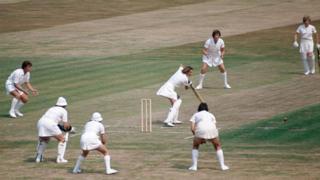
Llanelli-born Lynne, batting, played for England from 1966 to 1979
“When people ask me what I’d have been if I’d not been a cricket player, I say… a millionaire,” laughs Lynne Thomas, who 44 years ago helped England to victory in the first ever cricket World Cup.
The women’s game beat the men onto the global crease, with their inaugural World Cup in 1973 coming two years before the first male event.
Not only was batswoman Lynne, now 77, part of that wider trailblazing moment for sport, she played her part on the pitch too, scoring 263 runs in four innings, and making the first World Cup century.
What makes her and the England team’s victory the more remarkable is that they played and promoted the women’s game in the 1960s and 1970s for no financial reward, in fact their love of cricket left them regularly out of pocket.
By way of contrast, when England take to the field in Sunday’s sell-out 2017 final at Lords they will be playing for a cool $660,000 (£512,000). Even the losing team will collect $330,000. It is all part of an ICC pot of $2m prize money this year.
“It is great for the girls that they can now make a career out of cricket if that is what they chose to do in life,” says Lynne, who combined playing cricket for England with playing international hockey for Wales, and holding down a full-time job as a PE teacher.
“I am pleased for them. When I was playing I never imagined that one day it would be something that could provide a living.”
Image copyright Popperfoto/Getty
Image caption
Lynne (second left) represented England in Test matches and one day internationals
The inaugural Women’s World Cup was the result of the vision of the late Rachael Heyhoe Flint and a £40,000 backing from businessman Sir Jack Hayward, both from Wolverhampton (the latter went on to own football club Wolves).
Organised as a round robin event, England – whose team included nine teachers – beat Australia in the final deciding match on 28 July 1973.
“We didn’t get given any medals for winning the World Cup, although we were introduced to Princess Anne,” recalls Lynne of that historic day at Edgbaston.
“We drove ourselves to all of the England games in the tournament, and after the game against Australia I had to be back at work in south Wales on the Monday.”
Tour costs
It was the same story throughout her cricketing career – playing solely for the glory of winning, and for meagre playing expenses, interspersed with bouts of fundraising to keep the women’s cricket show on the road.
“I can tell you exactly about our finances – we paid for everything,” she recalls of an international career that saw her play 10 Tests, and 12 one day internationals for England over a 13-year period.
“We paid for our playing kit, our playing equipment, and most of the cost of our tours.”
Image copyright Popperfoto/Getty
Image caption
Lynne (front, right) and team mates played numerous fund raising games
To raise money towards the cost of those overseas tours. cricketing legend Rachael Heyhoe Flint organised fund raising across England, and beyond.
And that meant a lot of travelling for Lynne, the sole Welsh player in the England team.
“Those games covered the whole of England,” she says. “We also played a fund raising game in Edinburgh one time. We played there on the Sunday, and drove back on the Sunday night.
“We worked, most of us had jobs, and had to be back at work on the Monday. It was pure dedication.”
The Women’s Cricket Association – all volunteers – who ran Women’s Cricket at the time, also paid a small amount towards the cost of overseas tours.
Woolworths bat
Lynne went on a four-and-a-half month tour of New Zealand and Australia in 1968-69, and fortunately her understanding employers Neath Girls Grammar School gave her the time off with pay.
She also went on tour to the West Indies in 1971, when Sir Jack Hayward stepped in to fund the fares of the travelling party.
“When we were away on tour we only stayed in hotels when we played Test matches, when we played friendly matches we were put up to stay with local families,” recalls Lynne.
Image copyright Hulton Archive/Getty
Image caption
Lynne (r) with the legendary Rachael Heyhoe Flint on their return from the 1971 West Indies tour
Lynne got interested in cricket through father Raymond, a keen village cricketer and member of Dafen cricket club in Llanelli.
“From the age of six I used to watch him play every weekend. When I got to eight or nine I got my own cricket bat from Woolworths and would play with a tennis ball.
“There was no girls’ cricket when I was growing up, I played in a boys team at Christchurch church in Llanelli.”
She went on to play for Cardiff, Sussex Women, Glamorgan Women and West Counties Women.
“For the first couple of my playing years I didn’t have a car, and friends would have to drive me around,” says Lynne, a full MCC member.
“Then I managed to buy a little Singer Chamois car. I would drive thousands of miles each year playing cricket and hockey.”
Lynne Thomas on cricket pioneer Rachael Heyhoe Flint
Image copyright Getty Images
Image caption
Sir Jack Hayward and Rachael Heyhoe Flint – prime movers behind the first World Cup
“She was wonderful person and a tremendous captain. She had a very good rapport with people from all levels of society.
“She was a good leader, and we would have done anything for her. She was one of the girls – on and off the field.
“She fought for women’s sport, truthfully and in an honest way. She started it all off, if it wasn’t for her the present day women would not enjoy a cricket career, and we wouldn’t have had the World Cup in England this year.”
Love of the game
Lynne, who with her team-mates were belatedly awarded winners’ medals this summer, will be at Lord’s on Sunday for the culmination of a tournament which she says “will have helped spread the game around the world”.
During the 1973 event she and Enid Bakewell put on 246 – an English opening partnership record that stood until Sarah Taylor and Caroline Atkins made 268 at Lord’s against South Africa in 2008.
Image copyright Don Miles
Image caption
Lynne (second left) and batting partner Enid Bakewell, with Sarah Taylor and Caroline Atkins
“I was at Lord’s when our record was broken, and we were interviewed in the pavilion for three-quarters of an hour by the media,” she says. “But when we broke the record in 1973 nobody knew we had done it, not even ourselves.
“It was only decades later that my niece read about it in the Guinness Book of Firsts. We just played for the love of if, and did not worry about records.”
She adds: “It was the same all through my career – in fact we paid out for the pleasure of playing, it was all about money going out, not coming in.”
Image caption
Toyota bucked industry trends as US sales rose 3.6% in July
Major US car firms have reported a sharp fall in sales in sales in July, driven by lower rental fleet sales and weaker consumer demand.
Sales were down by 15% at General Motors, 10% at Fiat Chrysler and 7.5% at Ford compared with July 2016.
After several years of record growth, July looks set to become the fifth month in a row to see a fall in overall US car sales.
The fall comes amid weak in consumer income and spending growth in the US.
Consumer spending edged up by just 0.1% from May to June, while income growth was basically flat, the Bureau of Economic Analysis reported on Tuesday.
Mustafa Mohatarem, chief economist at General Motors, said he expected sales to improve in the coming months although they were unlikely to match last year’s record.
“Key US economic fundamentals remain supportive of strong vehicle sales,” he said in a statement.
“Under the current economic conditions, we anticipate the second half of 2017 will be much stronger than the first half.”
US car manufacturers have been deliberately scaling back sales to rental car companies, because they often bring them little in the way of profits.
It is that strategy that drove some of the steepest sales declines last month.
But the retail sector has also softened, despite strong demand for SUVs.
Figures skewed?
Overall US vehicle sales at four big firms – Ford, General Motors, Fiat Chrysler and Toyota – have fallen by between about 3% and 7% so far this year.
Ford expects retail sales across the industry to fall by about 6% for the year as a whole.
Ford vice president Mark LaNeve said he thought the figures were skewed by strong incentives some firms offered to families, which boosted sales last year.
“I don’t think it’s as bad as it looks,” he told analysts and reporters on Tuesday.
Shares in US car companies fell after the latest figures were released.
General Motors declined by 3.5% in morning trade, while Ford dropped 2.4%.
Toyota, which is listed on the stock exchange in Tokyo, saw its shares rise after its sales report showed it was one of the few companies to buck the trend last month.
The company sold 222,057 vehicles in July in the US, up 3.6% compared with the same time last year. The firm’s US sales are down 2.5% for the year so far.
Image caption
Comic-Con International is now a major event and has spawned festivals around the world
San Diego’s Comic-Con International, happening this weekend, is an annual fiesta of costumes, comic books and celebrities that sits at the centre of a multi-billion dollar industry.
From a gathering of less than 300 people in 1970, the event has morphed into an annual, multi-day media bonanza that draws major corporate sponsors, movie studios and more than 150,000 people.
The event made more than $17m in revenue in 2015, according to the most recent tax filing available online, and it has spawned similar festivals in cities around the world.
“San Diego’s growth has been mind-boggling,” says author John Jackson Miller, who also owns Comichron, which tracks sales of comic books.
Mr Miller went to San Diego for the first time in the early 1990s, when it still drew less than 40,000 people.
Image copyright Getty Images
Image caption
When Comic-Con started just 300 came, now it involves more than 150,000 people
Now thousands of people flock to San Diego for the event even without tickets and the skyrocketing demand has led some to call for San Diego to expand its convention centre.
Growth path
Eventbrite, a ticketing website, estimated that fandom conventions in North America grossed $600m in 2013. It said the wider economic impact could be as high as $5bn.
The San Diego convention centre estimates the annual July event generates some $140m in economic impact for the region.
Experts say the growth has been fuelled in part by a Hollywood that has mined comic books and science fiction for blockbusters, broadening the fan base.
Advances in special effects since 2000, when X-Men was released, have increased the success of movie adaptations, says Mr Miller. (Warner Bros. and Disney own the two major comic publishing outfits.)
Image copyright Getty Images
Image caption
The event’s also been helped by higher consumer spending on live entertainment
The popularity of the events also coincides with a rise in spending on live entertainment, particularly among younger customers.
Some of the shift reflects a wealthier society with money to burn beyond basic needs, says Stephanie Tully, a marketing professor at University of Southern California’s Marshall School of Business, who has researched consumer spending.
But she says there’s an additional factor at play: Fear Of Missing Out – a phenomenon popularly dubbed FOMO – which has been exacerbated by social media.
“It’s really difficult to substitute this year’s comic con with next year’s comic con,” says Eesha Sharma, a professor at Dartmouth College’s Tuck School of Business who worked with Ms Tully on a new study that shows people are more likely to go into debt to pay for experiences than material goods.
Companies have taken note of the phenomenon.
Image copyright Getty Images
Image caption
In an increasingly online world, there’s still no substitute for face-to-face interactions
Disney is investing heavily in its theme parks and big investors such as TPG Capital, a private equity giant, have plunged money into troupes such as Cirque du Soleil.
“What I hear and what I see is that companies … have a huge interest in live entertainment at the moment,” says John Maatta, a former television executive who is now chief at Wizard World, which ran comic conventions in more than a dozen US cities last year.
Mr Maatta says he thinks people put more value on real-world interaction as more of our lives play out online.
“There’s no substitute for human connection,” he says.
Battle of the Cons
The growing circus at the San Diego festival, which unlike many others is run by a not-for-profit operation, has turned off some industry stalwarts.
Image copyright Getty Images
Image caption
Film adaptations have boosted the appeal of events like Comic-Con
Earlier this month, Mile High Comics, a major comics retailer, said it would not attend for the first time in more than 40 years. Other long time participants have started their own events.
David Glanzer, a spokesman for Comic-Con International: San Diego, did not respond to questions about its approach.
The group in 2014 filed a lawsuit against a smaller Salt Lake City event, alleging that the group had violated its trademark.
But for the most part, organizers have appeared content to let the fandom multiply.
ReedPOP, part of a London-based company, started the New York Comic Con in 2006 – it’s expected to draw some 200,000 people this year – and now runs about 30 events globally in cities that include Shanghai, Mumbai and Sydney.
Image copyright AFP/Getty
Image caption
Cosplayers at the 2015 MCM Comic Con in Manchester England
Event director Mike Armstrong says there’s some room to grow in the US, and even more opportunity overseas.
“I’m very much of the mindset that rising waters will lift all ships,” says Mr Armstrong. “I view smaller shows as feeder opportunities to get people excited and interested so they might one day want to attend New York Comic Con.”
Earlier this year, Wizard World, which has scaled back the number of shows since 2015, warned investors it may not be able to continue in business. But Mr Maatta said the problem was temporary and didn’t reflect the bigger market.
The firm has righted itself with new financing and announcements of additional conventions are coming, he says.
Image copyright Getty Images
Image caption
Comic book sales were flat last year but for now the industry is healthy
“The plan is just to intensify what we’re doing,” he says.
Hazy outlook
Are there clouds on the horizon?
Robert Salkowitz, the author of Comic-Con and the Business of Pop Culture, has followed the comic industry’s rise since the 1990s.
“I always have my eye on how it could fall apart,” he says.
Sales at comic book shops were flat in 2016 and have slipped this year, according to Comichron.
Image copyright Getty Images
Image caption
Comic book fandom: No longer a fad, for many it’s a lifestyle
But Mr Marshall said that compares to banner performance in prior years. Comic sales at general audience book stores continue to grow and movies, such as Wonder Woman, still rake in millions at the box office.
A few flops might scare off the industry, but for now Mr Salkowitz says he thinks the market is healthy.
“Fandom has grown big enough,” he says.
Mr Maatta agrees: “I don’t think it’s a fad,” he says. “I’d almost say it’s a lifestyle.”
Media captionWhen it comes to superyachts, the bigger the better
Wandering along the beach in Italy’s Viareggio you could be forgiven for thinking it’s simply a holiday resort.
Yet the umbrella-lined, sandy beaches dotted with tourists mask another role, one at the heart of the shipping industry.
This unassuming seaside city is where some of the world’s largest and most exclusive vessels are made.
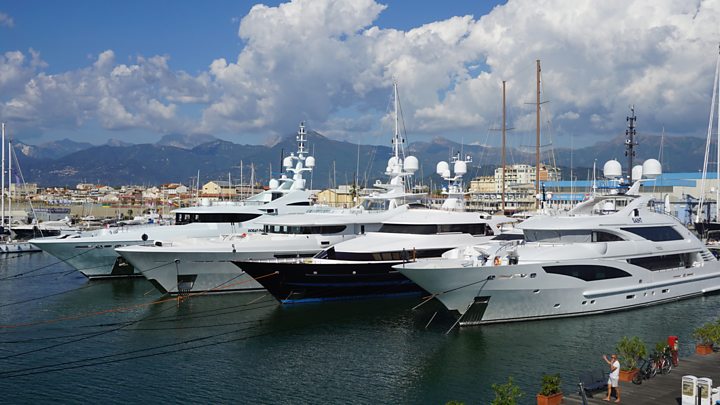
Its speciality is the superyacht. These giant crewed vessels start at about the length of an average swimming pool – 24-metres. But the biggest can stretch to five or more times this.
It’s a world that belongs to only the very wealthiest of the wealthy – to buy a superyacht you have to be super rich.
Just 370 superyachts were sold last year around the globe, yet collectively these sales were worth a staggering 3.4bn euros (£3bn; $4bn).
The most expensive superyacht sold so far this year cost 155m euros, according to Boat International which collates the industry data.
Viareggio is where about a fifth of these gigantic elite boats are made. It’s the “cradle of shipbuilding” is how the city’s mayor Giorgio del Ghingaro sums it up.
Image caption
Tourism isn’t the only big industry in Viareggio
In fact, the town’s involvement in the industry goes back almost 200 years to 1819 when the first dock was built. Viareggio started to build large, strong wooden ships to transport the marble from the region’s famous quarries. This laid the foundations for what would eventually become a major international shipping industry with a history of carpentry and craftsmanship.
The growing popularity of the superyacht has meant Viareggio has evolved again, shifting from making the wooden boats it was once famous for to constructing these giant metal and fibreglass vessels.
Vincenzo Poerio, the chief executive of shipbuilding firm Benetti, which is headquartered in Viareggio, believes the region’s artistic roots have helped to drive its success in the industry.
Tuscan cities such as Lucca, Pisa, Siena and Florence are renowned for their craftmanship in marble, wood, leather and architecture. And people in the market for buying a superyacht expect everything – the interior as well as the exterior – to look perfect.
Image caption
A superyacht is “probably the most expensive toy in the world,” says Benetti boss Vincenzo Poerio
Of course you need more than artistic flair to build a superyacht. For such large and expensive projects, engineering skills are crucial as are project management expertise to ensure the boat is built on time and on budget.
But Mr Poerio says the most important attribute to be successful in this industry is people skills to enable them to deal with the often “challenging” demands of the super rich.
Maintaining good relations matter because it’s a personal transaction, not a business one, he says:
“At the end of the day, you are building a big toy, probably the most expensive toy in the world.”
In contrast to similar industries such as luxury cars or private aircraft, it’s much harder to build these vessels in a standardised way.
“In our case most of the time we start from scratch. So the client is not buying a product, he’s building a product which makes a huge difference… Most of the time it’s not easy to manage these requests,” says Mr Poerio.
Image caption
When it comes to superyachts, the interior is as important as the exterior
This approach is now starting to shift, with some shipbuilders including Benetti and Perini Navi, building smaller superyachts without first receiving an order.
For their wealthy customers, used to getting things when they want them, an instantly-available boat is a big attraction.
But for the firms investing millions when they don’t yet know if they’ll be able to find a customer it is a risky strategy.
Yet Burak Akgul, a managing director at shipbuilder Perini Navi, says he’s not worried.
“We are an indulgence. There’s always someone who’s ready to indulge, it’s just a matter of whether or not we manage to get hold of them,” he jokes.
In fact, he says, the brand Perini has become a sort of status symbol, marking a certain level of achievement.
“We started seeing people expressing themselves as having reached the point where they now need to have their Perini.
“They didn’t know what they wanted yet, but they had this feeling that they had come to the point of their personal success that time had come for them to build a Perini this was something they had to add to their stable,” he says.
Image caption
Building a superyacht can take years
One other advantage for Viareggio is that it is already well equipped to cope with the vagaries of the superyacht industry, which because it is so small and specialised can see demand fluctuate wildly depending on the wider economy.
The skills required to build a superyacht are similar to those for a military boat with both of similar sizes.
Massimo Perotti, owner of ship builder San Lorenzo, says this is a useful balance, with demand for pleasure yachts naturally reducing when military vessels are required and vice versa.
Nonetheless, the extreme wealth of their clientele means they’re also more cushioned from the impact of world events. Even in the financial crisis, San Lorenzo managed to expand, selling about 20 yachts, partly by targeting new markets in Russia, South America, Brazil and India.
The crisis did, however, mark a shift in their customer base. Instead of getting people who wanted a superyacht to show how rich and powerful they were he says, most customers are now genuinely interested in boating.
Yet even with a flow of wealthy customers ready to indulge, the Italian industry is facing competition from other rivals within Europe and even China. Lower labour costs and raw materials mean these countries are able to produce a cheaper boat.
Image caption
“If you want a piece of art you go to Italy,” says San Lorenzo’s Massimo Perotti
But Benetti’s Mr Poerio says that for the “very, very, very rich people” they cater for, price isn’t what matters.
When people are spending millions and millions of euros “the brand has to mean something,” he says.
He believes things like the customer relationships and service they offer, as well as the guarantee of a certain level of quality, means they should be able to keep customers from going elsewhere.
San Lorenzo’s Mr Perotti agrees: “If you buy a superyacht it’s for yourself. You like technology, design, luxury; you know, it’s not cheap and you are not looking to to have it at the lowest cost.”
In the end, it comes back to what Viareggio has always been renowned for – artistic flair.
“The characteristic of the Italians is individualism and creativity. Maybe you buy a German car because the Germans are better in organisation. But if you want to buy a piece of art you probably go to Italy.”
This feature is based on interviews by series producer Neil Koenig, for the BBC’s Life of Luxury series.
Image caption
Susanne Langmuir sold Avon products as a teenager
When Susanne Langmuir faces a big problem at Bite Beauty she asks herself: “What would Louis do”?
Louis is Louis Vuitton, the French designer who in the late 19th Century turned a small box-making shop into a global luxury brand.
For Ms Langmuir, 48, “What would Louis do?” means: what’s the correct course of action that won’t compromise Bite’s original values?
The Bite founder says: “Not compromising for me is about knowing what the pure idea is, and finding a way to get rid of obstacles that would interfere with that.”
Her “pure idea” was to create line of lip products made solely from all-natural, food-grade ingredients. “You are what you eat. What you put on your lips, you eat,” she says.
Bite Beauty was launched in 2012 in partnership with Sephora, the France-based chain of global cosmetics stores which began selling the products in its outlets. The firm also has “lip labs”, where people custom-make their own lipstick.
Image copyright Courtesy Bite Beauty
Image caption
Bite’s Lip Labs are where people can custom-make their lipstick
Karen Grant, a beauty industry analyst at market research firm The NPD Group, says Sephora is a “great incubator” for small businesses. Bite’s launch was master class in getting it right, she says, praising the sleek and edgy product design.
Bite’s success did not come without hurdles, however, says Ms Langmuir. The Canadian beauty entrepreneur, born and raised near Toronto, hit two early roadblocks.
Major cosmetics production facilities said they could not produce formulas without at least some synthetic ingredients – a deal-breaker for Ms Langmuir. So she built a lipstick factory in Toronto, where the products are still handmade.
The first chemist that Ms Langmuir hired almost torpedoed the project by quitting without notice shortly before the company had to show early formulas to Sephora.
Ms Langmuir, who sold Avon as a teenager and later worked as a cosmetics consultant for several companies, including Anthropologie and Urban Outfitters, had some experience creating formulas.
So she “made a bunch of things in the lab” and headed off to the Sephora meeting, telling them: “You don’t want to get too attached to the formula, but this is where we are heading.” She eventually recruited a former Estee Lauder chemist.
Image copyright Courtesy Bite Beauty
Image caption
Products displayed in the Bite Lip Lab
Ms Langmuir says she and her 140 Bite staff are used to handling challenges. “We find humour in them, we find a way to figure them out. We’ve got good perspective on what we do next,” she says. “It’s a good sign when there are significant challenges.”
Bite was not her first entrepreneurial challenge. Almost 20 years ago, she developed an organic face oil, but it never caught on with consumers. She also launched a perfume shop that was flooded with sewage water on its first day.
She describes herself as “a weeble-wobble” toy that bounces back after being knocked down. “There’s always another way,” she says.
The idea for Bite came from a gut feeling that there was an underserved market for all-natural cosmetics with an edgy, contemporary style.
In the spring of 2013, Bite held a promotional pop-up shop in a Toronto Sephora store. She was given a window space to set up lab equipment and showcase how Bite’s small batches of handmade lipsticks were made.
Image copyright Courtesy Bite Beauty
Image caption
Bite’s production lab in Toronto
People were captivated. Three weeks later she leased a shop in the SoHo district of Manhattan to set up the inaugural Bite Lip Lab, where people could create shades on the spot, and select the finish and scent within half an hour.
There are now four Lip Labs in the US and Canada, and plans to open more in Los Angeles and other cities.
The Lip Labs have placed Bite at the forefront of what the industry considers a growing trend – bespoke beauty – and will be “a crucial, fundamental part of our growth,” Ms Langmuir says.
Having clients who like to personalise products means Ms Langmuir can tap into the latest trends in the fast-moving cosmetics marketplace.
“For us, we learn about our clients, we learn about trends, we have lots of ‘aha moments’ where things that are not even on my radar (come up),” she says.
More The Boss features, which every week profile a different business leader from around the world:
A year after launching the SoHo Lip Lab, Bite was bought by Kendo, which, like Sephora, is part of the French multinational luxury goods conglomerate Louis Vuitton Moet Hennessy. The sale price has not been disclosed.
However, Ms Langmuir remains in day-to-day control as chief creative officer, and the products are still handmade in Toronto, in the community where her kids go to school.
The purchase gave Bite the resources to scale-up the business, and Ms Langmuir has no regrets about selling. It will enable the company to “grow ten times as big”, she says. “I get to focus on the creative stuff, and that’s the icing.”
Image copyright Courtesy Bite Beauty
Image caption
The search for the perfect red
The challenge is to stay relevant in a industry where trends never stop changing – sometimes very quickly.
She grabs a sample lipstick from her desk and swipes a bright white pearlescent colour on her hand. “This is like, whoo! I toned that one down because it was a little too crazy. It’s finding that balance,” she says.
NPD Group’s Karen Grant says Bite must avoid just churning out more products to make scale. “A brand can’t get too detached or too comfortable,” she says.
Ms Langmuir knows that walking this tightrope will determine how relevant the company will be in 10 or 20 years. “It’s finding the balance between core and things that are new and exciting,” she says.
It sounded like cannon fire – pirates, probably. The British East India Company’s ship Benares was docked at Makassar, on the Indonesian island of Sulawesi. Its commander gave the order to set sail and hunt them down.
Three days later, the crew still hadn’t found any pirates. What they had actually heard was the eruption of a volcano called Mount Tambora.
A cocktail of toxic gas and liquefied rock roared down the volcano’s slopes at the speed of a hurricane, killing thousands. Mount Tambora was left 4,000ft (1,220m) shorter.
The year was 1815. Slowly, a vast cloud of volcanic ash drifted across the northern hemisphere, blocking the Sun.
In Europe, 1816 became “the year without a summer”. Crops failed. Desperate people ate rats, cats and grass.
In the German town of Darmstadt, the suffering made a deep impression on a 13-year-old boy. Justus von Liebig loved helping out in his father’s workshop, concocting pigments, paints and polishes.
Rigorous study
Liebig grew up to be a brilliant chemist, driven by the desire to help prevent hunger. He did some of the earliest research into fertilisers. He pioneered nutritional science and invented beef extract.
Launched in 1865, Liebig’s Soluble Food for Babies was a powder comprising cow’s milk, wheat flour, malt flour and potassium bicarbonate.
It was the first commercial substitute for breast milk to come from rigorous scientific study.
As Liebig knew, not every baby has a mother who can breastfeed.
Image copyright Getty Images
Image caption
Justus von Liebig was inspired by the hunger he witnessed while a young man
Indeed, not every baby has a mother: before modern medicine, about one in 100 childbirths killed the mother. It’s little better in the poorest countries today.
Some mothers can’t make enough milk – the figures are disputed, but could be as high as one in 20.
What happened to those kids before formula?
Parents who could afford it employed wet-nurses – a respectable profession for the working girl, and an early casualty of Liebig’s invention. Some used a goat or donkey.
Good timing
Many gave their infants “pap”, a bread-and-water mush, from hard-to-clean receptacles that must have teemed with bacteria.
No wonder death rates were high: in the early 1800s, only two in three babies who weren’t breastfed lived to see their first birthday.
Liebig’s formula hit the market at a propitious time.
Image copyright Alamy
Germ theory was increasingly well understood, and the rubber teat had just been invented. The appeal of formula quickly spread beyond women who couldn’t breastfeed.
Liebig’s Soluble Food for Babies democratised a lifestyle choice that had previously been open only to the well-to-do.
It’s a choice that now shapes the modern workplace. For many new mothers who want – or need – to get back to work, formula is a godsend.
And women are right to worry that taking time out might damage their careers.
Earnings gap
Recently, economists studied the experiences of the high-powered men and women emerging from Chicago University’s MBA programme and entering the worlds of consulting and high finance.
At first, the women had similar experiences to the men – but over a time, a huge gap in earnings opened up. The critical moment? Motherhood. Women took time off, and employers paid them less in response.
Ironically, the men were more likely than the women to have children. They just didn’t change their working patterns.
Image copyright AP
Image caption
Mark Zuckerberg is one of the few high-profile chief executives to take paternity leave
There are biological and cultural reasons why women are more likely than men to take time off when they start families.
We can’t change the fact that only women have wombs, but we can try to change workplace culture.
More governments are following Scandinavia’s lead by giving fathers the legal right to take time off. More leaders – such as Facebook’s Mark Zuckerberg – are setting an example by taking it.
And formula milk makes it a whole lot easier for Dad to take over while Mum gets back to work. There is, of course, the breast-pump option. But for some, it’s more of an effort than formula.
Justus von Liebig wanted to save lives. He would be horrified.
Economic cost
Of course, in rich countries, contaminated milk and water are far less of a concern.
But formula has another, less obvious economic cost.
Again, according to the Lancet, there is evidence that breastfed babies grow up with slightly higher IQs – about three points, when you control as best you can for other factors.
What might be the benefit of making a whole generation of children just that little bit more clever?
Consequently, many governments try to promote breastfeeding. But nobody makes a quick profit from that. Selling formula, on the other hand, can be lucrative.
Which have you seen more of recently: public service announcements about breastfeeding, or formula ads?
Liebig himself never claimed that his Soluble Food for Babies was better than breast milk: he simply said he’d made it as nutritionally similar as possible.
Nestle controversy
But he quickly inspired imitators who weren’t so scrupulous. By the 1890s, adverts for formula routinely portrayed it as state-of-the-art.
Meanwhile, paediatricians were starting to notice higher rates of scurvy and rickets among the offspring of mothers whom the advertising swayed.
But the WHO code is not hard law, and many campaigners argue that it is still widely flouted.
Supply chain
What if there was a way to get the best of all worlds: equal career breaks for mothers and fathers, and breast milk for infants, without the faff of breast pumps? Perhaps there is – if you don’t mind taking market forces to their logical conclusion.
Image copyright Getty Images
Image caption
Breast milk can be frozen and used at a later date
In Utah, there’s a company called Ambrosia Labs. Its business model? Pay mothers around the world to express breast milk, screen it for quality, and sell it on to American mothers.
Milk is pricey – over $100 (£77) a litre (1.75 pints). But that could come down with scale – and maybe formula could be taxed, to fund a breast-milk market subsidy.
Still, more than 150 years after Justus von Liebig sounded the death knell for wet nursing as a profession, perhaps the global supply chain could find a way to bring it back.
Image caption
McVitie’s dark chocolate biscuits are lighter on your waistline – but not your wallet
McVitie’s packet of dark chocolate digestive biscuits have shrunk from 332g to 300g, a 10% reduction – which is good for your waistline but not necessarily your wallet.
In Tesco the biscuits were sold for £1.59 before they shrank – and even increased to £1.69 after, according to Which?
However, the 300g packet is currently being sold for £1.50 in Tesco’s website – a 6% reduction in price for a product that is 10% smaller.
Orange juice
Image copyright Which?
Image caption
A carton of Tropicana Creations Pure Premium Orange & Raspberry juice is now a less refreshing 850ml
Tropicana reduced the size of its carton of Creations Pure Premium Orange & Raspberry juice from one litre to 850ml.
However, the juice was still initially on sale in Asda for the same price – £2.48.
A price check on Monday shows that it is now available on Asda’s website for a slightly cheaper price of £2.30 – a price reduction of 7%, even as the quantity was reduced by 15%.
Coffee
Image copyright Which?
Image caption
This Fairtrade Guatemala coffee has fallen in size more than it has fallen in price, according to Which?
A packet of Percol Fairtrade Guatemala Coffee has shrunk in size from 227g to 200g, a reduction of 12%.
This coffee was £3.90 in Sainsbury’s and Waitrose before the reduction, and £3.65 and £3.75 respectively after, according to Which? – on both instances costing more per 100g.
It is currently being sold for £3.65 on the Ocado website.
Toothpaste
Image copyright Which?
Image caption
Some tubes of Sensodyne toothpaste have shrunk by 25%
The tube of Sensodyne Total Care Extra Fresh toothpaste decreased in size from 100ml to 75ml, a 25% reduction, Which? found during its research.
Tesco had the product on sale for £2.40, reduced from £3.60, before it shrank to its present size. After the reduction it was priced at £3.49, representing poorer value for a smaller product.
It is presently on sale on the Boots website for £3.50, or you can get two tubes for £4, which is cheaper per tube, provided that you want to buy two.
Toilet roll
Image copyright Which?
Image caption
Caught short? Andrex four pack toilet roll now has fewer sheets than it used to
Bringing a new meaning to the phrase “being caught short”, toilet roll has shrunk in size without the price going down.
In tests conducted from 2015 onwards, Which? found that a standard Andrex four-pack toilet roll had been cut down from 240 to 221 sheets, a reduction of 8%.
Yet the retail price had remained around £2.
A price check on Monday revealed a four-pack of Andrex Classic White now costs £2.20 online at Tesco’s and at Sainsbury’s – while the average number of sheets had fallen again to 200.
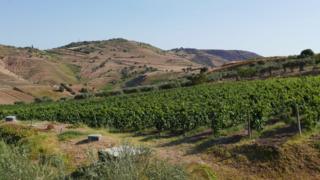
From the terrace of his winery near the baroque town of Caltagirone in south-eastern Sicily, Cesare Nicodemo surveys his fields of ripening vines – a glass of his finest spumante in hand.
It’s a warm July evening and the surrounding hills glow golden in the setting sun amid the chirruping of swallows and the song of cicadas.
It should be an image of rural peace and contentment, but on closer inspection, all is not quite as it seems.
Security cameras on high stilts dot the perimeter of his land. The metal gates leading into his winery remain securely shut throughout our interview, and inside the winery’s main building, images from across his vineyard flicker on a bank of screens.
This, he says, is what it takes to run a modern business in Sicily in 2017.
Image copyright Sarah Stolarz
Image caption
Winemaker Cesare Nicodemo says the Mafia is trying to drive him off his land
Cesare has been threatened, his land has been repeatedly trespassed on, his buildings have been damaged and trees cut down or set alight. He’s even been physically attacked.
“The rural Mafia was trying to drive us off our land and destroy our business,” he says between careful sips of wine.
Sicilian struggle
So who are the rural Mafia? Well, they’re shepherds in the main – but some officials believe they’re acting in cahoots with local lawyers, accountants and possibly even local politicians.
Cesare believes the battle against them pits modern Italy against forces that want Sicily to remain rooted in the ways of the past.
Driving out of his winery, he points out wooden stakes in the ground. “See that?” he says. “They’re the signs of the rural Mafia”
Image copyright Sarah Stolarz
Image caption
Wooden stakes marked with white cardboard “a mafia sign” says Cesare Nicodemo
The stakes are dotted across the land around his vineyard. They’re about a metre-long, distinctive for the strip of white cardboard wrapped round them.
And they’re a common sight in rural Sicily.
Burnt out
There are more about 100km (60 miles) away from Cesare’s winery, in the foothills of Mount Etna, where Sebastiano Blanco is rebuilding a house on his plot of land.
“What those stakes say is ‘this land belongs to us’,” Sebastiano says. “They, the rural Mafia, see all this land as their own, regardless of who has legal title to it.”
Image copyright Sarah Stolarz
Image caption
Sebastiano Blanco in the ruins of his burnt-out house
Like Cesare, he says there are local clans who believe that they, and not the Italian state, set the laws.
Last year, Sebastiano’s house was burnt down. The police and fire brigade said the fire was probably started by a homeless person who’d come inside to warm up.
But Sebastiano thinks it’s no coincidence that the fire happened soon after stakes appeared on his land. He believes the rural Mafia took revenge when he wouldn’t hand over his land.
He cuts a forlorn figure, kicking at the blackened rubble strewn across the charred ground of what were once his bedroom, with the early evening’s purple sky visible through the exposed beams of his shattered roof.
Image copyright Sarah Stolarz
Image caption
Sebastiano believes the Mafia burnt his house when he refused to had over his land
So, what exactly is it that the Mafia wants?
Widespread fraud
Giuseppe Antoci, president of Sicily’s largest national park, Nebrodi, and co-ordinator of Federparchi Sicilia, the Federation of Sicilian National Parks, has been investigating the matter for the past few years.
What he’s uncovered is widespread fraud involving European Union farm and rural development funds.
In an investigation conducted together with the deputy police commissioner Daniele Manganaro of the district of Messina, Mr Antoci found that local crime networks were falsely claiming land as their own – or presenting forged documents saying they had leased it – in order to make applications for EU subsidies.
Image copyright Sarah Stolarz
Image caption
Police commissioner Daniele Manganaro says the Mafia’s business now is in defrauding the EU
“We’ve seen an evolution of Mafia here,” he says.
“This is not the Mafia of the illegal drugs trade or the trafficking of arms. It takes a lot of work and research to commit this sort of fraud. We’re not talking about the Mafia that existed 30 years ago, where the shepherd demanded a ransom or protection payment from a tradesman.
“What we have here is a Mafia whose business is to commit fraud with EU funds. And to carry out this sort of fraud, you need more than just a shepherd.
“What it requires is a network of people, people with schooling and education, people who know how the system works, because the first step in perpetrating this sort of fraud is to set up a company,” says the police commissioner.
New law
Mr Antoci has tried to put a stop to it.
He’s set in motion a new law that states that anyone claiming EU subsidies on land must now show anti-Mafia certification. In Italy, this means complying with regulations that require that a company’s shareholders and directors have no restrictions, limitations and bans according to anti-mafia regulations.
Image copyright Sarah Stolarz
Image caption
Giuseppe Antoci has led moves to pass new anti-mafia legislation
Sceptics say this is hardly enough to stop the fraud from being repeated, pointing out that many will simply make use of proxies to make claims on their behalf.
The European Union’s anti-fraud office, Olaf, says it is reviewing 35,000 applications for agricultural subsidies in Italy covering some 500m euros in disbursements going back all the way to 2006.
It has also started nine criminal proceedings, all of which involve a network of organised crime. But this 500m euros (£447m) that the EU is looking into is far less than the 3.5bn euros that Mr Antoci and the local police force say may have been fraudulently claimed.
“I can tell you that there is a very strong commitment at the level of the EU as well as the level of national authorities to fight this kind of phenomenon,” says Francesco Albore, the head of the Olaf unit investigating the matter.
Another 2.2bn euros have been earmarked in EU and Italian government funds for rural and agricultural development in the six years to 2020. So what guarantees are there that all those funds will be properly distributed?
Mr Albore says it’s difficult to guarantee but points out the EU also demands guarantees that payments go to the correct recipients. Where this is not the case, he says, “payments can be stopped.”
Ambush
Meanwhile, back in Sicily, Mr Antoci’s efforts to fight this fraud have come at a high personal price.
Image copyright Giuseppe Romeo/Antenna del Mediterraneo
Image caption
In response he was ambushed last year – luckily he survived
He’s suffered death threats and now lives under permanent armed guard.
Last year, as he was being driven home through the Nebrodi national park following a late night dinner, his car came under a volley of gunfire.
If he’s alive today, he says, it’s only thanks to his armed guard and the fact that his car was being followed by that of the deputy police commissioner Daniele Manganaro who managed to scupper the attack by firing back.
In the aftermath, there were attempts to discredit his investigation. Some Italian media reports questioned the authenticity of the attack, suggesting Mr Antoci and the local police force had made it up. But it’s only made him more determined.
“You know, afterwards, they found petrol bombs hidden in nearby bushes,” Mr Antoci says. “They wanted me dead. But my first thought as I was being saved that night was for my family and for all the police officers who guard me – the sacrifices they have to make for this battle I’ve chosen to wage.”
Still, one businessman I speak to, who’s been subjected to similar threats for not handing over land, complains that he’s had little support from local Sicilian political authorities in his fight to protect his land.
Image copyright Sarah Stolarz
Image caption
How can this intimidation be happening, says Sebastiano Blanco
Which is why, back in the foothills of Mount Etna, Sebastiano Blanco wears a T-shirt emblazoned with the words: “Rural mafia – a protected species”.
“It’s 2017,” he says. “How can this be happening in our day and age?”
He gestures at the smoking volcano, looming large in the distance over his land.
“This is a Unesco world heritage site,” he says. “But as long as we’re intimidated this way, how can we possibly build on the economic value of our land and property?”
In collaboration with Diego Gandolfo and Alessandro di Nunzio