The marketplace is a volatile place. Like a field built on a fault line, it can crack at any moment. Sometimes, that results in economic anxiety, but at others, the cracks can reveal some stupendously profitable new market.
All we can do is study the trends and dive in when we find one. But, it doesn’t just stop at finding the market — that’s just the first step. The hard part is figuring how to enter that market and dominate your competition.
How do we do this effectively? I consulted some industry leaders, experienced entrepreneurs and investors who know what it takes to develop a plan from scratch, enter a new market and take it over.
1. Have deep-rooted knowledge of your target audience.
Business follows people. The deeper your understanding of the people in your emerging market, the easier it becomes to serve them the right product.
For Boris Mordkovich, the founder of Evelo, an electric bike company, says, “Success in entering new markets and taking over comes when you spend heavily in getting to know your product’s target audience, and aggressively serving them your products based on the customer information you have on them.”
From Mordkovich’s perspective, startups can’t survive for long in new markets with aggressive competitors if they don’t have an edge over the competitors in customer information.
“Not everyone is your target customer,” he added. Previously, we were heavily targeting the 20s and 30s for our electric bikes. But fortunately, due to our heavy investment in knowing our target audience and how to serve them, we accidentally discovered that our main customers were on the older side: 50 or 60, baby boomers, recent retirees, and that singlehandedly helped us build on the market.”
Creating your entry point strategy is where the magic happens. You need a concrete plan for your launch into a new market — a unique entry into a niche sometimes spells doom to the company that doesn’t strategize well.
For Jack Vogt, CEO atCredit Zipper, says, “If we don’t have a concrete and astounding entry strategy into the new market, my team and I will put a hold on the launch. Your entry will become your culture. It’s the way you enter that spells how your audience will see and perceive you. And this is hard to change. Any mistake from your brand during that fragile brand build-up stage can thwart your business progress in that new market.”
It’s a waste of resources to delve into a market you don’t have an entry point strategy for. A thorough business analysis will constrain your decisions and make you plan your entry point strategy better.
3. Make partnerships a solid strategy.
Don’t try to do it all yourself. If you have a weakness or need help, meet another brand with strength in that area and partner with them for a mutually benefiting business.
Rebecca Montrenes, CEO of Lanyards USA, says, “Partnerships are pretty awesome. We regularly partner with brands in new territories to reach far more than our capacity can reach as a company. Partnerships help us get deeper market penetrations which end up with the two companies making a profit as a result.”
“We take over new markets by making sure we stretch ourselves to beat everyone in that market on products coverage or services coverage,” says James Bradly of Dealslands. “I have found out that when a company becomes that big, they automatically become the face of the new market. And this position helps your brand pick up the signals of new markets and new trends within the main market before others discover them. That way, your brand is always investing before others and buying out promising competitors before they even become real traits.”
Own the niche through sheer size. Even if this is the costliest of all the strategies mentioned, it works profoundly on new markets.
Image copyright Peterson Institute for Internatinal Economics
Image caption
Adam Posen, president of the Peterson Institute for International Economics and former MPC member
A former member of the Monetary Policy Committee, Adam Posen, has predicted that the Bank of England will not change interest rates today.
The MPC will publish its regular decision on borrowing costs at midday.
Mr Posen, interviewed on the Today programme on Radio 4, said rates may not rise until next year.
“I think they are not going to vote for a rate hike at this time and probably not until at least November and maybe not even until 2018”, he said.
The Bank last changed interest rates in August last year when it cut its bank rate from 0.5% to 0.25% in the immediate aftermath of the UK’s referendum vote to leave the European Union.
Image copyright AFP
Mr Posen was asked why the Bank should not raise rates now, given the worrying rise in consumer borrowing and the past year’s rise in inflation to 2.6%.
He said the Bank’s role was to judge where inflation might be in two to three years time – and he said that the Bank’s current forecast was “too high”.
“It is pretty clear the economy is slowing… it’s a credit-fuelled expansion and so it’s likely to come to an end soon,” Mr Posen said.
“There’s no good reason for the pound to appreciate further right now, particularly against the euro,” he added.
He also disagreed with the widespread view that that the Bank’s policy of low interest rates had stoked up excessive consumer borrowing and that this problem should be dealt with by raising rates.
“The big lesson of the financial crisis is that the one interest rate the central bank controls doesn’t have that much implication for the whole range of financial products and borrowings that exist in a modern economy,” he said.
“We were unable to stop [the crisis] solely by moving down the interest rate and we’ve been unable to reflate the economy just by moving the bank’s interest rate also,” he added.
Instead, he argued, the Bank’s Financial Policy Committee (FPC) should use its powers to limit the lending of commercial banks where it thought this had got out of hand.
Yes or no?
In recent months members of the MPC, including the Bank Governor Mark Carney, have differed publicly over whether or not rates should rise soon.
For instance, in June Mr Carney said the time was not right for a rate rise.
The next day the Bank’s chief economist, Andy Haldane, said he favoured increasing the cost of borrowing later this year.
Then a week later the Bank’s deputy governor, Sir Jon Cunliffe, publicly suggested that now was not in fact the right time for such a move.
That flurry of debate reflected the unusually divided vote at the last MPC meeting in June, when its eight members voted by only 5-3 to keep rates at their current level.
Mr Posen, who was an MPC member from 2009 to 2012, said there was nothing wrong with close votes as it indicated that active debate was taking place within the committee.
And he said there was “no mistaking the fact” that following Brexit, the UK economy would suffer a shock and that in two years’ time it would be in “much worse shape” than it is now, with higher inflation.
However, fewer than 36,000 firms have actually switched supplier.
Businesses with large premises may have more than one supply point for water or sewage, and the industry counts the number of supply points that are switched, rather than the number of businesses involved.
The new market for enabling businesses to change their water and wastewater suppliers is run by Market Operator Services (MOS).
Chris Scoggins, chief executive of MOS, acknowledged that the process of encouraging switching was still in its very early stages.
“While it is early days, we are already seeing some positive developments, with customers of all sizes engaging in the market,” he said.
“That’s great news, but there’s still much to do.”
The water regulator, Ofwat, said: “In addition to those who have switched, we have heard that many others have agreed new deals with their current retailer.”
“More needs to be done however; comparing offers is still not as easy as it needs to be and we have told retailers they must remedy this,” added its chief executive Cathryn Ross.
Image copyright Getty Images
When a company switches its water supplier or sewerage firm there is no change to the pipes supplying its land or premises, or to the water or waste flowing through them.
They are still owned and controlled by the privatised regional monopolies in England, or the 16 small, water-only, suppliers which have always been privately owned.
The business customers sign a new contract for water supply, sewerage services, or both, with one of the 22 companies who have set themselves up as specialist business-only water retailers.
Some are simply existing water firms trading under a different name but 10 are new entrants to the industry.
They all have the right to sign up new business customers in any part of England, send them bills, and to supply them with water or take away their wastewater.
The existing water and sewerage firms operate as wholesalers to the new suppliers, while continuing as before with their business customers who have not switched.
There are no plans in England to let householders switch their water utility providers.
Image caption
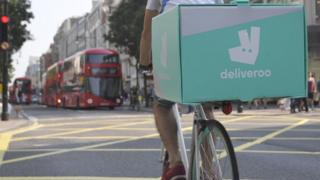
Last month, drivers working for Deliveroo and UberEats were among five people injured by moped riders in north London.
The food delivery company Deliveroo is introducing safety measures to try to protect its riders from violence.
It follows acid attacks in London last month, where the victims included riders delivering by bike or moped.
Since then, over 70 Deliveroo riders have said they did not want to complete a delivery because of safety fears.
Among the measures being introduced are a new app feature that allows riders to raise security concerns, plus a trial of helmet cameras.
Last month, two riders working for Deliveroo and UberEats were among five people injured within 90 minutes in north London by moped riders who threw acid in their faces.
‘Working in a jungle’
Deliveroo drivers are all self-employed so are not entitled to sick pay if they get attacked. They also use their own bikes and mopeds to deliver.
The company says it has upgraded its app for its riders, allowing them to raise safety concerns about specific delivery addresses.
These will then be shared with the company’s headquarters and local authorities.
It is also conducting a trial with helmet-mounted cameras to allow riders to gather evidence, and to pass on information to the police.
The trial is taking place in Hackney, east London, which has become a trouble spot for riders.
Deliveroo is also hiring 50 new staff who will have a focus on rider safety.
Delivery rider Jabed Hussein was the first victim in the series of acid attacks last month. He was working for delivery company UberEats.
He told the BBC’s Victoria Derbyshire programme: “It was like getting fire on my face, I was screaming on the street.
“This shouldn’t be a job where your life should be put at risk.
“Drivers I know are now clocking off at 22:00, it’s too dangerous after then.
“Most of them won’t work after this, whereas we used to work until 01:00.
“Now, I feel I’m working in some sort of jungle, like anything can eat me, I’m not safe.”
Deliveroo managing director Dan Warne said: “The safety of our riders is the most important thing to us, and it’s our responsibility as a company to step up our efforts so they can feel safe all of the time.”
Watch the BBC’s Victoria Derbyshire programme on weekdays between 09:00 and 11:00 on BBC Two and the BBC News channel.
Media captionThe entrepreneurs cashing in on the drone revolution
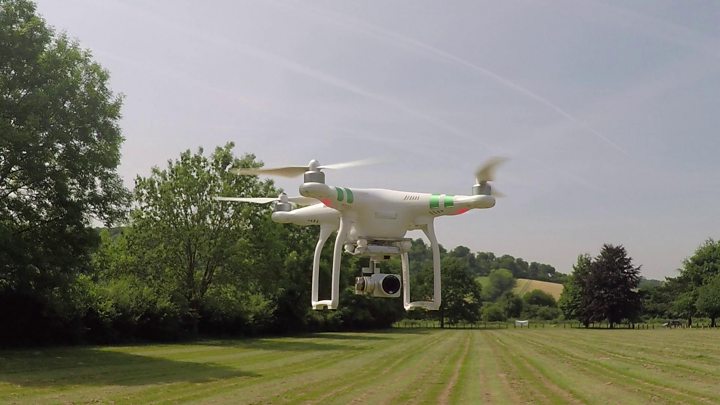
A tiny unmanned aircraft is hovering quietly above a green field in Buckinghamshire, offering its owner, Joby Stephens, an “eye in the sky”.
The drone is kitted out with a tiny high-definition camera that sends crisp images via wi-fi to a phone clipped to the drone’s remote control unit.
“The ability to film with a drone adds another string to my bow,” the professional cameraman and producer says as he pilots the aircraft towards some nearby trees.
“Being able to legally and safely deliver drone footage should be a great addition to many projects.”
Mr Stephens runs production company Jam96, which specialises in making behind-the-scenes videos on movie sets – places where there will invariably be lots of people.
“In the environments I operate in, I need to be 100% safe,” he says.
So he has completed a training course for commercial drone operators.
Reducing risk
The course was run by Whispercam’s Alistair Johnson, a former Royal Air Force pilot with a degree in aeronautical engineering and a day job as a commercial pilot with British Airways.
“At the moment, anybody can buy a drone online or from a retailer and use it as part of a hobby or for fun,” he says.
Image copyright Joby Stephens
Image caption
Joby Stephens plans to use drones to make films
“But if you want to do it in any commercial capacity, or in a congested area, you’ll have to get a Permission for Commercial Operations licence from the Civil Aviation Authority (CAA).”
This requirement is not universally understood, and neither are the risks posed by drones, Mr Johnson explains as he goes through safety procedures before take-off.
Whispercam’s training field on the outskirts of High Wycombe in Buckinghamshire might seem safe to an amateur, but Mr Johnson is quick to point out risks. There’s a private air field to the south and a military helipad to the north, as well as kites being flown overhead and curious people entering the field.
“It’s all about situational awareness,” Mr Johnson says, as he checks a “Notice to Airmen” app on his phone, which contains alerts from the aviation authorities about potential hazards in the area.
‘Automation-induced complacency’
Flying a drone can be both surprisingly easy and extremely complicated, depending on the circumstances. Controlling its pitch, roll and yaw is simple even for the uninitiated, but knowing what to do if something goes wrong is another matter altogether.
“There’s very much more to commercial drone operations than flying the aircraft,” says Mr Johnson.
Image copyright Getty Images
Image caption
Drones are useful for capturing aerial footage
“In aviation, things can go wrong very quickly.”
Pilots cannot simply rely on the automated safety systems included in some drones, such as GPS controls that prevent the aircraft from drifting with the wind, he explains.
“There’s always a risk of what we call ‘automation-induced complacency’,” he says.
Having passed his flight test, film maker Mr Stephens is determined not to fall into that trap.
More stories from the BBC’s Business Brain series looking at quirky or unusual business topics from around the world:
“The larger and more complex drones get, there will be situations where it goes wrong, and you really don’t want to be the fall guy,” he says.
Beyond safety, there are also growing concerns about invasions of privacy by drone users, which the Information Commissioner’s Office says could be covered by the Data Protection Act.
Image copyright Getty Images
Image caption
Companies already use drones to deliver goods
According to Mr Johnson, there are basically three types of drone user: commercial pilots with proper qualifications; hobbyists that do it for fun but who are facing tougher government scrutiny; and those with criminal intent.
This latter group may use drones with wilful negligence, for intrusive photography, to smuggle drugs into prisons, or even to carry out terror attacks using “weaponised” drones.
Extensive opportunities
Whispercam was founded four years ago as a part-time enterprise by a couple of entrepreneurial colleagues at British Airways.
“We were one of the first companies to offer commercial drone pilot training, but a lot of others have sprung up since so there’s a lot of competition,” says Mr Johnson.
Whispercam’s course, which costs £1,140, includes both theory and practical exams and culminates in an application for a CAA licence.
Demand for the course has risen dramatically in recent years as drones are increasingly used, not just by photographers and film makers, but by a growing range of professions.
Image copyright Room 7540
Image caption
Commercial drone pilots face a range of risks, says Whispercam’s Alistair Johnson
“Organisations that do surveying, whether of buildings or pipelines, power lines or railway lines, are increasingly using drones, which are much cheaper than helicopters,” says Mr Johnson.
“Archaeologists use them to get a bird’s eye view to decide where to dig; farmers use them to heat-map fields, and identify hot spots that are doing well, and cold spots that require more fertilisation.
“They are also used for search and rescue by the emergency services, or to deliver food, blood or medicines. Local authorities use them to monitor flooding, and they are used in emergency relief operations.”
The main benefit, he says, is that drones save time and money, and the opportunities to use them seem “almost endless”.
Personal flight
There are indeed so many ways in which entrepreneurs can make money from drones that Waypoint, a drone website, has created its own “Dronepreneurs” section to profile some of them.
One of the most ambitious operators is Germany’s Volocopter, which has built a drone so large and powerful that it can carry two passengers.
Image copyright B.KERN
Image caption
Volocopter has built a drone so large it can carry passengers
Volocopter’s aircraft, a drone with 18 independent electric motors that power one propeller each, is capable of autonomous flight.
This makes them ideal air taxis, according to co-founder Alexander Zosel, who has just signed an agreement with Dubai’s Roads and Transport Authority to launch a five-year test programme later this year.
For now, autonomous drones are illegal in the UK and many other countries, whether they carry people or not, hence it could take time before an aircraft like the Volocopter catches on.
But consultations on unmanned aircraft regulations are underway in both Westminster and Brussels, so that could change over time.
“We see Dubai as the pioneer for a huge evolving market,” says Mr Zosel.
Media captionUAW vote at Nissan: The racially-charged fight for a union
It’s a warm Sunday in Canton Mississippi, and in a field about two miles from the Nissan plant, the crowd of workers is angry.
One wears a T-shirt reading “vote yes,” while another leads the group in a rousing song about “knowing your worth.”
Welcome to the front lines of one of the nastiest labour fights in the US.
On one side, these aggrieved auto workers are demanding better pay and benefits via unionisation. On the other, French-owned carmaker Nissan, which claims organising could kill jobs.
The bitter, 14-year battle is set to climax on Thursday and Friday when the 3,700 workers vote whether to join the United Auto Workers or not. This Nissan plant in Canton is one of three around the world that is not unionised.
Show of support
“I want to have a voice in the plant”, Nissan employee Robert Hathorn told the BBC.
Nissan’s use of temporary staff has energised people here. These workers earn less than long time employees and have worse benefits.
“To me it’s not fair”, said Nissan worker Eric Hearn.
“What we’re doing is looking for fairness,” he added.
Tensions have escalated ahead of the vote.
Workers say Nissan has fought them every step of the way, threatening them with loss of wages and plant closures.
“You know they’re pulling workers in one-on-one conversations”, said Travis Parks, a Nissan employee and union supporter.
He said he was told: “You might lose benefits if you form a union. You might lose this. You might lose that.”
To get its message across, Nissan has posted anti-union messages inside the factory.
A spokesperson for Nissan told the BBC that voters have the right to know the company’s perspective.
The Japanese carmaker warned that the presence of the UAW union could harm the plant’s global competitiveness.
‘Feeding families’
When Nissan opened the plant in 2003, the Mississippi state government gave the company $1.3bn in tax breaks, in the hope that it would provide good-paying, full-time jobs to the community.
“Nissan is the best thing to happen to the state of Mississippi”, said Tony Hobson, a Nissan technician.
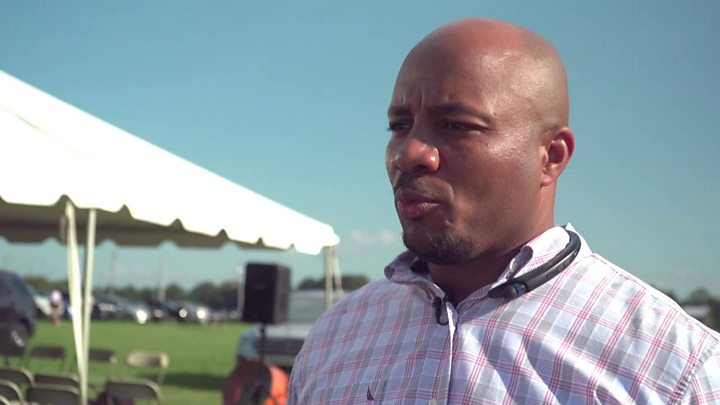
Image caption
Tony Hobson says Nissan is the “best thing to happen to Mississippi”
He’s been with the company for 15 years and is firmly anti-union.
“We have something to lose. We are feeding families here,” he explained while wearing a T-shirt with “vote no’” emblazoned across it.
The UAW has worked for years building support in Canton.
Past efforts to organise at Nissan, Volkswagen and Mercedes, to name a few, have been pushed back. In part because the message the South sent to foreign manufacturers was: “Come here, and we’ll keep unions out.”
Facing a political climate hostile to organised labour, supporters in Mississippi have linked unionisation to civil rights among the plant’s majority African-American workforce.
“It’s about inequality which is about civil rights,” according to Mississippi minister Dr Isiac Jackson Jr, chair of the Mississippi Alliance for Fairness at Nissan.
He has memories of growing up in Mississippi during the civil rights movement of the 1960s.
“When blacks would go to register to vote, somebody might come by their house burning a cross or wearing a hood,” he said.
“Now they don’t wear the hood or burn the cross but they come by saying we’re going to close the union, we’re going to close the plant.”
Game changer?
Nissan worker Tony Hobson calls that the biggest falsehood of all.
“Slaves don’t make what we make,” he said. “Slave labour is like what they make at these fast food restaurants.”
A win at Nissan could be a game changer.
The UAW has never won a union vote at any of the South’s foreign-owned car assembly plants.
In Canton a victory could provide a model for organising across the rest of the South.
Find out how to optimize your website to give your customers experiences that will have the biggest ROI for your business. Register Now »
The following excerpt is from Dan S. Kennedy and Dustin Mathews’ book No BS Guide to Powerful Presentations. Buy it now from Amazon | Barnes & Noble | iTunes
You can often make a pretty good meal, or two or three, out of leftovers. Have you ever turned leftovers from several prior days’ meals into a soup or stew? Or turned Thanksgiving feast leftovers into a night of sandwiches and another night of open-faced turkey sandwiches with gravy?
Presentations leave leftovers on the table, too. There are the people who expressed interest but never registered online — at your website, or by calling your office. There are the people who registered to attend or watch but failed to show up. There are the people who showed up but failed to buy or take another desired action. There can be recoverable value in all of those lists.
Sometimes, monetization can be a simple matter of somehow giving them the same presentation again. For a TV infomercial client, I once took all the people calling in but bailing out of the conversation with the order-taker before buying and sent them a letter with an audio recording of the very same infomercial they’d watched. This converted more than enough of these nonbuyers to buyers to be nicely profitable. For most of the nine years that I spoke on America’s number-one seminar tour, Success, usually as the last speaker of the day, I came home and mailed a very long letter essentially transcribed from my presentation to all the ticket buyers who hadn’t bought my resources. Many hadn’t stayed all the way to the long day’s end to even see me at all. Others were, by then, spent out, lugging bags of other speakers’ resources.
This follow-up mailing never failed to be satisfactorily profitable, and it brought thousands of new customers into my world who would have been left behind otherwise. Similarly, during the several years that I did a lot of consulting with Weight Watchers International Inc., I determined that people going to introductory meetings and getting the initial presentation but not joining were getting little or no follow-up, and I proved that an immediate follow-up letter built around the presentation sent the next day by Federal Express got a large number of those people to join.
Other times, more complex and sophisticated follow-up can be warranted. I have a longtime client who sells a service to dentists via a presentation delivered live and in person in seminars and online by a webinar. The doctors attending the seminars or watching the online presentations who don’t sign up for the service get not one but three sequential follow-up campaigns, each with 16 to 32 steps, incorporating mail, email and phone, over eight to 10 weeks. The first campaign offers the same service by restating the same presentation carved into pieces. The second campaign offers a stripped-down version of the same service at a lower price. The third campaign offers an entirely different service and drives to a different online presentation to sell it.
You should brace yourself for the piece of insider’s information I’m going to share with you: The profit from eating these leftovers is almost identical to the profit from the primary presentation and its sales. In other words, we nearly doubled the income from the same audience by this follow-up.
This isn’t a freak situation. To the contrary, I usually find some opportunity to make good meals out of leftovers, with just about every client I work with, by follow-up, often recycling the same presentation or at least the elements and content of the original presentation.
Based on this, in acting as your own consultant, you have two questions to give a lot of consideration to:
Where are leftovers being tossed in the trash, rather than being used to make meals?
How many times, places and ways can I reuse or recycle my effective presentations?
During the two years that I was coaching a group of high-income, top-performing financial advisors who all obtained clients by assembling audiences for their own preview seminars, I asked, What do you do with all the people who attend these seminars but don’t book private appointments with y’all? Given the success of these advisors, I got surprisingly poor answers. One said sheepishly, “Nothing much.” Two, “We put them back into our prospect list” — which meant they got future mailings (only) for the same seminar they’d already attended and failed to act on. Three, “If Harriet has time, she calls them.” And how often would you guess that Harriet has time to call them? We developed a 16-step, eight-week follow-up system, using mail and email, entirely automated and saw conversion rates as high as 25 percent. This follow-up message leveraged the content of the original presentation.
These unconverted prospects contain gold like cactuses contain water — it isn’t obviously visible, but it is there.
When Nick Scarpino was 17 years old, he worked the cash register at Portillo’s, a food chain founded in the Chicago area in 1963 known for its hot dogs. Now, he’s vice president of marketing and PR for the brand. In this video, he explains how he climbed the corporate ladder and breaks down a few marketing tips you can use for your business.
For example, are you using social media as your entire marketing platform or as a piece of it? Do you have a physical location, and if so, what are you doing to make sure you attract consumers?
Entrepreneur Network is a premium video network providing entertainment, education and inspiration from successful entrepreneurs and thought leaders. We provide expertise and opportunities to accelerate brand growth and effectively monetize video and audio content distributed across all digital platforms for the business genre.
EN is partnered with hundreds of top YouTube channels in the business vertical. Watch video from our network partners on demand on Amazon Fire, Roku, Apple TV and the Entrepreneur App available on iOS and Android devices.
Click here to become a part of this growing video network.
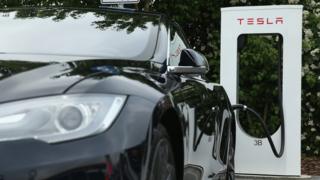
Electric car-maker Tesla quarterly revenues have more than doubled helped by higher deliveries of its upmarket vehicles but its losses also grew.
The company reported revenue of almost $2.8bn (£2.1) in the three months to 30 June, up from $1.3bn during the same period last year.
Losses increased to $336m, compared with $293m last year.
But investors were encouraged by the firm’s prospects and shares rose by more than 8% in after-hours trading.
Tesla, which also has a solar energy division, said about $2.3bn in revenue during the quarter came from the firm’s automotive unit – roughly the same as in the previous quarter, but 93% higher than the same period in 2016.
However, the company’s costs, including for research and development and sales, also rose contributing to the 15% rise in its losses for the quarter.
Tesla is preparing to ramp up car production, as it rolls out its most affordable car yet for the mass market.
Tesla told shareholders it expects revenue to grow “significantly” in the second half of the year, while expenses hold steady.
The firm delivered more than 47,000 of its earlier high-end Model S and Model X cars in the first half of 2017, growth of more than 50% from the prior year.
Since it rolled out its latest car, Model 3, last week, it is averaging more than 1,800 reservations for the car a day, it added.
The firm hopes to make 5,000 of the Model 3 cars per week by the end of 2017. The firm hopes to eventually make more than 500,000 a year at its Fremont factory – or almost 10,000 per week.
Analysis: Dave Lee, BBC North America technology reporter, San Francisco
Elon Musk’s company is spending big to make sure the target of 50,000 Model 3s by the end of the year isn’t missed.
Production of the “affordable” ($35,000) car being on schedule is critical to the company’s future – perhaps even the future of Mr Musk himself as he seeks to court even more money for outlandish projects.
That’s why Tesla burned through over $1bn in the last quarter, as analysts had anticipated.
There are half a million pre-orders for the Model 3, and Mr Musk said the company is facing “manufacturing hell” to get them all made.
According to the latest projections, Tesla thinks it’s on course to keep customers happy. Any wavering on that goal would send the stock price south. For now, things are on track.
 Image copyright