Category: Business News

  • Why Adding Live Chat to Your Site Just Makes Sense

    Free Webinar | August 16th

    Find out how to optimize your website to give your customers experiences that will have the biggest ROI for your business.
    Register Now »

    Millennials these days… they prefer texting over calling. They prefer messaging apps over voicemail. But I’ll bet you that they aren’t the only generation making the switch to text.

    Not too long ago, web experts suggested — no, required — that a business has their phone number visible to site visitors, so that customers who needed an answer fast could get a hold of you or your staff. But in the age of multitasking, people now are willing to sacrifice a little bit of urgency for convenience.

    Maybe you’ve already tried this. If you’re like me, you’re online banking and wire transfers with your bank and you have frequent questions. Using their online chat system, I’m able to take my time chatting with a representative while handling other important issues on the phone.

    There are many other reasons why someone would prefer to message you rather than call you. And, there may be reasons why someone like you would want to add live chat to your business’s website.

    1. Website visitors who chat may purchase more.

    In a report published by Bold360, they found that people who engaged with a site via live chat were 4.5 times more valuable than visitors who did not chat. This means that you or your staff could easily focus on those engaged visitors and get them to buy more. This is basically a reflection of the Pareto Principle (or the 80/20 rule) in customer service.

    2. Website visitors who chat leave more satisfied.

    In addition to converting at a higher rate, customers who utilize your live chat system may also develop a better sentiment with your company. According to eDigitalResearch, a global intelligence firm, users had a higher sense of satisfaction after chatting with a company representative on the site, compared to phone and email contact.

    3. You could free your staff up to do other tasks.

    In my scenario above, I was free to do other things while I was waiting for a bank representative to take care of my issue. The same holds true for staff. Many live chat services have notification settings where it can alert your staff when a message comes in, so that you’re not waiting around looking at your computer. In between messages, staff could complete other tasks while waiting for the next customer.

    4. You could provide a better response to customers.

    Have you ever been asked a question you didn’t have an immediate response to? For many new or junior staff who answer questions over the phone, panic may set in and a wrong answer may be given. A live chat software could help your team provide more consistent service across the board. Most software will allow you to create libraries of canned responses so you know your staff is delivering the most preferred lines. Also, for the more complex answers that require a more thought-out response, there’s no need to awkwardly place the customer on hold. Your staff could simply ping their manager or you for the answer, or they could chat with colleagues in person while writing out their response to the customer.

    Bonus: Some live chat software include features like canned responses that could potentially help you increase sales.  For example, a canned response could provide messages that may guide the customer to purchase more from your business. For instance, if you’re an online fashion retailer and a customer reaches out to you about a return policy for something they’ve accidentally torn, your staff could offer to sell them a convenient sewing kit that matches the color of their garment.

    5. You’re providing more contact options to people who can’t call.

    Since wifi is almost everywhere these days, some people have better data than they do cell service, so they might prefer to converse online. Some people may be working at a busy and loud coffee shop, so they may not want to chat on the phone. Maybe there’s a language barrier between you and the potential customer, and they may feel it would be easier to type out their concerns rather than speak. Or, it could be that today’s society simply does not like talking on the phone.

    There is a variety of live chat software available, ranging dramatically in cost and features. Some popular ones are Olark, LiveChat, Zendesk, Intercom, and many more.

    Of course, you will want to work with a web developer that can help you implement the software on your site and overall sales process. They may also have more insight into which software might benefit your specific business the most.


  • Men from poor backgrounds ‘twice as likely to be single’

    Man walking past some boarded up housesImage copyright
    Christopher Furlong

    Image caption

    The earnings gap between men from poor families and rich ones is widening, the IFS said.

    Men from poor backgrounds are twice as likely to be single in their early 40s than those from rich families, new research suggests.

    The Institute for Fiscal Studies (IFS) also found this group were likely to earn less and marry women with lower incomes.

    It said the trends made poverty more likely to continue from one generation to the next and reduce social mobility.

    The government said it wanted to “build an economy that works for everyone”.

    Since coming to power, Prime Minister Theresa May has promised to do more for families who are “just about managing”.

    Among other things, she has said it is vital to tackle the shorter life expectancy for those born poor, and the lower chances of white working class boys going to university.

    Image copyright
    Getty Images

    Image caption

    The Prime Minister has promised to do more for those “just about managing”.

    However, with price increases outstripping wages since the Brexit vote, many workers are getting poorer on average in real terms.

    Moreover, average real wages in the UK are still lower than they were before the financial crisis 10 years ago.

    ‘Inequalities widening’

    The IFS based its findings on the most recent long-term study available, which surveyed people born in 1970 and followed them as they got older.

    It found that more than a third of men aged 42 from the poorest fifth of families, did not live with a partner in 2012. That compared with only a seventh from high-income backgrounds.

    It said men from disadvantaged backgrounds experienced lower rates of marriage and higher rates of divorce.

    Image copyright
    Getty Images

    Image caption

    Men from disadvantaged backgrounds experience “lower rates of marriage and higher rates of divorce”

    It also looked at men in couples. It found that the partners of those from richer backgrounds earned more than 70% more than the partners of men from poorer families.

    Chris Belfield, a research economist at the IFS, said: “As well as having higher earnings, those from richer families are more likely to be in work, more likely to have a partner and more likely to have a higher-earning partner than those from less well-off backgrounds.

    “And all these inequalities have been widening over time.”

    ‘Regardless of background’

    The IFS said it was “well known” that the sons of richer parents tended to go on to earn more.

    However, it said the earnings gap with those from less well-off backgrounds was widening.

    In 2012, employed 42-year-old men whose parents were among the richest fifth of households earned on average 88% more than those from the poorest families, it said. Back in 2000 the figure was only 47%.

    However, a treasury spokesman insisted that overall, income inequality had fallen and that more people were in work than ever before.

    He added: “We want to build an economy that works for everyone regardless of their background.

    “That’s why we are helping people keep more of what they earn by taking 1.3 million people out of tax and increasing the National Living Wage which is worth an extra £1,400 a year.”

  • Electricity switching rises 14% to hit three million

    Finger on switchImage copyright
    Getty Images

    The number of customers switching electricity suppliers has risen 14% this year.

    Over three million customers had already switched their electricity supplier by the end of July, according to the latest figures.

    UK Energy, the trade association for the energy industry, said one in five had signed up to small or medium sized suppliers.

    In July alone 385,000 customers switched, a 16% increase on July 2016.

    Lawrence Slade, chief executive of Energy UK, said: “There are now over 50 suppliers to choose from, which is driving innovation, improvements to customer service and providing an incentive to keep prices competitive as suppliers fight to keep and attract customers.”

    Although the largest number of switches were done by customers moving from one large supplier to another, some 34% transferred from a large supplier to a small or mid-tier one.

    Energy price rises

    The steady increase in the number of consumers looking for better deals comes as electricity and gas price rises outstrip inflation.

    British Gas owner Centrica said in August it would hike electricity prices on its standard tariff by 12.5% from September, although it is maintaining a freeze on its gas prices.

    The five other big suppliers – E.ON, ScottishPower, npower, EDF Energy, and SSE – have come out with similar increases.

    The price comparison website uSwitch estimates that the average annual cost of dual-fuel standard tariffs from the “Big Six” will rise between 7% and 10%.

    ‘Households still overpaying’

    However, those taking advantage of switching are still in a minority. uSwitch believes that seven out of ten households are overpaying for gas and electricity on expensive standard tariffs.

    The reasons for the inertia were revealed in a report last year by the Competition and Markets Authority (CMA).

    It said: “Those who have low incomes, have low qualifications, are living in rented accommodation or who are above 65 are less likely to be engaged in the domestic retail energy markets.”

    However, it also found that consumers in these groups were the ones most likely to gain from switching energy supplier.

    Another review into the cost of energy was announced last week.

    It will be led by Professor Dieter Helm and examine the entire electricity supply chain of generation, transmission, distribution and supply, in light of the Government’s ambition to have the lowest energy costs in Europe.

  • How long could my summer holiday flight be delayed?

    People queuing at GatwickImage copyright
    Oli Scarff

    Image caption

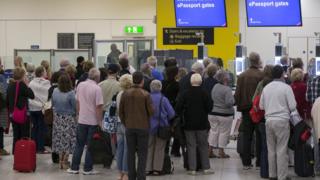
    Passengers leaving Gatwick have suffered the longest average delays, the research found.

    Air passengers leaving Gatwick have suffered the longest average delays during summer getaways from major UK airports, BBC analysis reveals.

    Those travelling to and from the UK on EasyJet flights have waited the longest among the 10 busiest airlines.

    Figures collected by the Civil Aviation Authority (CAA) during the last two summers reveal the typical delays.

    All flyers using EasyJet had an average delay of 24 minutes, and those leaving from Gatwick waited 27 minutes.

    Both said they appeared at the top of the delay list partly as a result of having among the biggest number of flights.

    Performance

    The analysis, by the BBC’s data journalism team, is based on the last two years of CAA data for all flights from or to UK airports during June to August.

    Below, you can enter your UK departure city, and your destination, to find average delays for the airlines serving this route in the last two summers.

    Sorry your browser is not supported

    EasyJet has the longest average delay at 24 minutes when taking all summer flights into consideration, whether delayed or not, for the busiest airlines in June to August for the last two years. Aer Lingus delays were half that length, at 12 minutes.

    This chart shows the average delay per journey for the 10 airlines with the greatest number of flights from or to the UK over the last two summers.

    Past performance will not necessarily be repeated during this and future summers.

    An EasyJet spokeswoman said: “EasyJet operates the largest number of flights of any UK airline, flying over 78 million passengers per year. In 2017, EasyJet will operate 33% more flights than in 2011, with less than 0.8% delayed by more than three hours.

    “In fact, despite a number of adverse external factors like increasingly congested airspace, particularly in the London area, and record numbers of air traffic control strikes, over the last year, EasyJet has actually reduced the proportion of flights delayed by more than three hours.

    “We work hard to minimise disruption and fully comply with all relevant regulations.”

    Airports

    While Gatwick had the longest average delay per outbound flight, the data reveals that travellers were less likely to experience departure delays at smaller UK airports.

    Sorry, your browser cannot display this map

    A spokesperson for Gatwick Airport said it had more flights to Europe than any other UK airport, and was impacted disproportionately by events on the continent. He said the airport was calling on UK and European authorities to accelerate plans to increase the efficiency of UK and European airspace.

    “We recognise the inconvenience that delays cause to our passengers, and we will continue to do everything possible to prevent them from occurring,” he said.

    “We operate the world’s busiest and most efficient single runway airport, but, over recent years, Gatwick has been disproportionately affected by issues beyond our control.

    “These include repeated strike action by French, Greek, Spanish and Italian air traffic controllers and airport employees, prolonged bad weather, and heavily congested airspace above parts of Europe and London.

    “Gatwick has made it a priority to address punctuality and, in partnership with our airlines and ground handlers, we are already seeing the benefits of a new wide range of measures that have been implemented to improve punctuality.”

    Travellers flying from the EU or on European airlines do have a right to compensation. This means:

    • If your flight departed the European Union or was with a European airline, you might have rights under EU law to claim if the delay or cancellation was within the airline’s control
    • If your flight’s delayed for two or more hours the airline must offer food and drink, access to phone calls and emails, and accommodation if you’re delayed overnight – including transfers between the airport and the hotel
    • If you arrive more than three hours late in a journey of less than 1,500km (932 miles) you are entitled to 250 euros (£225) in compensation from the airline
    • If you arrive more than three hours late in a journey spanning more than 1,500km, but within the EU, you can get 400 euros in compensation from the carrier
    • Journeys to non-EU destinations more than 3,000km away that arrive between three and four hours late put you in line for 300 euros in airline payouts, while delays longer than four hours to these destinations are due 600 euros in compensation

    Alex Neill, from the consumer organisation, Which?, said airlines should offer compensation, rather than wait for customers to come to them: “If you’re unlucky enough to experience a severe delay, compensation could be available and people should claim what they’re entitled to.

    “We want to see airlines introduce automatic compensation where possible so that passengers can quickly and simply receive the money they are owed.”

    Methodology

    All data used on this page is compiled and made available by the Civil Aviation Authority, which publishes aggregated statistics on punctuality for all flights taking off or landing at major UK airports.

    The BBC has combined the CAA’s data for June, July and August of 2015 and 2016 and used this to calculate the average (i.e. mean) delay per flight across these months for all routes listed in the data.

    Routes with fewer than 50 flights over this period were excluded, as were airlines that registered no flight data for the summer months of 2016 (even if they had been active in 2015). Chartered flights were not distinguished from scheduled flights in the calculations for airlines that fly both categories on the same route.

    The data for outbound delays is based on the time the aeroplane takes off from the UK runway, and the data for return delays is based on the time the aeroplane arrives back on the UK runway.

    Flights that take off or land early are recorded as having a delay of zero minutes.

    Produced by Ryan Watts, Ed Lowther, Nassos Stylianou, Ransome Mpini, Daniel Dunford, Gerry Fletcher, Becky Rush, Joe Reed, and Kevin Peachey.

  • Manchester businesses recovering after attack impact

    Manchester city centreImage copyright
    Getty Images

    Image caption

    Business groups expect the financial impact on the city to be ‘short-lived’

    Like other terror attacks in Europe: London, Paris and Brussels, Manchester was fundamentally a human tragedy.

    But even in the immediate aftermath, Manchester was resolute that it would carry on; it was “business as usual”.

    Growth in professional services, tourism and the burgeoning tech sector over recent years means it is now the UK’s second city in terms of economic activity.

    However, businesses in the area near to the Manchester Arena said they experienced a noticeable drop in trade following the event on 22 May in which 22 people were killed.

    Image caption

    There was an increased police presence in the city following the attack

    Howard Burns, who runs a jewellery business that has been in the city since the late 1800s, says that in the days immediately following the attack “there was no one shopping here”.

    “I think that the retail business in Manchester dropped off an awful lot just after the bomb because people were worried to come into Manchester.

    “Some people were frightened of being in a crowded area, some people were just scared of anyone with a rucksack on their back, and anyone who acted suspiciously.”

    Manchester City Council says it had offered support to firms closest to the arena, including business rate relief.

    Cllr John Flanagan, Manchester City Council’s executive member for finance, says: “Businesses within the inner cordon were impacted most acutely, and we have been in conversation since the attack to support them, including business rate relief, and the Manchester Business Continuity Forum has been updating and reviewing their continuity plans.”

    Image caption

    Howard Burns, a jeweller in the city, said it took two weeks for normal trade to resume

    He added that the council and tourism groups would “continue promoting the city as a key UK destination, and to make sure visitor perceptions are not affected in the long-term”.

    Certainly in Paris, the tourism sector reported a sharp fall in the number of visitors to the city following the attacks in 2015.

    Fewer tourists meant lost business for restaurants, shops, tourist attractions and transport.

    Christian Spence, ‎head of research and policy at Greater Manchester Chamber of Commerce, says: “Broadly… we don’t expect anything in the long term; certainly not beyond some of the comparables we’ve seen in other cities who’ve faced similar incidents.”

    Image copyright
    Thinkstock

    Image caption

    There was a sharp fall in visitors to Paris after the 2015 attacks

    Manchester’s economic data for the summer months will not be available “for a long time”, but chamber members expect the impact on businesses in the city to be short-lived, Mr Spence adds.

    According to its latest Quarterly Economic Survey, the city’s Chamber of Commerce is predicting that UK growth will be 1.6% this year and 1.5% in 2018, while growth in Greater Manchester will be 3.25%.

    Mr Spence says: “For those businesses that were closest to the terror site itself, of course there was a colossal impact in the immediate aftermath, which lasted for around a week as the cordon stayed in place.

    “Otherwise more widely the major impact will have been around our conference and hotel facilities. That’s a relatively short-term impact… but it will have hit some of those businesses.

    After London, among British visitors, Manchester is the second most visited city in the UK.

    Image caption

    Adrian Ellis, chair of Manchester Hoteliers’ Association (MHA), says many hotels in the city had lost a lot of business, but that the industry is recovering

    The tourist economy is worth around £7.5bn to the Greater Manchester region.

    Tourism was a sector that felt an immediate impact following the May attack.

    The general manager of the Lowry Hotel, Adrian Ellis, says: “Our hotel, and along with the other hotels in the city, lost considerable amount of business, mostly with concerts cancelling because the arena was closed and still is closed.”

    The Manchester Arena is due to reopen in September 2017. Concerts by acts including Celine Dion, Radiohead, Bros and Blink-182 have been cancelled or rearranged.

    Image caption

    Gavin Sharp, owner of the Bank on the Wall, venue says visitor numbers dropped noticeably

    Mr Ellis, who is also chair of Manchester Hoteliers’ Association (MHA), said the hospitality sector was noticing an improvement now.

    Perhaps inevitably, other music venues were affected too.

    One of those to experience a noticeable drop in visitors was the iconic Band on The Wall club, run by chief executive, Gavin Sharp.

    He says: “Probably the best example is Craig Charles, who plays with us the last Saturday every month… it always sells out, it’s quite a mainstream, broad audience.

    “The Saturday after the bomb was Craig’s show and it didn’t get to sell out that time, and in fact 60 people who had bought tickets didn’t turn up for the show, so even though they’d spent the money they decided they weren’t going to come into the city centre.”

    Image caption

    Katie Gallacher, head of Manchester Digital, says the attack has not put people off relocating to the city for work

    But the mood in the city is optimistic, particularly among those in the tech sector. It is Manchester’s fastest growing industry.

    Katie Gallacher, head of Manchester Digital, says the industry had been relatively immune to events. She and many others in her sector are trying to encourage digital and tech professionals to relocate to Manchester.

    “We’re still seeing companies relocating here. It’s a really great place to be, and the community’s stronger than ever.”

  • How the selfie stick became a million dollar idea

    Selfie sticks – also known as the “wands of Narcissus”: So many people use them that they’ve been banned from concert halls, art galleries and stadiums, the world over.

    But to become a modern-day craze, they had to be invented not just once, but twice.

    Video journalist: Jeremy Howell

  • Home repossessions drop amid low interest rates

    Monopoly piece on coinsImage copyright
    Getty Images

    The number of homes seized by lenders due to owners falling behind on their mortgage repayments has fallen to a new low.

    Repossessions of homes in the UK fell from 1,900 in the first quarter of the year to 1,800 in April to June, according to lenders’ trade body UK Finance.

    This is the lowest since quarterly data was first published in 2008.

    The number of people falling behind with repayments also fell.

    Those mortgages in arrears of 2.5% or more of the outstanding balance fell to 88,200 in the second quarter of the year – the lowest level since this data was first collected in 1994. This was down 5% on the first three months of the year.

    Low interest rates have generally helped to keep mortgage repayments at affordable levels, even for families with stretched finances.

    ‘Plan ahead’

    There was also a drop in the number of homeowners seriously behind on their monthly payments, reversing a recent trend.

    There were 25,200 mortgages in arrears of 10% or more of the outstanding balance, down 5% on the first three months of the year and ending a run of five successive quarters of increases.

    Paul Smee, head of mortgages at UK Finance, said: “These figures show that the overwhelming majority of borrowers are managing their mortgage payments successfully, and many of those who have experienced some difficulty in the past are able to recover their financial position. The recent improvement in the number of mortgages with high levels of arrears is particularly welcome.

    “Borrowers are being helped by low interest rates, but mortgage costs are certain to rise at some stage. It is important therefore for customers to plan ahead and consider how their finances would be affected in those circumstances.

    “As ever, lenders will continue to help borrowers resolve any financial difficulty if possible, so customers should not hesitate to contact their lender if they anticipate any payment problems.”

  • Wall Street lower on US-North Korea tensions

    NYSE tradersImage copyright
    Reuters

    US stocks saw their largest losses since May on Thursday, as tension mounted between North Korea and the US.

    Pyongyang, which has threatened to fire missiles toward the US Pacific island territory of Guam, gave more details of its plans.

    Meanwhile, President Donald Trump intensified his rhetoric, saying North Korea should be “very, very nervous” if it does anything to the US.

    The Dow Jones fell 0.9% to 21,844.01 and S&P 500 fell 1.5% to 2,438.21.

    The Nasdaq lost 2.1% to 6,216.87.

    “If the North Korean situation worsens… I would expect the stock market to react negatively,” said Richard C Marston, of the Wharton School of finance.

    “Corporate earnings can be easily overshadowed if there is a real threat of a conflict.”

    ‘Not tough enough’

    Mr Trump earlier this week said North Korean would be met with “fire and fury” if it continued to threaten the US.

    Some criticised the comments for being too provocative, however on Thursday he told reporters: “Maybe that statement wasn’t tough enough”.

    Markets had been bracing for a correction after weeks of record highs. The sell-off was widespread, with shares in financial and consumer companies leading the declines.

    Two big retailers saw their shares fall rapidly after they announced results this morning.

    Macy’s has been cutting costs and closing stores. It saw a surprising rise in its profits, but its shares dived 10%.

    Its big rival Kohl’s said sales in its stores that had been open more than a year had fallen, and its shares were down 5.8%.

  • Snap shares plunge after earnings disappoint

    The Snapchat app is displayedImage copyright
    Getty Images

    Snapchat shares plunged 14% on Thursday after the social media firm reported more than $400m in quarterly losses and fewer than expected daily users.

    The share price fall extended a decline that started almost immediately after Snapchat started trading on the stock market this spring.

    The firm had 173 million active daily users, up 4% on the prior quarter.

    But the messaging app is struggling with fierce competition from Facebook, which offers similar features.

    Snapchat said revenue over the three months to the end of June was $181.7m, more than double the same period in 2016.

    But expenses grew even faster, reaching more than $630.6m for the quarter, including expenses related to stock-based compensation.

    The number of users climbed more than 20% year-on-year. The firm made an average of $1.05 in revenue per user, up 16% from the prior quarter and more than double the period in 2016.

    Still, shares in the firm fell more than 14% in after-hours trade.

    Its stock, which was priced at $17 for its public offering, is now trading at less than $14.

  • Lego boss replaced after eight months

    Bali Padda, new ceo of LegoImage copyright
    Lego

    Toymaker Lego has replaced its 61-year-old chief executive, Bali Padda, after just eight months in the job, saying he was never expected to remain in the post long-term because of his age.

    When Mr Padda took over last December Lego said the search would begin immediately for a successor.

    The search “went faster than expected”, it said.

    The Danish company’s new chief executive will be 51-year-old Niels Christiansen, former boss of Danfoss.

    Lego said the somewhat temporary nature of Mr Padda’s appointment as chief executive was “a combination of Bali’s own wishes – as well as a clear understanding between him and Jørgen [Lego’s chairman] around the duration not being long-term”.

    A Lego spokesman said Mr Christiansen, who left engineering company Danfoss at the end of June was the “perfect match” for the chief executive job at Lego.

    He will take up his new post in October.

    Mr Padda, who had been with Lego for 15 years and was its first British chief executive, will remain with Lego as a special adviser.