Category: Business News

  • Ofsted to publish critical report on training provider

    apprenticesImage copyright
    Getty Images

    Image caption

    Learndirect offers courses and training to adults in sites across England

    The future of one of the UK’s largest adult-training providers is in question after it failed to block publication of a critical report by Ofsted inspectors.

    An injunction obtained by Learndirect against the publication of the report was lifted on Monday.

    The Ofsted report is understood to raise concerns about the management of apprenticeship study and high levels of students not completing their courses.

    The company said it was “extremely disappointed” with the verdict.

    It is understood the Sheffield-based company, which offers apprenticeships and adult training to thousands of trainees in sites across England, was awarded the lowest possible grade – grade four – by inspectors.

    ‘Ineffective’ management

    According to reports passed to the BBC by the trade newspaper FE Week, which was in court, the Ofsted report says the “management of apprenticeships is ineffective”.

    It says about one in every three of the apprentices did not receive their entitlement to off-the-job learning, failing to develop the skills required to progress to the next step in their career.

    The court also heard concerns about the proportion of apprentices who did not complete their apprenticeship on time, which has been increasing “steadily over the past three years”.

    In a statement, Learndirect said: “Learndirect Limited’s underlying business remains stable, and we continue to be focused on supporting our learners as usual.”

    Learndirect, which was privatised in 2011, has more than 70,000 trainees on its apprenticeships and training programmes and employs more than 1,600 staff members.

    It said it had challenged Ofsted’s inspection over concerns that the process did not give a “true reflection” of the company’s training quality and performance.

    FE Week editor Nick Linford said an Ofsted grade four was extremely serious for a private training provider.

    “In these cases, public funding is nearly always withdrawn, and Learndirect indicated in court that they had been told this would happen to them.

    “As nearly all of their income would be withdrawn, they said they would likely go bust and over 1,600 people would lose their jobs.”

    But Mr Linford said learners should try not to panic, as it was not uncommon for a training provider to go bust.

    “The government are resourced to support them and find an alternative provider to ensure they complete their course,” he said.

    “Given Learndirect’s published performance figures were so poor and that they were heavily criticised by Ofsted for delivering limited training or skills development, I would actually expect a switching of provider to be a positive outcome for current Learndirect learners.”

    David Hughes, chief executive of the Association of Colleges, said local colleges would be ready to support those affected.

    Image copyright
    Getty Images

    “The most pressing concern must be for the students and the impact this will have on them,” he said.

    “Colleges across the country stand ready and able to assist in securing ongoing learning opportunities for those students and apprentices affected.”

    Report delayed

    A spokesman for Ofsted said the inspection had been in the spring, but publication of the report had been delayed initially because of the general election and then because of the court injunction.

    He said: “Seventeen inspectors took part in this inspection over four days when they spoke to learners and apprentices.

    “Inspectors interviewed employers, apprentices and learners in person and over the phone, reviewed portfolios of work, and looked at progress reviews when they gathered evidence.

    “As well as visiting apprentices in their workplace, inspectors also reviewed a wide range of evidence to ensure that both the judgements and inspection grades were secure.

    “Ofsted will publish the inspection report about this learning provider on Thursday.”


    What were your experiences of studying with Learndirect? Did you get the workplace training you needed and did you finish your qualification? You can email with your experiences.

    Please include a contact number if you are willing to speak to a BBC journalist. You can also contact us in the following ways:

  • Strike will severely hit Argos customers, union warns

    Argos truckImage copyright
    Getty Images

    A strike at Argos’ distribution centres will “severely hit” the retailer’s customers, a union has said.

    Unite members have begun a strike over what the union says is Argos’ failure to negotiate a national deal covering redundancy and severance packages.

    It has accused Argos of failing to guarantee that workers’ future terms and conditions will be safeguarded.

    However, Argos insists that its contingency plans mean customers will not be affected.

    ‘Unreasonable demands’

    The strike, due to continue until Tuesday 5 September, covers five sites: Basildon in Essex, Bridgwater in Somerset, Castleford in West Yorkshire, Heywood in Greater Manchester and Burton-on-Trent.

    Unite said that because Argos works on a “just-in-time” delivery policy – keeping the minimum amount of stock on its shelves – the smallest disruption could upset the supply chain.

    But an Argos spokesperson said: “Customers will not be impacted and should be reassured that full contingency plans are in place.

    “We’re disappointed with the union’s actions, which are based on unreasonable demands and are wholly unnecessary. This dispute isn’t about pay and benefits. It’s not about job losses. The union has made a series of demands based on entirely theoretical scenarios.”

    Workers voted to strike after Argos, now owned by supermarket giant Sainsbury’s, transferred 500 workers from Argos’ Lutterworth distribution hub in Leicestershire to Wincanton Logistics, 25 miles away in Kettering, Northamptonshire.

    Matt Draper, Unite national officer for logistics and retail distribution, said: “What we are faced with is the thin end of the wedge with Sainsbury’s pulling the strings behind the scenes – and that the not-so-hidden agenda is serious cost-cutting to the detriment of our members.

    “The transfer of the workers from Lutterworth to the Wincanton site at Kettering, whether they wanted to go or not, led to this strike ballot.”

  • House price growth holding steady

    Sold signImage copyright
    PA

    The average price of a home in the UK went up by nearly £2,000 to £223,000 in June, according to official figures.

    The annual rate of increase is running at 4.9%, down from 5% in May, while prices rose 0.8% between May and June.

    The Office for National Statistics (ONS) figures show the wide variation in price movements across the UK.

    In the month of June, the average price of London home fell £3,000 to £482,000, while a house in the North East of England gained £2,000 to £130,000.

    The ONS analysis of the housing market is widely followed because it is based on actual transactions compiled by the Land Registry and shows movements at a local level.

    The biggest change was in Orkney where the average price is 28% higher than a year ago at £148,000.

    In the City of London, the average dropped by 20% to £724,000.

    The ONS said: “While the annual growth rate has slowed since mid-2016 it has remained broadly around 5% during 2017”.

    Last week, the Royal Institution of Chartered Surveyors said its members believed prices had stood still on average in recent months and that a slowdown was spreading from London to other parts of the South East of England.


    Where can I afford to live?

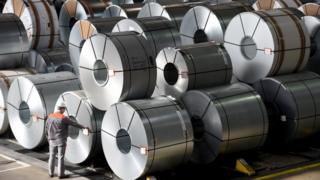
  • German growth slows but remains robust

    Steel worksImage copyright
    Reuters

    Germany’s economic growth slowed in the second quarter of the year but remained robust, according to official data.

    The country’s gross domestic product rose by 0.6% in the three months to June, the Federal Statistics Office said, which was slightly lower than analysts’ forecasts.

    Growth was driven by consumer and state spending plus company investment.

    However, the strong domestic economy sucked in a higher rate of imports dampening overall growth.

    The Federal Statistics Office, Destatis, said that “the development of foreign trade… had a downward effect on growth because the price-adjusted quarter-on-quarter increase in imports was considerably larger than that of exports”.

    Alexander Krueger, an economist at Bankhaus Lampe, said: “The German economy is proving its staying power, the upswing continues.”

    He said the European Central Bank’s low interest rates were boosting the eurozone’s largest economy.

    Destatis also revised upwards its growth estimate for the first quarter of the year to 0.7% from the initial estimate of 0.6%.

  • FTSE 100 continues to recover

    Trader in front of FTSE screenImage copyright
    Getty Images

    The UK market continued to recover in early trade as tensions between the US and North Korea eased.

    Worries over the war of words between the two countries last week had led to a sharp sell-off on global markets.

    But shares recovered some ground on Monday, and as trading got under way on Tuesday the FTSE 100 rose 12.67 points to 7,366.56.

    Newly-formed fund manager Standard Life Aberdeen was the biggest riser in the index, up 2.8%.

    But shares in Next fell 3.6% after Berenberg cut its rating on the High Street fashion chain to “sell” from “hold”.

    On the currency markets, the pound fell 0.2% against the dollar to $1.2941 but rose 0.2% against the euro to 1.1023 euros.

  • China imposes import bans on North Korean iron, coal and seafood

    Bridge over the Yalu river near DandongImage copyright
    Getty Images

    Image caption

    Bridge over the Yalu river near Dandong, which is where most goods cross between the two countries

    China is to stop importing coal, iron, iron ore and seafood from North Korea.

    The move is an implementation of UN sanctions, which were imposed in response to North Korea’s two missile tests last month.

    China accounts for more than 90% of North Korea’s international trade.

    Beijing had pledged to fully enforce the sanctions after the US accused it of not doing enough to rein in its neighbour.

    Economic impact

    The UN approved sanctions against Pyongyang earlier this month that could cost the country $1bn (£770m) a year in revenue, according to the figures provided to the Security Council by the US delegation.

    Although China’s coal imports from North Korea totalled $1.2bn last year, the figure will be much lower this year because China had already imposed a ban in February, experts said.

    “China has already imported its quota of coal under sanctions for 2017. So no net impact there, and North Korean exports to other countries are minimal,” said David Von Hippel, from the Nautilus Institute -a think tank based in Oregon -who has researched North Korea’s coal sector.

    Image copyright
    Getty Images

    Image caption

    North Korean labourers work beside coal mound near the Yalu River

    The sanctions might have more of an impact on iron and seafood, experts said.

    Although they are both much smaller sources of export revenue for North Korea, the two industries have seen a rise in exports this year.

    Iron ore exports grew to $74.4m in the first five months of this year, almost equalling the figure for all of 2016. Fish and seafood imports totalled $46.7m in June, up from $13.6m in May.

    The sanctions do not apply to the growing clothing assembly industry in North Korea.

    Mr Von Hippel said in gross terms, it is nearly as large as coal, but in reality it is worth much less because North Korea has to import the inputs.

    Trade and security tensions

    The sanctions come against a backdrop of increased tensions between the US and North Korea, as well as heightened trade tensions between the US and China.

    After weeks of heated rhetoric between the US and North Korea, on Tuesday North Korea’s leader Kim Jong-un has decided to hold off on a strike towards the US territory of Guam, state news agency KCNA reported.

    The apparent pause in escalating tensions comes after US President Donald Trump warned of “fire and fury like the world has never seen” if Pyongyang persisted with its threats.

    On Monday, the US President Donald Trump ordered a trade probe into China’s alleged theft of US intellectual property, which the Chinese state press saw as an attempt to force China to act more decisively on North Korea.

    Officially, the US has denied any link between the two issues, although the president had previously suggested he might take a softer line on China in exchange for help on North Korea.

  • If You’re a Startup Looking to Capitalize on U.S.-China Border Investments, Here’s How

    Developments in the Chinese technology sector, and cross-border investment, are opening important doors for U.S. startups. As the general manager of the first U.S.-China technology incubator platform and an observer of U.S.-China cross border investments and entrepreneurship, I’m often asked about key investment trends, issues and tips on how U.S. entrepreneurs can navigate their companies in this new reality.

    Related: China’s Effect on the U.S. VC Game

    Here are some of the trends I see, and how American entrepreneurs can take advantage:

    Trend 1: Chinese companies are seeking “innovators” for acquisition — and looking beyond their own backyard.

    After years of growth, Chinese venture capital and technology industries had a downturn in 2016 due to the failure of Online to Offline (020) businesses. O2O was supposed to create a plethora of unicorn companies, but that didn’t happen. True, there were some successes: DidiKuaidi, LittleRedBook, and Yingke live-streaming.

    But many new businesses failed to anticipate the time, money and resources needed to acquire users and compete with large internet and mobile companies, like Alibaba, Baidu and Tencent, which were also deploying O2O strategies.

    With little competition from unicorn companies, there’s now fierce competition among these giants to gain a leadership position in China and other regions. The result: I see this trend opening the door for more Chinese investment into the United States, as China’s tech giants race to acquire companies that further strengthen their monopolies. Acquisition is, in fact, favored over building from scratch.

    Related: China is Now Inviting Entrepreneurs to its Newest Investment Hub Guizhou

    Tip: If you’re looking for funding, you have more options than ever. Chinese investors are supporting innovators creating disruptive technologies. And they’re putting hard cash into those companies. Just look at unicorn companies like Zoox, Tesla, SpaceX, Hyperlook, Uber, and Airbnb — their funding isn’t coming just from U.S. investors.

    Hot industries include augmented and virtual reality, artificial intelligence, robotics and autonomous vehicle applications. And, of course, many of these technologies are being developed in Silicon Valley.

    Trend 2: M&A teams and venture capital funds are taking hold at China’s tech companies.

    Beyond their growing U.S. presence, focused on R&D, business development and marketing, Chinese tech giants are investing and creating their own venture funds.

    In 2013, Tencent invested $330 million in U.S. game developer Epic Games, and now owns 48.4 percent of the company. According to Forbes, the company also invested in four of China’s largest technology venture deals, in 2014. More recently, Baidu announced Baidu Capital, a $3 billion investment fund focused on mid-to-late-stage deals in the internet sector. I believe these types of activities will continue, though they have slowed down in 2017.

    Tip: While their overall approach is the same, Chinese investors operate differently: Chinese venture capitalists, I believe, are more practical than their U.S. counterparts because they come from a highly competitive domestic market. Their expectations are higher regarding a company’s growth and the founder’s ability to achieve healthy business metrics.

    Chinese VCs possessing business backgrounds in banking and business similar to those of U.S. VCs also usually co-invest at Series A or B rounds, or later. They have more data about companies at later stages, making this an easier decision because it requires less work; that’s important when you’re doing deals remotely.

    The exception is consumer technology. That’s a field where some Chinese VCs are willing to take more risks. Many of these investors witnessed Chinese consumer tech companies that started with tiny or even negative margins, then became enormously successful. Those companies grew so fast they had to raise a huge amount of money right at the start.

    This aggressive approach has carried over into how some VCs approach acquiring companies in markets beyond China. That, however, is starting to change based on the experiences investors are having.

    Further, corporate and strategic investors from China take more risks. They look at their existing businesses, see what’s lacking and find what’s better in terms of innovation and technology. They are more likely to bet big on moon-shot projects regardless of the tremendous technological and market risks. They’re also more likely to invest big in companies building new platforms without substantial near-term revenue. Magic Leap is such a company that raised a lot of money from China.

    Chinese angel investors typically are high net worth individuals and successful entrepreneurs, themselves. They may do deals at early stages, but as is widely known, given the restrictions on investment flow, U.S. dollars are hard to come by, so participation may be limited at this time.

    Trend 3: Cross-border investment is slowing with Chinese regulatory tightening.

    An additional trend is that in the last few years, a large amount of cash has flowed out of China into real estate and technology. The Chinese government has taken greater steps to regulate these transactions, including temporarily forcing all applications of foreign deals to slow down. Applications are being looked at with more scrutiny, and big investments are being temporarily suspended.

    Although it’s difficult for Chinese investors to get their RMBs (short for Renminbi, China’s currency) out of the country right now, don’t expect investment flow to completely shut down. Stronger policies to control the flow will lead to a healthier cross-border investment environment.

    The inancial Times reported that more than $75 billion of overseas deals was canceled due to regulatory tightening and foreign exchange controls, resulting in only 30 Chinese acquisitions of European and U.S. companies. Canceled transactions in 2015 totaled about $10 billion and increased seven-fold in 2016.

    According to the People’s Bank of China and China Foreign Exchange Trade System, foreign exchange reserves fell $320 billion last year. To maintain reserve levels, Chinese-funded enterprises may find new obstacles to overseas acquisitions.

    Yet, a caveat here: While so many deals were canceled, Rhodium Group’s Baker McKenzie reported that China’s investment in North America and Europe still reached a record $94.2 billion, with U.S. investments tripling.

    Related: The Goldilocks Test: Why China Is Just Right

    Investment interest, meanwhile, doesn’t look to be dipping any time soon. I believe this tightening is temporary, as the government puts more sound processes in place to handle investment outflow and ensure foreign deal validity. In the long run, better transaction processes would benefit only cross-border investments.

    Tip: Keep calm and go with the flow. How much such investment will slow down is tough to predict. Also, it’s unpredictable when the Chinese government will re-instate cross-border investment activity, given the state of U.S. and China trade relations with the Trump administration. As a best bet, my suggestion is that startups will do well to find investors with a footprint in both the United States and China.

    Cross-border investment opens the door to a world of opportunities — in China and globally. China’s transnational companies are truly reshaping global business and competition. So, if yours is a company interested in Chinese investment, embrace the opportunity to see how those Asian transnational companies are innovating new business models and products. This will help you better compete in the global economy.  

  • Commuters braced for rises in regulated rail fares

    passengers board trainImage copyright
    Getty Images

    Millions of rail users in the UK are bracing themselves for news of an increase in regulated rail fares from January 2018.

    Train operators are allowed to raise fares by as much as the Retail Prices Index (RPI) figure for July, expected to be in the region of 3.5%.

    The exact figure will be published later this morning.

    Passenger groups said commuters would be worst-hit, and suggested that the RPI measure should be scrapped.

    The rises will affect “anytime” and some off-peak fares as well as season tickets in England and Wales.

    In Scotland, it is mainly commuters who will be affected, with off-peak fares rising by a smaller amount.

    The Scottish government currently limits rises in off-peak fares to RPI minus 1%.

    There are no plans for increases in Northern Ireland.

    Inflation

    Unregulated fares, which include super off-peak travel and advance tickets, will be set in December.

    Transport Focus, which represents the interests of passengers, said rail users were already fed up with getting poor value for money.


    Analysis: Richard Westcott, transport correspondent

    Oh the irony… Regulated fares were meant to be the government’s way of stopping private rail firms from overcharging passengers.

    They apply to tickets where people don’t have much choice but to go by train: commuting into big cities, for example.

    But for many years, ministers have deliberately used the system to put prices up anyway. Why? Because they want passengers to pay a bigger chunk of the rail bill, so that the government pays less.

    Fares used to account for about half the cost of running our trains. Today it’s about 70%.

    It does mean, of course, that people who don’t commute by train, which is most of the country, pay less to subsidise the system.

    But that’s little consolation to workers who’ve faced consistent price rises that have often outpaced their salary. Even allowing for inflation, rail fares have gone up by about 25% since the mid-1990s.

    I’ve spoken to many passengers – often young people at the start of their careers – who’re on the brink of changing jobs because they can’t afford the increases.


    “Wages are not keeping pace with inflation and performance remains patchy,” said a spokesperson for the group.

    “Passengers, especially commuters, face potential strike action, the consequences of the continual rise in passenger numbers, and disruption caused by railway upgrades.”

    Image copyright
    Getty Images

    Transport Focus said it would also like to see the RPI measure replaced by the Consumer Prices Index (CPI), which is currently running at 2.6%.

    CPI is typically lower than RPI.

    Costs

    However the government said the fare increase was justified by improvements to the network.

    “We are investing in the biggest rail modernisation programme for over a century to improve services for passengers – providing faster and better trains with more seats,” a spokesperson for the Department for Transport said.

    “We have always fairly balanced the cost of this investment between the taxpayer and the passenger.”

    The Rail Delivery Group, which represents train operators, said there would be an extra 170,000 seats for commuters by the end of 2019.

    The Department for Transport also rejected the idea of using CPI to determine price rises.

    It said RPI was used across the rail industry – for example in calculating the cost of running train services.

  • Have it your way: The growth of luxury customisation

    Media playback is unsupported on your device

    Media captionHow customisation is luring the rich

    In the luxury market, unique customised items are one way of luring the rich. Italian entrepreneur Lapo Elkann explains how his firm is changing everyday items.

    Mass production came of age in the 20th century, with the promise of cheap products available to almost anyone.

    But the price of achieving this was uniformity. To keep costs down, items on the assembly line needed to be largely identical.

    “Any customer can have a car painted any colour that he wants so long as it is black,” said pioneering car maker Henry Ford.

    But not even he could completely snuff out all desire for individuality. At various times during its production life, the famous Ford Model T was available in a range of colours, not just black.

    A century on from the introduction of Henry Ford’s assembly line, we may now be entering the era of “mass customisation”, where a growing number of items such as handbags are offered in a huge range of variations to suit individual tastes.

    From the cleaner to the chief executive, “freedom of expression is something that everyone wants,” says the entrepreneur Lapo Elkann.

    Image caption

    Lapo Elkann is in the process of restoring this Agip petrol station in Milan, which will become his company’s new headquarters

    Today, he continues, “personalisation is something that you can find at the low end of scale of products, at the medium, and at the high”.

    Yet at present it is still the luxury field that offers the most striking examples of bespoke products. Mr Elkann believes it is a market that has plenty of potential for growth.

    Amongst the items that his Milan-based Garage Italia company has customised are yachts and private jets, as well as cars.

    Examples of the latter include multi-coloured versions of BMW models, inspired by the design ethic of the Memphis group, founded by Ettore Sottass.

    Mr Elkann says the exercise was a kind of antidote to “an era where there is a lot of bad news…[which]makes you think ‘grey’; we said let’s make people think in colours, because colours mean energy… passion …liveliness.”

    A more esoteric example of the company’s work is a Fiat 500 covered with erotic illustrations taken from the Kama Sutra .

    Racier elements of the design are covered with the word “censored”, which disappear as the temperature rises, thanks to the special heat-sensitive paint covering the vehicle.

    Image caption

    Even the inside of the BMW customised models are inspired by the design ethic of the Memphis group

    For Mr Elkann, the key to success in the field of high-end customisation, or “transformation” as he prefers to call it, lies in understanding the customer, and helping them to understand themselves.

    “It’s not only about doing the product, it’s about feeling, living, sensing, and creating the story which they dream about,” he says.

    The world of luxury is one that Mr Elkann knows well.

    His grandfather, Giovanni Agnelli, led the growth of Italian car maker Fiat into a huge global enterprise.

    Early in his career, Mr Elkann worked as an assistant to Henry Kissinger. After working at Fiat for a time, where he helped to relaunch the Fiat 500, Mr Elkann went on to found a string of businesses of his own, including sunglasses maker Italia Independent, as well as Garage Italia.

    Mr Elkann has also collaborated with Ferrari on a “tailor-made” project, which allows customers to add an element of personalisation to their cars.

    Image caption

    Being honest with yourself is important says Lapo Elkann

    Nevertheless, it has not been all plain sailing for Mr Elkann. He has faced a number of personal setbacks, including a battle with drug addiction.

    He says he has learnt a lot from his experiences.

    “You need to balance inner self and outer self, and if you don’t find the balance of both, you go against the wall,” he says. “Rigorous honesty with yourself is a key point”.

    But despite these challenges, Mr Elkann’s enterprises seem to continue to make progress.


    Life of luxury

    More from the BBC’s series on the firms which serve the rich

    The secret supplier to the world’s top brands

    The city that makes the most expensive boats in the world

    The luxury firms using art to sell


    According to Peter York, who has been an adviser to many large luxury businesses, Mr Elkann’s background is one that is likely to help him, “because people will think you’re a person of style and heritage so you’re likely to get it right”.

    This is important, Mr York says, because clients in the field can be exceptionally demanding and may be more likely to trust suppliers they believe really understand their needs.

    Those trying to make a viable enterprise in the luxury customisation market need all the help they can get, adds Mr York, because it’s “quite a risky business – real customis ation is very expensive and very time consuming”.

    Success will partly depend on achieving the highest quality of craftsmanship, continues Mr York. This is as essential now as it was in the earliest days of the automobile, when the first cars were luxury, hand-built items.

    However, Mr York says that the growing “commodification of luxury” products means that the market for high-end bespoke products and services is only likely to grow. He agrees with Mr Elkann that, for those who have the skills, reputation and nerve, there is money to be made in the field.

  • 6 Ways Irresistible Product Images Enrapture Customers and Boost Conversions

    Free Webinar | August 16th

    Find out how to optimize your website to give your customers experiences that will have the biggest ROI for your business.
    Register Now »

    We all know detailed product descriptions are important for selling products online. But a picture is still worth more than all those words.

    In fact, one survey found that 67 percent of customers believe product images are more important than descriptions and reviews when it comes to deciding whether to buy. Other studies have found professional images can reduce shopping cart abandonment and boost the likelihood of making a sale.

    Related: 7 Content Marketing Tip for New Entrepreneurs

    That means any brand that sells online would do well to invest in their product images. Here’s how to utilize product images for maximum conversion-boosting effect.

    1. Emphasize quality.

    In order to effectively boost conversions, images need to be high-quality. Professional images will lend credibility to your brand and help customers feel more comfortable purchasing from your site. Avoid pixilated images, stock photos and any visuals that aren’t relevant to the product at hand. Keep the background clean and relevant to the product. And make sure your photos are large and high-resolution to optimize their impact; large photos consistently result in better conversion rates.

    2. Provide as many views as possible.

    Buying products online can be daunting, because customers don’t have a chance to interact with them up close and ensure they’re getting exactly what I want. Your images should provide customers with almost as much information as they’d get from handling the product in person in order to reduce the friction involved in buying online. To that end, provide multiple views of the product (i.e. front/back/sides), include a zoom option that allows customers to view details up close, and include photos of each of the different color and style options on offer. Bonus points for 360-degree spin or 3D imaging features.

    3. Help customers envision the product in their lives.

    In order to purchase a product, customers need to be convinced it will enhance their lives in some way. Help potential customers visualize how your product(s) could play a role in their lives by showcasing products in the settings where people are most likely to use them. For example, if you’re selling a suitcase, adding a shot of the product in an airport or train terminal would be effective. Take a look at this post about mattress size dimensions from Mattress Clarity. It features graphics of people utilizing the different products in question, so potential customers can visualize exactly how various options would relate to their own bodies.

    Related: 5 Ways to Optimize Your Ecommerce Campaigns

    That brings us to another relevant point. In order to help people visualize themselves interacting with the product, it’s useful to include people in your images. Adding in this human element consistently increases conversion rates. That’s because including people in your photos can help direct customers’ attention, build empathy and provoke an emotional reaction that then gets associated with the product. For example, a photo of a person relaxing on a beach towel is going to make a viewer associate that beach towel with a sense of relaxation, which they will no doubt crave. Again, be sure to avoid cheesy stock photos. Those can have the opposite effect.

    4. Prioritize accuracy.

    While a few professional touch-ups are fine, it’s important that your photos accurately represent your products. If customers purchase a product based on a photo only to discover the real thing looks nothing like what they thought, that’s going to result in dissatisfied customers, poor reviews, high return rates and lost customer retention. Make sure your photos are accurate depictions of your products, and test the view on multiple devices and in multiple web browsers to ensure that colors and details are presenting accurately.

    5. Add images to site search.

    Making sure your product images show up in your site’s search drop-down menu can boost conversions. That’s because customers are likely to click directly on the auto-filled image instead of typing out the rest of the search entry. In other words, images help customers find what they’re searching for faster, which can reduce impediments to buying. Additionally, images can catch the attention of customers faster than text, so they’re likely to click directly on appealing visuals even if that’s not what they were searching for originally.

    Related: 3 Fundamental Areas of Ecommerce You Should Never Skimp on

    6. Use images in content marketing.

    Not only should you be incorporating images into your own content marketing efforts but you also should be encouraging your external PR and marketing efforts to do the same. For example, at Digitalux, we have had a lot of success sending products to bloggers and encouraging them to take as many pictures as possible to go with their review. A good example would be this post on BrainWiz.org. A blogger took high-quality pictures to correspond with the article. This not only helps the reader get a more in-depth look at the product, but it also keeps it on their mind longer. Research has shown that when people hear information, they’re likely to remember only 10 percent of that information three days later. However, if a relevant image is paired with that same information, people retained 65 percent of the information three days later.

    The takeaway? When it comes to boosting online sales, product images matter. In addition to writing detailed product and features descriptions, including high-quality images will help you make more sales, reduce your risk of returns, and get people to remember your products for a much longer time.