Category: Business News

  • Coronavirus: Manicures and tattoos now possible in England as lockdown eases

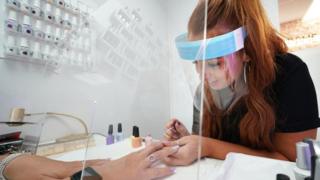
    Beautician Alex Smith, 26, does the nails of Jules Aspen, 40, at the Madame Beauty salon in Chirton, North Tyneside, as they reopen to customers on following the easing of lockdown restrictions in England

    Image copyright
    PA Media

    Beauty salons, spas, tattoo parlours and nail bars are welcoming back their first clients for almost four months, as lockdown restrictions ease further in England.

    But some treatments, such as eyebrow threading, are still banned, leaving many salons unable to reopen.

    In Scotland, indoor shopping centres are allowed to reopen.

    In Wales, pubs, bars and restaurants can start serving customers outdoors, while hairdressers can also reopen.

    Businesses will be required to follow guidelines to reduce the spread of coronavirus – and treatments which involve work directly in front of the face will not be available.

    Government guidance says services including face waxing, eyebrow threading, eyelash treatments, make-up applications and facials should not be provided because of the greater risk of Covid-19 transmission.

    • Government to decide on face masks in shops
    • How can I have my nails done safely?

    Naresh Bhana, who runs Flamin’ Eight tattoo studio in north London, said the business was only taking advance bookings, so “you can’t walk off the street unannounced”.

    “We can accommodate two or three being tattooed but we stagger their start times,” he said. “Work areas are four metres apart. Everyone’s wearing masks. Clients will wear visors as well.”

    He has created a commemorative tattoo for his wife to mark the reopening.

    Image copyright
    Sonia Bhana

    Image caption

    The tattoo design to mark the end of lockdown for tattoo parlours was created for Naresh’s wife, Sonia

    Beard trims have been allowed since barbers opened last weekend – but should be limited to simple tidy-ups or thinning which can be carried out from the side or by circling the client to avoid the highest risk zone in front of the face, the British Beauty Council has said.

    The co-founder of the home beauty service, Blow Ltd, Fiona McIntosh, said the ban on beauty treatments involving the face was “hugely frustrating”.

    “We still don’t know when we’re going to be able to do those services, which is having a huge impact on the freelancers who work for us,” she said.

    “We have 250 women, freelance beauticians on our platform across London, Manchester and Birmingham who can’t work and they have been given no date on when they can work.”

    She added: “I found it very difficult to understand how a lash treatment when you actually could have a mask on to have that done is different to a beard treatment.”

    Image caption

    Blow Ltd uses 1,000 self-employed beauticians and about a quarter of them can still not work, says Fiona McIntosh

    Angela Burnett, the co-founder of Moreton Place Beauty and Wellbeing in London, added: “It’s half of our business, not being able do facials and facial treatment. For example we can’t do any eyebrow waxing, any tinting, any lip waxing. So we’re just doing manicures, pedicures and massages.”

    Vanita Parti, founder and chief executive of the Blink Brow Bar walk-in beauty bar chain, which has 11 shops in London and specialises in eyebrow treatments, said her salons would not be able to reopen under the guidelines.

    “I’m furious,” she told the BBC last week. “This will kill so many businesses. I wish they’d consulted us.”

    Massage studios, tanning salons, physical therapy businesses and piercing services are also now allowed to reopen in England.

    Business Secretary Alok Sharma said: “Enabling these often small, independent businesses to reopen is yet another step in our plan to kickstart the economy to support jobs and incomes across the country.”

    Image copyright
    Martin Rickett/PA Media

    Image caption

    Some nail bars have installed plastic screens to reduce the spread of coronavirus

    Image copyright
    Getty Images

    Image caption

    At a salon in Birkenhead, a nail technician wears a PPE face shield and mask

    Image copyright
    PA Media

    Image caption

    People – including a woman in Chirton, North Shields – are also returning to sunbeds for the first time in three months

    In Scotland, hospitals are reopening to visitors and children and young people are now allowed to play contact sports outdoors.

    From Wednesday, Scottish hairdressers and barbers will be able to reopen and indoor pubs, cafes and restaurants can return to business.

    In Wales, hospitality businesses can open for outdoor service. Only half of venues are predicted to do so, with major chains, including Wetherspoons and Brains, waiting until customers are allowed indoors from 3 August.

    The National Trust is also reopening some of its historic houses, with visitors allowed at seven properties in England and Northern Ireland in a test run of new rules intended to keep the public and staff as safe as possible.

    “We’re really grateful to our members and supporters for sticking with us during lockdown,” said Tarnya Cooper from the National Trust, who spoke to BBC’s Breakfast from Petworth House. “This is the first time in 16 weeks we’ve been able to contemplate reopening our houses.”

    She said about one million visitors had already pre-booked trips to National Trust’s parks and gardens since they opened in early June.

    Face masks under review

    Meanwhile, the government’s approach to face coverings in England continues to be discussed, following calls for clarity over the weekend.

    Boris Johnson has said people in England “should be wearing” masks or other coverings inside shops to help prevent the spread of coronavirus.

    He said the government would decide in the next few days if “tools of enforcement” were needed.

    Earlier, Justice Secretary Robert Buckland has said he would “perhaps” support making the wearing of masks in public compulsory but his colleague Michael Gove said on Sunday he thought the matter should be left to people’s “common sense”.

    Mr Buckland told BBC Radio 4’s Today programme: “Wearing them in an enclosed space where you’ve got lots of people, for example a busy shop, seems to be sensible.

    “It is all about increasing confidence. I think the more of us who do the courteous and responsible thing, the more people you’ll see venture out into shops.”

    He added: “If it becomes necessary to nudge people further by taking further action then of course we will consider that. I think the matter is under careful and daily review.”

    Image copyright
    Getty Images

    Image caption

    Face masks are mandatory in shops in Scotland but not in England, although some shoppers do wear them

    A further 650 coronavirus cases were reported across the UK on Sunday, according to the Department of Health. That is an increase on the 516 cases reported on the same day a week earlier – but hugely down on the peak in April when there were about 5,000 new cases a day.

    The total number of people who have died with Covid-19 in the UK is now 44,819, a rise of 21 on the previous day – although figures tend to be lower at weekends because of reporting delays.


    Are you having your nails done or getting a tattoo today? Or are you a nail technician or tattoo artist who has reopened? Share your experiences by emailing

    Please include a contact number if you are willing to speak to a BBC journalist.

    • BRITAIN’S CANCER CRISIS: How has cancer care been impacted by Covid-19?
    • GYMS, LIVE MUSIC AND COMEDY: What’s the latest?
  • Shopping centres reopen as lockdown restrictions are eased

    Union Square, Aberdeen

    Scotland will see “the most significant easing of lockdown” this week with shopping centres, pubs and restaurants reopening, the first minister has said.

    From Monday, non-essential shops inside shopping malls will be able to return to business.

    Children and young people will also be allowed to play organised outdoor contact sports.

    Further restrictions on the indoor hospitality sector will be lifted from Wednesday.

    Family and friends will be able to visit hospital patients from Monday.

    Patients can have a designated visitor, although they will have to follow strict public health guidance and arrange a time to visit in advance.

    • Face coverings now compulsory in Scotland’s shops
    • Which lockdown rules will change next – and when?

    Dentists will be able to offer some routine treatments, such as examinations, hand scaling and extractions.

    But they will not be able to carry out aerosol procedures – those which produce a fine mist, like the use of a high-speed drill.

    That will rule out most fillings, crown preparations and treatments involving a water spray.

    Image copyright
    Jeff Holmes

    Image caption

    Perspex screens have been fitted to protect staff at the intu Braehead shopping centre in Glasgow

    Nicola Sturgeon said continued success in suppressing coronavirus allowed the relaxation of lockdown restrictions.

    But she has warned they could be revoked at any time if there is a spike in Covid-19 cases.

    The first minister said: “The fundamental, primary responsibility to keep the virus low in Scotland is on the shoulders of all of us to do the right things.

    “That means face coverings, avoiding crowded places, cleaning our hands and keeping two-metres distancing, following the advice to self-isolate and get tested if we have symptoms.”

    Restricting access to people in hospital had been necessary “to keep patients and staff as safe as possible”, Health Secretary Jeane Freeman said.

    Image caption

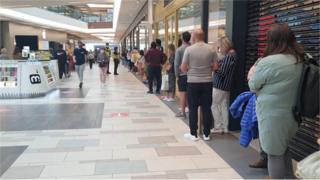
    People waiting outside a clothes shop in the Union Square centre in Aberdeen

    She also said the measures had “helped us protect the capacity and resilience of NHS Scotland”.

    Ms Freeman added: “I want to thank everyone who has followed this guidance as I know how hard it has been for patients, families and carers not to have seen their loved ones in hospital.

    “There is a need to balance the risk of physical and psychological harm that the absence of visitors can cause, with the gradual reduction of Covid-19.

    “The safety of patients, staff and visitors will continue to be our priority.”

    Seating plans

    From Wednesday, hairdressers and barbers will be able to reopen – with enhanced hygiene measures.

    Indoor pubs, cafes and restaurants can also return to business.

    They can seek an exemption from the two-metre distancing rule, but will have to warn customers that they are entering a 1m zone, produce revised seating plans, and improve ventilation.

    Guidance on physical distancing will have to be followed, and customers will have to provide their contact details.

    All holiday accommodation can also reopen from 15 July, as can museums, galleries, cinemas, monuments and libraries.

  • Coronavirus: Welsh pubs and cafes reopen – but only outdoors

    The Pelican

    Image copyright
    Mick Lobb/ Geograph

    Image caption

    The Pelican, in Ogmore-by-Sea, will welcome drinkers back on Monday

    Pubs, bars, restaurants and cafes in Wales are allowed to start serving customers outdoors on Monday – but only half are predicted to open.

    Major pub chains including Wetherspoons and Brains will wait until customers are allowed indoors from 3 August.

    With turnover expected to be at 25% of pre-lockdown levels, independent businesses say only half will open.

    After self-catering accommodation opened on Saturday, hairdressers will also welcome customers back on Monday.

    On Friday, First Minister Mark Drakeford said hospitality businesses could reopen indoors from 3 August, providing coronavirus cases continue to fall.

    Media playback is unsupported on your device

    Media captionConfused about what you can do when? This should help

    He announced the date in a long list of changes to coronavirus restrictions, including that exemptions will be made to the 2m social distancing rule for some businesses.

    Mark Griffiths owns four pubs in Bridgend and Vale of Glamorgan and is gearing up to start serving from two of these, while the other two will remain shut.

    The Pelican, at Ogmore-by-Sea, has been serving takeaway food for a month, and Mr Griffiths said “it went really well, but we had to slow down”.

    “We were selling too many and the bank behind it was like Henman Hill,” he said.

    Image copyright
    Getty Images

    Image caption

    Pubs with an outdoor space they own will be able to open to customers

    He is hoping to open the pub from 12:00 BST until 20:00, and maybe later on the weekend, as well as The Haywain in Brackla, Bridgend, where an 80-seater marquee has been erected in the car park in case it rains, with social distancing measures put in place.

    Hundreds of people have booked tables on social media for The Haywain, including a group of eight for Monday, Friday and Saturday.

    But Mr Griffiths has decided not to open his other two pubs – The Five Bells in Bridgend and The Seahorse in Porthcawl – because they have no outside area.

    “I will concentrate on the two,” he said.

    “The weather is looking quite good, so if I can get 100 people outside both pubs every day next week, that will be good.

    “We have lost the summer money now, there’s no point trying to chase it. It’s a case of making what you can.”

    Image copyright
    Jaggery/ Geograph

    Image caption

    Staff at The Lion in Treorchy have been preparing to reopen

    Reopening pubs in England on a Saturday was “irresponsible”, according to Adrian Emmett, of The Lion in Treorchy.

    “I think the Scottish and Welsh governments have the right idea opening on a Monday. It will make my job a lot easier.”

    Mr Emmett said “the pressure is going to be on” staff to make sure customers adhere to rules.

    At the St Brides Inn, Little Haven, Pembrokeshire, 80% of trade is from tourists.

    Landlord Malcolm Whitewright has arranged tables two metres apart and hopes social distancing measures will be reduced to one metre.

    Image copyright
    Christopher Davies/Geograph

    Image caption

    Tourists usually flock to Little Haven during the summer months

    “We have a modest garden with about ten tables available,” he said.

    “We probably won’t make a profit but at least we will be up and running again and get some of our staff back to work.”

    Out of 18 employees, about eight will start work again, with the rest remaining on furlough.

    Miguel Santiago is looking forward to pulling pints again after spending £30,000 preparing to reopen.

    The landlord owns The Beaufort, in Raglan, Monmouthshire.

    Image caption

    Miguel Santiago is looking forward to pulling pints again after spending £30,000 preparing to reopen

    He told BBC Radio Wales he had made changes to the pub’s outdoor seating and had bought bought two tiki huts – a kind of outdoor bar.

    “I think I’ve spent close to £30,000, which on top of everything you’ve lost is a lot,” he said.

    “But when you get left alone in a big building and are a bit bored, you start spending money you haven’t got!”

    He said staff were “really looking forward” to returning to work.

    “We will attract a lot of people from the city, because they will come out to more rural areas because we have more outside space here,” Mr Santiago said.

    “I’m looking forward to meeting some new people.”

    Image copyright
    Gower Brewery

    Image caption

    The Gower Brewery has focused mainly on online orders since lockdown, delivering between Llanelli and Cardiff and sending beer around the UK

    The Swansea-based Gower Brewery has been delivering hundreds of draught beer kegs in readiness – but the company’s Bob Dudley-Jones said many pubs in the city will not open.

    “A lot have no beer gardens, or you have to go through the pub to get to them,” he said.

    “More on the coast and seaside resorts will, but because people are sat outside, a lot will depend on the weather.”

    The Welsh Independent Restaurant Collective warned that limited potential to make a profit would see as few as half of independent premises open on Monday.

    None of the 104 pubs owned and managed by Cardiff-based brewer SA Brains will reopen, although some of the 40 which are tenanted may.

    Image copyright
    Getty Images

    Image caption

    The Duke of Cambridge opened the brewery’s new site in Cardiff Bay after it moved from the city centre

    In a statement, it said it looked forward to welcoming customers when it has “the green light” to open fully – with 3 August announced as the date on Friday.

    Brains is not the only chain to take this approach, with Wetherspoons and Mitchells & Butlers, each of which own about 50 pubs in Wales, not opening.

    But Stonegate will open a number of its premises, including Henry’s, The Woodville and Owain Glyndwr in Cardiff, Railway Hotel in Penarth and The Carlton, Llandudno.

    The Ei group will serve pints from 64 premises, including The Old Cross Keys in Swansea, Bulls Head in Bala and The Mitre in Pwllheli.

  • ‘If we’re heroes then why are we being exploited’

    Key workers Kevin and Melissa Antwhistle

    Image caption

    Key workers Kevin and Melissa Antwhistle are stuck in “a financial nightmare” because of their mortgage

    MPs are calling on the government to step in and help more than 170,000 “mortgage prisoners” who are trapped on high interest rates.

    Thousands of frontline workers, including nurses and hospital workers, are forced to pay double the interest they would on a competitive mortgage.

    Strict affordability rules prevent them from re-mortgaging to a cheaper deal.

    MPs now want the government to order regulators to investigate capping the profits firms make from the borrowers.

    They are asking for the Competition and Markets Authority (CMA) and the Financial Conduct Authority (FCA) to undertake a joint consultation and introduce a cap on standard variable rates.

    The Treasury said it sympathises with the situation of borrowers who cannot switch mortgages if, for example, their loan is too high against the value of their home or because they are now too old to re-mortgage.

    Last October, the FCA reformed the affordability rules to allow lenders to help mortgage prisoners with cheaper home loans.

    But so far not a single lender has done so.

    Some key workers, who are also mortgage prisoners, say the financial pressure caused by paying far more than other homeowners is worsening the considerable stress of being on the frontline during the coronavirus pandemic.

    ‘Financial nightmare’

    Melissa Antwhistle has been dressing in protective equipment every day for round-the-clock shifts on the frontline at Scunthorpe general hospital, including in the intensive care unit.

    But financially, she feels far from supported.

    Speaking between shifts, she said: “Many mortgage prisoners are key workers like my husband and me. Doing this job with all the stress of Covid and also looking after our children aged one and three, we could do without the extra stress and anxiety of this financial nightmare.

    Image copyright
    Melissa Antwhistle

    Image caption

    Melissa Antwhistle is a frontline NHS worker

    “While the nation clapped for key workers every Thursday evening in admiration, in fact we have been risking everything not just to fulfil our vocations but also because we were forced to work round the clock just to keep a roof over our heads.”

    Her husband Kevin – also a key worker who runs and maintains a power station on the south Humber bank – took out a £120,000 mortgage with Northern Rock in 2007 at 100% of the value of his house with an unsecured loan on top.

    Northern Rock’s “Together” mortgage was approved at the time by regulators under the oversight of the Treasury.

    But it’s a decision he has had 13 years to regret.

    After it was nationalised, the Treasury put his loan along with hundreds of thousands of others into a new entity called Northern Rock Asset Management (MRAM).

    The Treasury then allowed NRAM to make bigger profit margins on standard variable rate mortgages, preparing the way for the sale of a portfolio of mortgages to private investors who could make large profits from the repayments Kevin and Melissa were making.

    His loan was then sold in 2014 as part of a £13bn portfolio of loans to private investors whose mortgages were outside the regulation of the FCA.

    Image copyright
    Getty Images

    Image caption

    Northern Rock collapsed in September 2007 before being nationalised

    It was the biggest privatisation in UK history, meeting the Treasury’s long-cherished goal of re-privatising the mortgage assets nationalised in the 2008 financial crisis.

    However, the investors purchasing the loans were typically ‘inactive’ lenders, meaning they were not willing or able to offer competitive new deals to existing borrowers.

    It meant that when their initial fixed-rate interest rate deals expired, Kevin and Melissa could not re-mortgage to a cheaper deal with their existing lender.

    Instead they moved on to the high standard variable rate where they paid interest rates of between 6% and 9%, compared to loans of less than 3% had they been able to re-mortgage.

    Melissa and Kevin have been paying £780 a month on their Northern Rock loan, compared to £420 or less if they could re-mortgage. But because they borrowed more than the value of the property, the regulators’ affordability rules now say they can’t re-mortgage.

    The rules, in other words, say they can’t afford to pay less.

    “Watching the widespread financial support during the current crisis has been a bitter pill to swallow. For many years we’ve been blamed for being ill-prepared and told that buying a mortgage is the risk you take,” Kevin says.

    “Yet whilst we’re asked to risk our lives and take risks with our families’ health, making huge sacrifices, we continue to be financially exploited without any choice. Our job is vocational but also necessary to pay the crippling interest rates.”

    ‘Immediate action’

    Rachel Neale of the UK Mortgage Prisoners campaign said appeals to the Treasury to help key workers and others trapped on high-interest loans haven’t helped a single mortgage prisoner.

    “Families are being crippled by these high interest rates and aren’t able to live properly because of it. We need action immediately before things get even worse and drive people into further arrears or cause repossessions.”

    In a letter to the Competition and Markets Authority, the all-party parliamentary group on mortgage prisoners says even during this period of record-low official rates, mortgage prisoners are typically paying 4.4%, two and half times the most competitive rates of 1.8% or less.

    Image caption

    Campaigner Rachel Neale says families are being “crippled” by high interest rates

    “Mortgage prisoners are being exploited, by both fully regulated lenders and unregulated vulture funds by being held on high standard variable rates, “says the letter, signed by LibDem, Conservative and Labour MPs.

    “We believe that the only way mortgage prisoners will see the vital improvements they need within an acceptable timescale will be for the CMA and the FCA to conduct a joint consultation and introduce a cap on standard variable rates.”

    A spokesman for the Treasury said: “We know that being unable to switch your mortgage can be stressful.

    “That’s why we’ve introduced rules that will make it easier for some customers to change provider, which we now expect to be in place by the end of the year.

    “The Financial Conduct Authority has also reiterated to lenders that customers on variable rate mortgages must be treated fairly, and that lenders should be actively reviewing their rates.”

  • How video is challenging the traditional CV

    Although the CV remains the bedrock of most job applications, candidates are increasingly being asked to present themselves in video format.

    Large corporations with lots of applicants use platforms like Shine or HireVue, for example.

    Now a start up called Slync has built a platform centred around personal videos “for the Snapchat generation”. But is video as fair as the old-fashioned written CV?

    A film by business digital reporter

  • The Entrepreneur's Playbook Always Shifts

    The founder of Würkin Stiffs, a magnetic collar stays company, talks about turning his invention into a growing business.

  • How to Create Multiple Happiness Streams in Your Life


    6 min read

    Opinions expressed by Entrepreneur contributors are their own.


    When it comes to increasing financial wealth, many experts have said it’s wise to diversify and create multiple streams of revenue or cash flow.

    The same goes for increasing happiness. 

    Happiness is the biggest challenge I see entrepreneurs struggle with as they gradually as their business grows. There are many things that go by the wayside in the rest of their lives that impact their overall happiness and wellbeing as they focus on their business to make it more successful, secure and valued. They don’t spend a lot of time doing the same thing for their happiness. 

    Related: 5 Actions You Can Take to Increase Your Happiness Quotient

    The reality is most people don’t. Instead, they rely on one stream of happiness. Relying on one source creates a dependent relationship and can become troublesome, especially, in the case of a pandemic, if that source becomes unavailable to you. Just like any financial expert will tell you, using that similar mentality won’t be great for your financial success.

    A way to resolve this is by creating multiple streams of happiness. 

    The following are three key streams of happiness that will level up your business, wellbeing, and fulfillment.

    Level one: People

    “You’re the average of the five people you spend time with the most.” 

    It’s a catchy quote that only matters at a high level. People are the easiest source to tap into your happiness.

    If you’re not spending a lot of time with anyone, but specifically those who make you happy, this will severely impact your happiness, business, and eventually, health. Loneliness has proven to be an actual killer and this isn’t something unfamiliar for those taking the lonely entrepreneurial path.

    As entrepreneurs, we are very aware of the stories of depression, increased anxiety, lower motivation, and lack of physical care-taking.

    Related: Shark Tank Star Mark Cuban: ‘Money Can’t Buy Happiness’

    To combat that, it’s vital to instill social connection as a daily practice. Having close connections has been proven to lessen susceptibility to premature death, increase the ability to survive a fatal illness, and in day-to-day application, better your ability to handle stressful events.

    Creating more social engagement, especially during this pandemic, when we’re not able to be physically close, has become more important than ever. These connections will provide you happiness and joy. Studies have shown even talking to strangers can make you happier. This is the complete opposite of what we’ve been taught growing up. Yet, your business and future are dependent on connecting with strangers.

    In addition, this stream includes the people you want coming into your life as you continue to move forward in yours. Who are those people who will be in your circle? They can be made up of possible mentors, influencers, friends, and associates who have strengths you’d like to improve in your life. 

    Whether or not you have close relationships with them, are having conversations with them over zoom, or just shooting a text, having social engagement is vital to your health and happiness stream. 

    Level two: Places

    We have the ability to create or go to environments that bring us joy. During a pandemic, you may feel limited in where those places are. Let’s take a look at three types of environments. 

    The first is inside your home. This could go without saying but as we now live in a “work at home” world, it’s even more important to have spaces inside your home that aren’t work-related and specifically designed to make you happy.

    Related: 7 Keys to Unlock Your Happiness

    For example, working from the couch or bed doesn’t make those places fun when you’re not working. Having a designated space for work and leaving everything there (laptop, accessories, etc.) will allow you to have the rest of the space to yourself.

    The second is public and available open-air locations such as parks, beaches, or trails. Exposure to these places (and vitamin D) will ground you and naturally increase your self-esteem and happiness. 

    The third are virtual places. We can use video conferencing tools and other tech platforms such as social media and meetup apps to socially engage. While social media is a go-to platform to connect with others, I personally recommend using it with caution, as excessive social media use is tied a decrease in happiness. 

    Whether it’s attending a virtual concert, yoga or meditation class, or pub trivia, finding and knowing you can always have access to these places will virtually (pun intended) guarantee you moments of joy, especially if you haven’t had those experiences in a while. 

    Level three: Things or experiences

    “What do you do for fun?” 

    While it’s nice to have people around and places to go have fun, what you do to have fun is vital.

    Personally, no matter what happens in life, video games will always be that source for me. I can always play video games at any time, knowing it’ll make me happier. 

    The more time you experience these moments of joy, the less you worry about the stresses that come as an entrepreneur, and the more you experience gratitude. 

    Even though combining these three streams create the maximum impact on happiness, using them as separate streams will make life happier, more joyful, and in the long term, create more success for you as a well-balanced entrepreneur.

    Whether it’s through (social) engagement, environments, or experiences, having diversity in the creating of joy will create sustainable, long-term happiness, even in the most stressful of times. If one becomes unavailable or temporarily boring, which will happen, you can pick up another source and create variety.

    While being able to rely on a single source creates security in anything, what creates even more security is expanding beyond just one source of reliability. And this applies to virtually everything in life. Take this time to create more streams of happiness. 

    Your business and soul will thank you.

  • Coronavirus: I trust people’s sense on face masks – Gove

    Media playback is unsupported on your device

    Media captionMichael Gove: “It’s always better to trust people’s common sense”

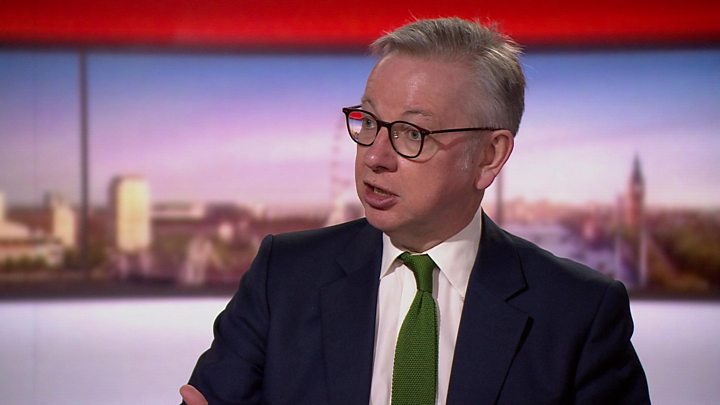
    Senior minister Michael Gove has said he does not think face coverings should be compulsory in shops in England, saying he trusts people’s common sense.

    Speaking to the BBC’s Andrew Marr, Mr Gove said wearing a mask in a shop was “basic good manners”.

    On Friday, Boris Johnson said a “stricter” approach was needed so people wear masks in confined spaces.

    Senior government sources have said the issue is being kept under review, as Labour called for clarity on the issue.

    Currently, face coverings are compulsory on public transport in England, Scotland and Northern Ireland to help stop the spread of coronavirus.

    In Scotland, they are also mandatory in shops. Wales recommends masks but they are not compulsory.

    However, there have been calls for the UK government to make its stance on masks clearer, following comments from the prime minister on Friday.

    Mr Johnson – who was pictured wearing a mask for the first time during a visit to his constituency – said: “I do think we need to be stricter in insisting people wear face coverings in confined spaces where they are meeting people they don’t normally meet.

    “We are looking at ways of making sure that people really do have face coverings in shops, for instance, where there is a risk of transmission.”

    Also on Friday, senior Whitehall sources said the government was considering making face coverings mandatory in shops.

    They said while no decision has yet been made, it is an issue that is being kept under review.

    The Department of Health and Social Care said on Sunday that 44,819 people have now died in UK hospitals, care homes and the wider community after testing positive for coronavirus, a rise of 21 on the previous day’s figures.

    Image copyright
    No 10

    Image caption

    Boris Johnson wore a mask for the first time as he visited a shop in Uxbridge on Friday

    Asked on the Andrew Marr Show about the issue of face masks, Mr Gove said: “I don’t think mandatory, no, but I would encourage people to wear face masks when they are inside, in an environment where they are likely to be mixing with others and where the ventilation may not be as good as it might.

    “I think that it is basic good manners, courtesy and consideration, to wear a face mask if you are, for example, in a shop.”

    The Cabinet Office minister added: “Now of course the government at all times does look at the emerging evidence about what the best way to control the disease is.

    “If necessary, and if tough measures are required and as we have seen in Leicester, obviously a very different situation, then tough measures will be taken.

    “But on the whole… it’s always best to trust people’s common sense.”

    Guidance on face coverings has evolved over the last few months.

    The key issue now is whether people will wear them without being forced to.

    The Scottish government is worried they won’t – and so has told people they have to wear one in shops.

    On Friday, Boris Johnson appeared for the first time in public in a covering and hinted that stricter rules were coming in England.

    But now Michael Gove seems to be saying something different – that we should trust the common sense of shoppers.

    My sources are keen to point out Mr Gove also said the government would take more action when necessary – so mandatory face coverings in England aren’t off the table. His comments are also in line with the policy as it stands just now.

    But at a time when public messaging is crucial, some believe the government view on whether or not stronger action is needed isn’t clear.

    Earlier, Mr Gove told Sky’s Sophy Ridge On Sunday that wearing a face covering “definitely helps you to help others in an enclosed space”. He also urged people to return to work rather than stay at home.

    “We want to see more people back at work, on the shop floor, in the office, wherever they can be,” he said.

    Shadow Cabinet Office minister Rachel Reeves said Labour would support mandatory face coverings for shops, as it “would inspire greater confidence and might encourage more people to go out and spend money”.

    “I think people are increasingly wearing them but I think some greater clarity from government about that, I think, would be helpful,” she said.

    “People want to do the right thing but they want to know what the right thing is. We already have it on public transport.”

    Media playback is unsupported on your device

    Media captionCoronavirus: How to wear a face covering

    In the early days of the pandemic, the UK government was hesitant about advising people to wear face coverings, arguing the scientific evidence that they reduce transmission was “weak”.

    In early June, the World Health Organization changed its advice to say people should wear face coverings in public where social distancing is not possible. The WHO originally said there was not enough evidence to say that healthy people should wear masks.

    Rules compelling people to wear face masks on public transport in England were introduced on 15 June.

    Earlier this week, the WHO said there was “emerging evidence” of airborne transmission.

    Professor Wendy Barclay, who sits on the Scientific Advisory Group for Emergencies, said coronavirus particles can remain suspended and infectious in the air for more than an hour.

    A further 148 deaths were recorded in the UK, according to latest government figures on Saturday, bringing the total number of recorded deaths of people who have tested positive for coronavirus to 44,798.

    • YOU, ME AND THE BIG C: Cancer treatment during the pandemic
    • GROUNDED WITH LOUIS THEROUX: The ten most surprising moments from the lockdown podcast

  • Coronavirus: Primark says no to £30m job retention bonus

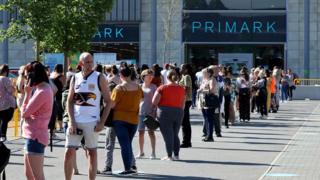
    Shoppers queued outside Primark when it reopened on 15 June

    Image copyright
    Getty Images

    Image caption

    Shoppers queued outside Primark when it reopened on 15 June

    Primark said it will not take advantage of a £30m bonus from the government, potentially putting pressure on other major firms not to take taxpayer money.

    Chancellor Rishi Sunak announced last week that all businesses will be paid £1,000 for each employee they bring back from furlough.

    Primark placed around 30,000 workers on the government’s coronavirus job retention scheme.

    But it said it has now brought them all back and would not ask for the bonus.

    “The company removed its employees from government employment support schemes in the UK and Europe in line with the reopening of the majority of its stores,” said a spokesperson for Primark’s owner Associated British Foods.

    “The company believes it should not be necessary therefore to apply for payment under the bonus scheme on current circumstances.”

    • Summer Statement: Key points at a glance
    • Public spending on crisis soars to £190bn

    Announcing the Job Retention Bonus in last week’s summer economic update, Mr Sunak said: “One of the most important things we can do to prevent unemployment is to get as many people as possible from furlough back to their jobs.”

    Companies can get a £1,000 per person bonus if they bring back an employee from furlough for at least three months after the government’s wage payment scheme ends in October.

    There are currently 9.4 million on the government’s furlough scheme who, if they all returned to work, could cost the public purse more than £9bn in bonus payments.

    Mr Sunak said the Job Retention Bonus scheme would be open to “all” companies.

    But Labour leader Sir Keir Starmer criticised the scheme for not being targeted on those companies that needed it most.

    While he agreed that the government “is right to act”, he said: “Our concern is the action they’ve taken isn’t focused on the right places, so the Jobs Retention Bonus is a bonus for all jobs and many of those jobs, many of the people would have been brought back in any event.

    “Some are really at risk of losing their jobs, so we say it should have been targeted in the areas that most need it.”

    Jim Harra, chief executive of HMRC and the Treasury’s principal accounting officer, refused to sign off on the measure, telling the Chancellor in a letter that it does not represent “value for money”.

    Image copyright
    Getty Images

    Image caption

    Chancellor Rishi Sunak revealed the Job Retention Bonus in his summer economic update

    It is not yet clear if other companies will apply for the bonus. A spokesperson for M&S said it “welcomed” the support shown for businesses during the pandemic.

    “However, at this stage, it’s too early to confirm our plans to use the furlough bonus scheme announced by the chancellor earlier this week.”

    M&S said in May it had put 27,000 staff on furlough who are being brought back on a gradual basis.

    McDonald’s said it is “still working through the details of the chancellor’s announcement” and is unable to comment.

    Primark said it lost sales of around £650m a month through shutting shops because of the coronavirus pandemic.

    The retailer started to reopen European stores in early May. It then reopened all 153 of its shops in England on 15 June.

    What do I need to know about the coronavirus?

  • Top 3 Reasons Why You Should Invest in Business Software Now

    Many companies are cutting costs right now, but adding more tech to your operations can help your bottom line.

    Grow Your Business, Not Your Inbox

    Stay informed and join our daily newsletter now!


    4 min read

    Opinions expressed by Entrepreneur contributors are their own.


    The Organization for Economic Cooperation and Development (OECD) has forecasted that global growth will contract by 6 percent to 7.6 percent in 2020, and it could take years to return to pre-crisis growth levels. Many businesses have instituted blanket spending moratoriums, frozen hiring and deemed most new purchases non-essential. However, some business leaders understand that opportunities exist to optimize business efficiency, capture more market share, and cost-effectively invest in critical infrastructure. HBR suggests playing offense and defense by first stabilizing your business and ensuring liquidity, and then determining how to outmaneuver your competition. 

    The current business environment has caused many software providers to revise their forecasts down for 2020, but some software companies, like my team at Anvyl, have taken a different approach. We have been illustrating the competitive advantages customers can enjoy by spending more money on tools that enable their teams to scale, deliver better customer experiences, and enjoy a clear return on investment. Here are three reasons why investing in software now can make your business more resilient and profitable.

    Related: How Your Business Can Make Professional-Grade Videos on a Bootstrapped Budget

    1. Scale without hiring.

    If you are considering hiring new employees to scale your business, it is important to understand what each new hire will cost your organization. In addition to salary, benefits and payroll taxes; recruiting, onboarding and training a new hire can also be costly. Before hiring, determine if your teams are actually performing at their maximum capacity. Evaluate whether greater efficiencies could be achieved through software, collaboration or better processes. Consider the roadblocks to optimal output and uncover issues that might delay, frustrate, or hinder organizational efficiencies. If you look closely, these opportunities exist in almost any business. 

    For example, one of Anvyl’s clients was able to realize a 300 percent increase in productivity with its existing team by adding collaborative supply chain visibility software. Before evaluating the ROI, the company expected to hire two or three additional employees. Once it uncovered the gaps in its process, the business determined that it could recoup close to 6,000 non-productive manhours by adding collaboration software. This eliminated the need for each employee to maintain a spreadsheet, manually call and email vendors on each order or chase down original files across old email threads. 

    2. Automate repetitive tasks. 

    Artificial intelligence and machine learning tools have become more accessible and affordable to businesses of all sizes and industries. Gartner’s 2019 CIO Survey found that the number of organizations implementing AI grew 270 percent in the previous four years, despite talent shortages. 

    AI/ML software allows you to automate boring or repetitive tasks, freeing your team up to focus on more creative or strategic work. What employee responsibilities could you turn over to technology to boost employee happiness, engagement or productivity? Automated chatbots, data analytics or lead generation and sales tools can go a long way to reduce operational inefficiencies, improve team morale, and maximize results. 

    Related: Report: iPhone 12 Won’t Include a Charger or EarPods

    3. Improve visibility.

    Having transparency in your business operations is crucial when preparing for unforeseen challenges as many manufacturing businesses learned during the peak of these difficult times. It is critical to identify potential disruptions in your business operations and have a plan to mitigate them ahead of time. Implementing real-time visibility software across functional operational areas like supply chain, logistics, sales and customer success will enable proactive, strategic decision making. 

    Your leadership team should have real-time visibility and access to cross-functional data across all departments. Adding software will democratize data across departmental silos mitigating the risks of lost data through unexpected employee departures and will also enable timely strategic decision making. 

    Economic downturns are unavoidable, but recognizing the opportunity and taking decisive action can dramatically improve your business trajectory. Focus on optimizing business efficiency, capturing more market share and investing in the future of your business.