Category: iT news

  • Young people ‘feel anxiety and terror’ using fitness apps

    Woman checking fitness tracking watch

    Image copyright
    Getty Images

    Image caption

    Use of fitness tracking technology has become commonplace among runners in recent years

    Young peoples’ use of phone apps to monitor and improve their health has led to “obsessive behaviour, anxiety and terror”, a study has suggested.

    The Digital Health Generation said children as young as eight were using the internet as part of their quest for fitness, a six pack or a thinner body.

    It warned the use of fitness trackers, while “potentially motivating, could lead to obsessive behaviour”.

    Respondents also said the apps should identify when users needed to stop.

    Jack Bardzil, 19, from Bath, said he could see how fitness trackers and apps could make people paranoid.

    Image copyright
    Jack Bardzil

    Image caption

    Jack Bardzil is now studying chemistry at UCL

    “There are heartbeat monitors and in the future they might have glucose monitoring… these things can lead to paranoia,” he said.

    And he said the way social media sites sometimes promoted content based on users’ previously-viewed material felt “upsetting…. [as] they can keep shoving it down your throat”.

    The survey noted the use of health and fitness apps could contribute to some young people over-exercising or engaging in harmful dietary practices.

    Image caption

    More than 70% of young people, some as young as eight, are using apps and other digital online technologies to track and manage their health, according to the authors

    One respondent, named Leif, said society judged people by their appearances and many went to great lengths to improve their physique.

    “There’s a fine line between going too far and developing an obsession,” he said.

    “I think, a lot of these fitness apps… you’re not seeing the results you want to see instantly.

    “I’ll look in the mirror and be like ‘Why am I not ripped yet?’.”

    Another respondent, Daphne, said she had become obsessed with an app that tracked her food intake and exercise and her sister had told her to delete it from her phone.

    Image copyright
    Getty Images

    Image caption

    Many young people “lacked comprehension” of how their personal health data is stored or who can access it

    Tom Madders, from the children and young people’s mental health charity YoungMinds, said while fitness tracking could be a positive experience, when it became “all-consuming” this could cause negative consequences for mental health.

    “For some young people, fitness trackers may exacerbate disordered eating and exercise, and it’s important that they are designed in a way that minimises the risks – for example, by not bombarding people with notifications,” he added.

    Nearly half the participants said they struggled in finding accurate medical information online.

    One respondent, Andrew, spoke of how easily searching symptoms online could lead to a “ridiculous” diagnosis that only made the person even more anxious.

    He said, for example, typing in symptoms often produced an article wrongly suggesting “you’ve got cancer and you are going to die tomorrow”.

    “That kind of panic, I think, is pretty prevalent on the internet,” he said.

    “I think there are a lot of amateurs who think that they know a lot more than they actually do, and they’re undoing all the work that the NHS is trying to do.”

    Prof Emma Rich, from the University of Bath, said the two-year study looked at how 1,019 people aged between 13 and 18 engaged with digital health via apps, social media, and the internet.

    The research suggested as a result schools should expand their digital literacy lessons to include health matters.

    Prof Rich said many participants used apps to to track their sleep, diet, heart rate and menstrual cycle, but often what the trackers said did not tally with how their bodies felt.

    She was concerned people were constantly checking fitness trackers and worried the “gameification” of health apps led to obsessive behaviour in an attempt to get the most shares or likes from their peers.

    “Many spoke of the need for health and fitness apps to come with warning alerts… advising them on when they might be exercising or dieting excessively.”

    And Elliot, 14, said: “I think if you’re going to have a [fitness] app it needs to tell you when to stop, to stop you going too far.”

    The study was conducted by the universities of Bath, Salford and University of Canberra,
  • Bringing Mars back to Earth

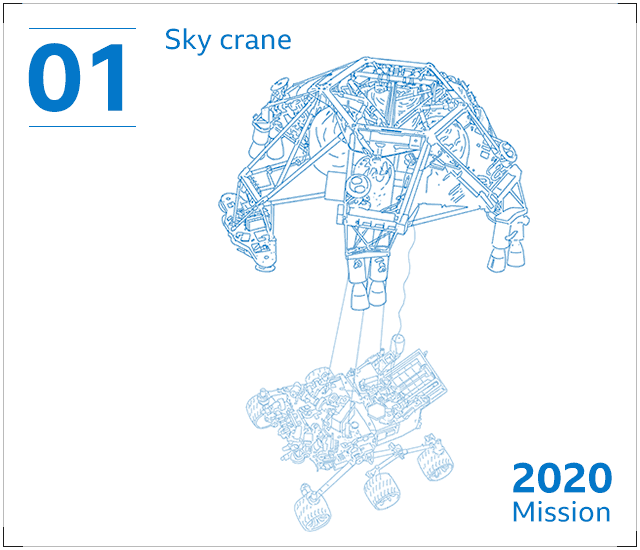
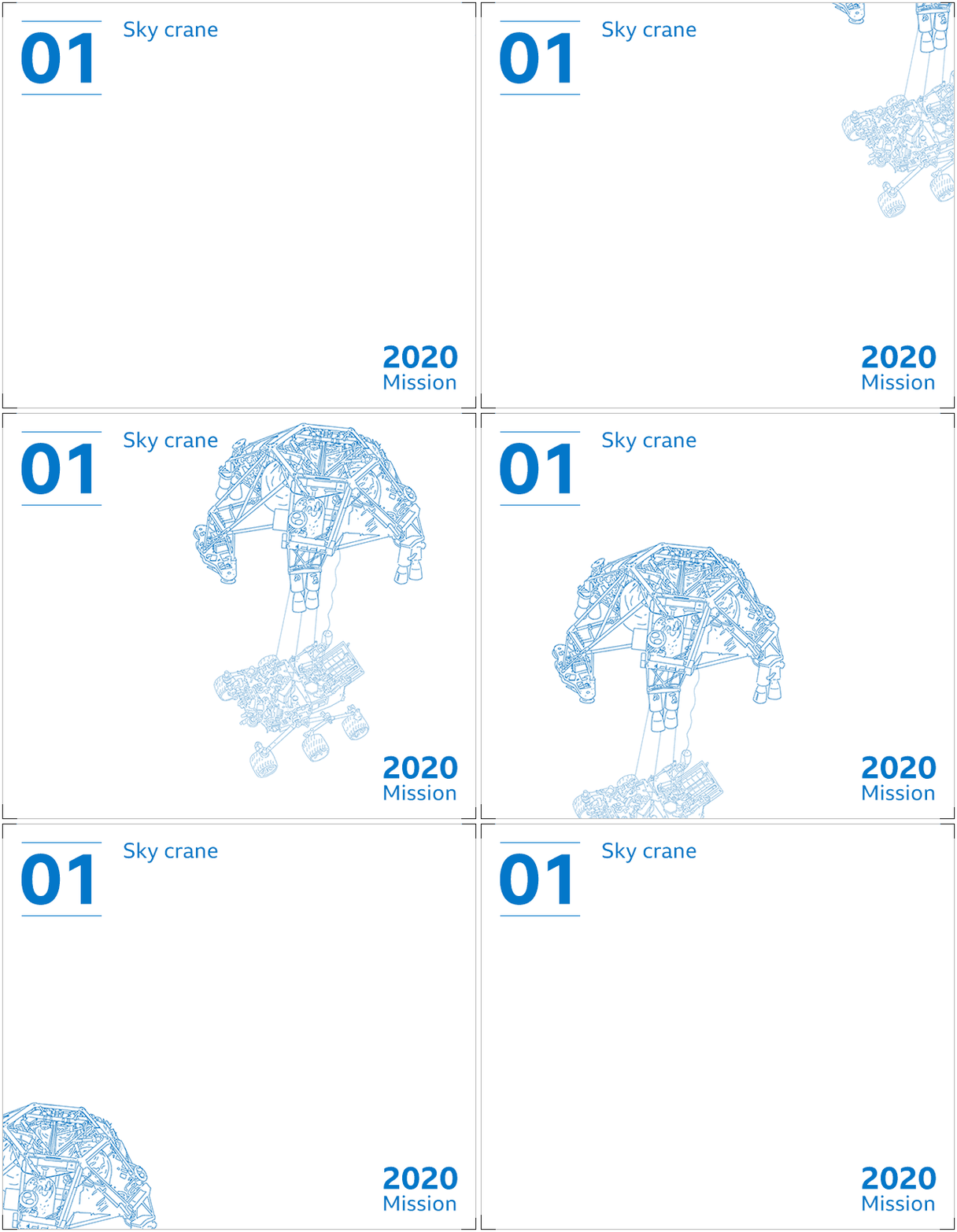
    The 'sky crane' is used to slow the rover's descent to Mars and lower it to the surface using cables.

    The 'sky crane' is used to slow the rover's descent to Mars and lower it to the surface using cables.

    A new rover built by Nasa and named Perseverance will land on Mars in February 2021 using the “sky crane” method. A giant parachute and rocket motors will slow the mission’s descent before the rover is lowered to the surface using cables.

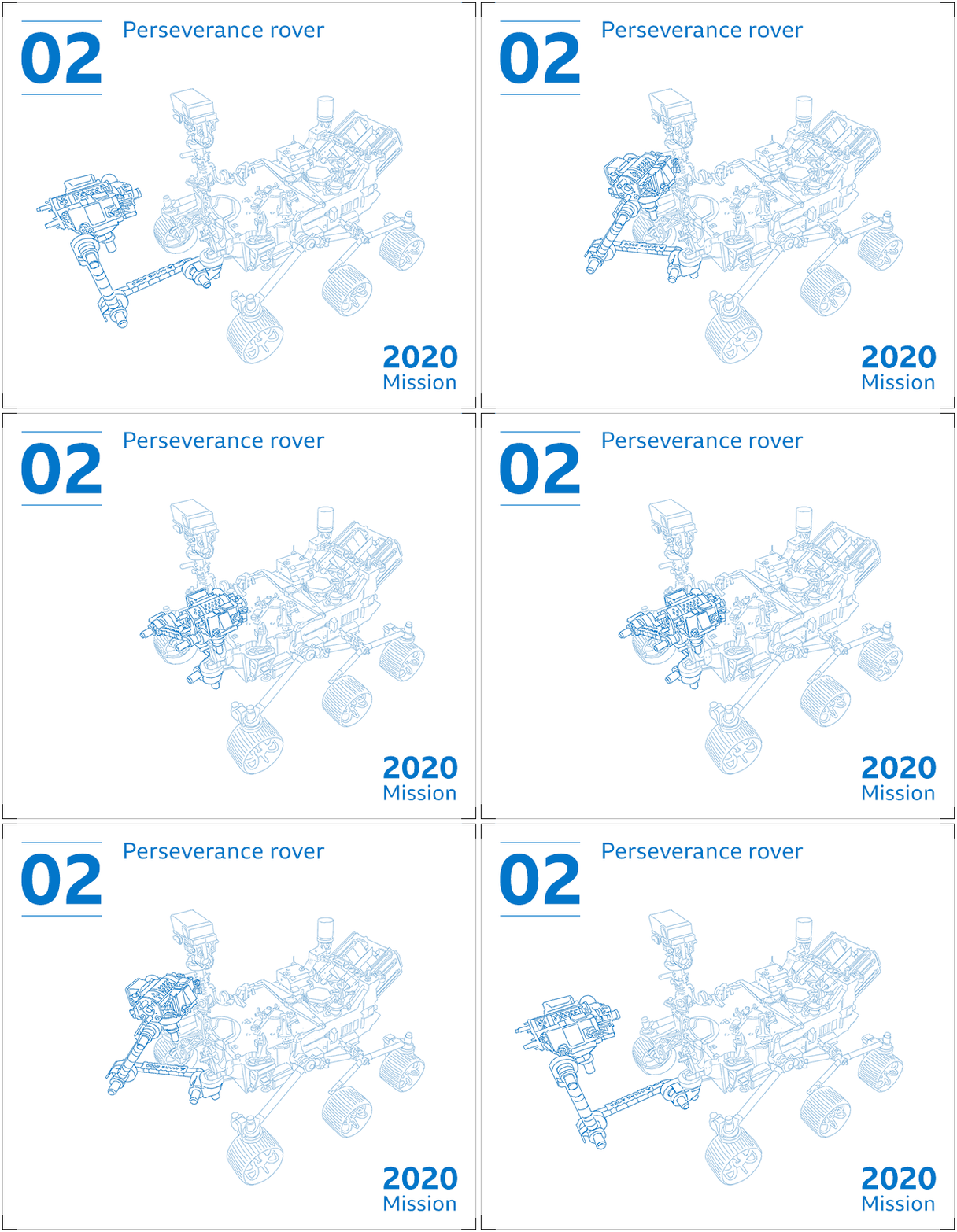
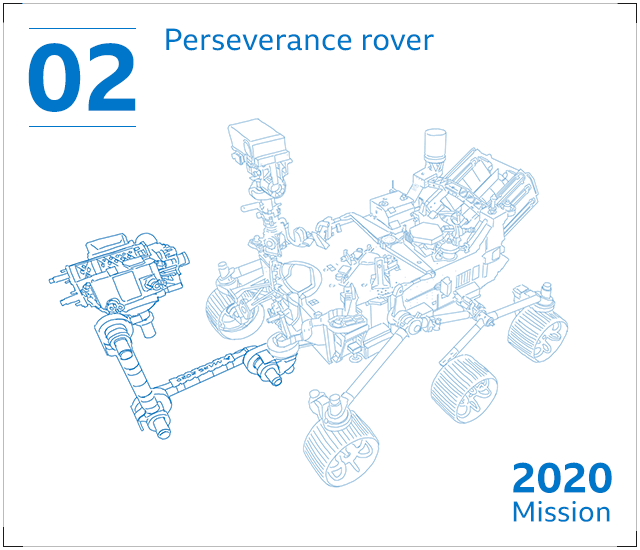
    Nasa's latest Mars rover is a six-wheeled robotic machine named Perseverance

    Nasa's latest Mars rover is a six-wheeled robotic machine named Perseverance

    Perseverance – a six-wheeled robotic machine with 23 cameras and a drill – will seek signs of ancient life in a large crater called Jezero. It will collect rock and soil samples that look like they may have been altered by contact with micro-organisms.

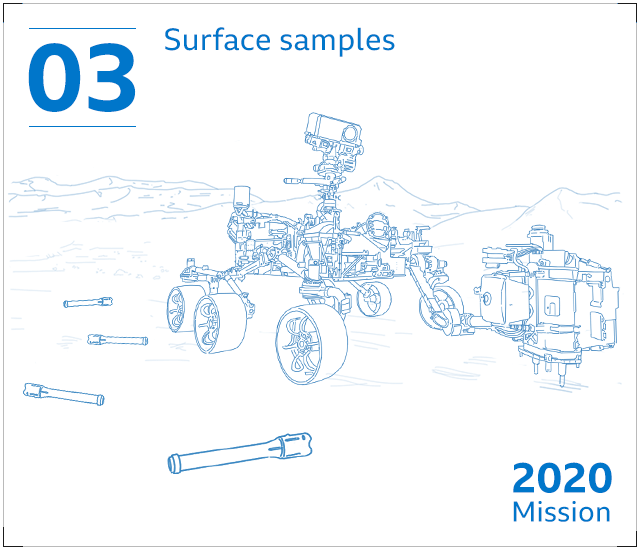
    The Perseverance rover collects and stores samples of Martian soil and rocks in metal canisters, which it leaves behind on the surface

    The rover will store its samples in metal canisters – but leave them behind on the Martian surface to continue its mission. Perserverance’s plutonium-based power supply could keep the rover trundling around Mars for 10 years or more.

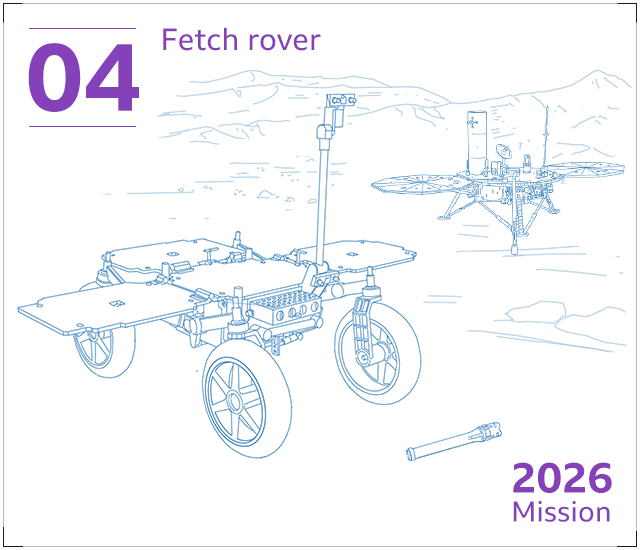
    A small robotic machine called the fetch rover collects the samples left behind by Perseverance

    Later this decade – after 2026 – a second, smaller rover, to be built by the European Space Agency (Esa), will arrive on Mars. This “fetch rover” will travel across the surface picking up the sample canisters left behind by Perseverance.

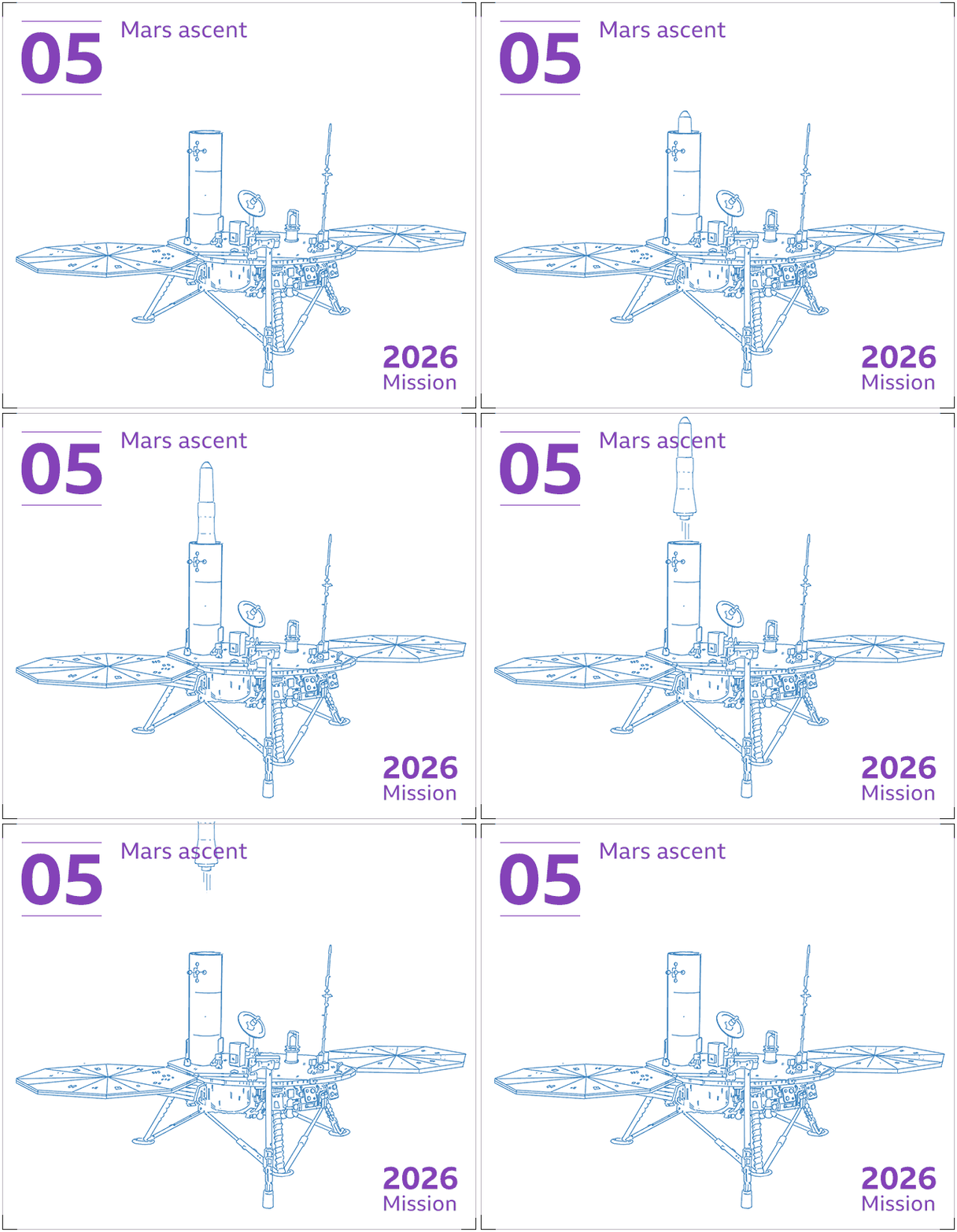
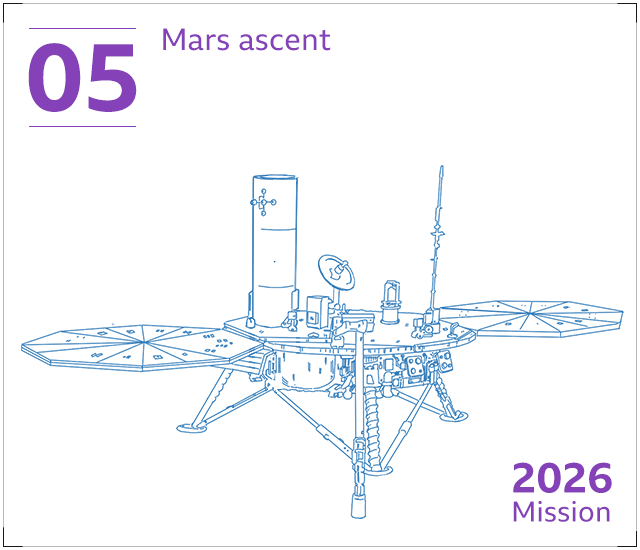
    The samples are fired out of the Martian atmosphere into orbit by a small rocket called the Mars Ascent Vehicle or MAV

    The samples are fired out of the Martian atmosphere into orbit by a small rocket called the Mars Ascent Vehicle or MAV

    The canisters will be loaded into a protective container and placed into a small rocket – the Mars Ascent Vehicle or MAV. This will blast into the sky, placing the container into orbit around Mars.

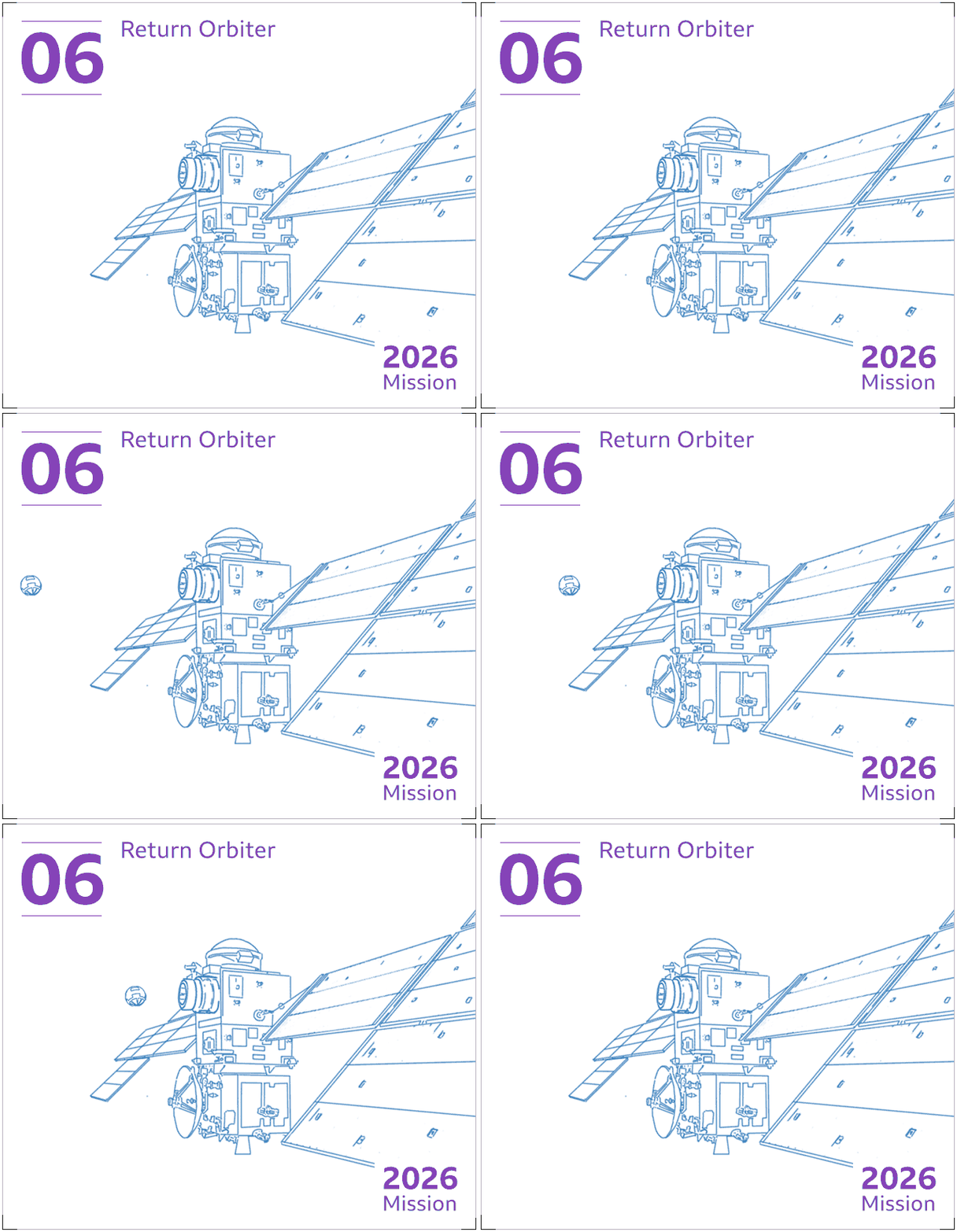
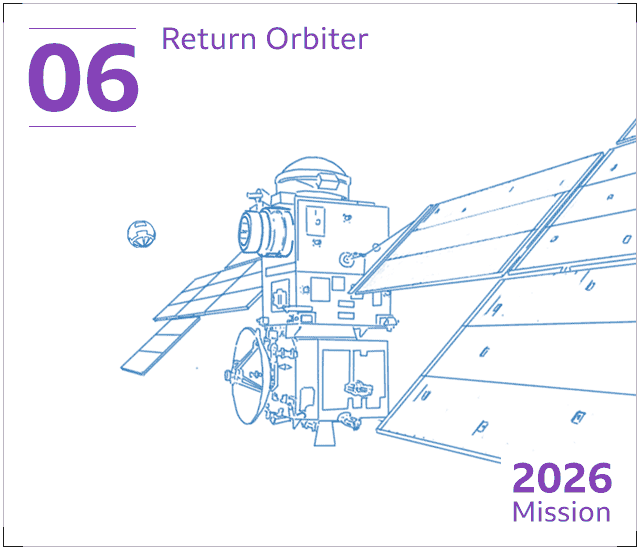
    The sample container is caught by the satellite return orbiter

    The sample container is caught by the satellite return orbiter

    The sample container will be met in orbit and caught by a European satellite. This “return orbiter” will act like a cargo ship, bringing the precious rock and soil specimens back to Earth.

    The rock samples are carried back to Earth by the return orbiter and released into the atmosphere in a heavily-protected container

    The rock samples are carried back to Earth by the return orbiter and released into the atmosphere in a heavily-protected container

    We don’t expect the satellite to arrive home until at least 2031, by which time the sample container will have been packaged in a heavily protected capsule, to be sent into Earth’s atmosphere to land in North America.

    Martian rock samples being studied in an Earth laboratory

    Scientists will then study the rocks and soil using advanced techniques, including some that have yet to be invented because there should be enough material to investigate for decades ahead. The samples will shed light on Mars’ history and whether it has ever supported microbial lifeforms.

  • TikTok blasts ‘copycat’ Facebook as US starts probe

    The TikTok logo is seen here partly covered by a ring of alternating US and Chinese flags

    Image copyright
    Reuters

    Image caption

    Caught between nations: Chinese-owned TikTok faces a US investigation

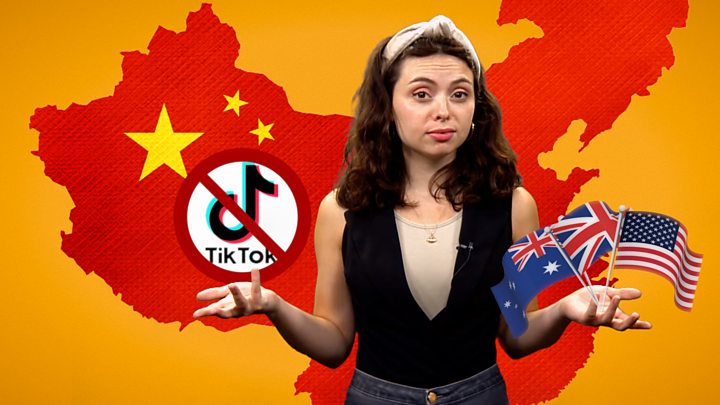
    TikTok has launched a direct attack on Facebook, accusing it of being a “copycat” and trying to end TikTok’s presence in the US under the guise of patriotism.

    It comes as TikTok, owned by Chinese firm ByteDance, faces fresh scrutiny.

    US Treasury Secretary Steve Mnuchin said TikTok was now being reviewed over national security concerns.

    Meanwhile, Facebook and other big tech firms are due to defend their practices in front of the US Congress.

    Facebook’s Mark Zuckerberg will join Sundar Pichai from Google, Apple’s Tim Cook and Amazon’s Jeff Bezos to answer questions from politicians on Wednesday.

    TikTok has long battled allegations that it is too close to the Chinese state – something it fiercely denies.

    Announcing the review, Secretary Mnuchin said TikTok was being investigated by the Committee on Foreign Investment in the United States (CFIUS), which examines commercial transactions for national security concerns.

    He did not say if it was linked to ByteDance’s purchase of the Musical.ly app, which Reuters previously reported was being looked at by CFIUS.

    A recommendation would be made to President Donald Trump this week, he said. Mr Trump separately said that his administration was “thinking about” making a decision on the app later this week.

    It came shortly after TikTok published a firmly worded defence of its role in the United States.

    ‘Not the enemy’

    Chief executive Kevin Mayer said that while big firms “rightly” come under scrutiny, “we have received even more… due to the company’s Chinese origins”.

    He went on: “TikTok has become the latest target, but we are not the enemy”.

    He also took direct aim at Facebook, writing off its new Instagram Reels feature as a TikTok clone.

    Media playback is unsupported on your device

    Media captionWATCH: Will TikTok be banned?

    Much like Tiktok, the app is focused on short-form ephemeral video.

    “Facebook is even launching another copycat product, Reels (tied to Instagram), after their other copycat Lasso failed quickly,” Mr Meyer’s statement said.

    Lasso had been referred to as “a TikTok clone” by media outlets for its similarities, but was shut down in July.

    Mr Meyer also defended the cultural impact of TikTok, and warned that without his firm, American advertisers would be left with fewer options.

    A repeated theme was that TikTok was good for competition. Without it, he wrote, “competition would dry up and so too will an outlet for America’s creative energy”.

    He also insisted the company had no political leanings or agenda.

    This is not the first time TikTok has faced trouble. It was recently banned in India amid heightened tensions between that country and China.

    A lawsuit filed in December alleged that TikTok sent “vast quantities” of user data back to mainland China – something the company denies.

    US politicians have frequently criticised the social network, with Secretary of State Mike Pompeo warning it may be banned.

    When asked if he would recommend downloading it, he replied: “Only if you want your private information in the hands of the Chinese Communist Party.”

  • Wiley apology for tweets ‘that looked anti-Semitic’ after Twitter ban

    Wiley performs on the main stage on Day 1 of Wireless Festival at Finsbury Park on July 6, 2018 in London, England

    Image copyright
    Getty Images

    Grime artist Wiley has apologised for “generalising” Jewish people after being banned from social media.

    In an interview with Sky News, the artist insisted: “I’m not racist.”

    “My comments should not have been directed to all Jews or Jewish people. I want to apologise for generalising, and I want to apologise for comments that were looked at as anti-Semitic.”

    Twitter had earlier banned his account permanently after a public backlash over a perceived lack of action.

    “We are sorry we did not move faster,” Twitter said in a statement.

    Sky published excerpts of an interview with the rapper, which it plans to broadcast later.

    It reported that the offensive tweets were sparked by a falling-out between the rapper and his former manager, who is Jewish. The pair cut ties in recent days.

    “I just want to apologise for generalising and going outside of the people who I was talking to within the workspace and workplace I work in,” Wiley said.

    “I’m not racist, you know. I’m a businessman. My thing should have stayed between me and my manager, I get that.”

    However, Sky News said the artist “refused to distance himself from most of the anti-Semitic comments he posted on social media” during the interview.

    Wiley’s series of anti-Semitic tweets appeared on Friday night.

    One tweet read: “I don’t care about Hitler, I care about black people”, and compared the Jewish community to the Ku Klux Klan.

    Media playback is unsupported on your device

    Media captionRapper Wiley’s Twitter account has been suspended after anti-Semitic posts

    Twitter did not immediately respond, prompting a public outcry and a 48-hour boycott of Twitter by many users over what they said had been an unacceptable delay.

    The social network eventually banned Wiley for violating its “hateful conduct” policy – a day after Facebook and Instagram had deleted the music star’s accounts for “repeated violations” of their rules.

    Twitter said it had decided to make an earlier temporary ban permanent, and wipe all his past posts from its platform, “upon further consideration”.

    “We deeply respect the concerns shared by the Jewish community and online safety advocates,” the statement said, promising to continue to tackle anti-Semitism.

    The star, known as the “godfather of grime”, was awarded an MBE for services to music in 2018.

    He told Sky News that he “never wanted it” and would be willing to forfeit the honour.

    “I never felt comfortable going to get it. Just look at Britain’s colonialism history,” he said.

    Analysis

    By Marianna Spring, specialist disinformation and social media reporter

    The permanent suspension of the rapper’s Facebook, Instagram and Twitter profiles has been widely welcomed.

    However, it is emblematic of a slowness to act on hateful abuse from social media sites. And many are asking why this took so long.

    Time and time again, decisive action from social media sites over racist abuse, misinformation or hate speech has come only once comments have reached thousands of users.

    What does it take for Twitter to act decisively on anti-Semitic abuse?

    In this case it appears to be external pressure – the move comes after a boycott by users.

    And it also seems to be dependent on what the other social media sites choose to do: Facebook moved to suspend Wiley’s accounts on Tuesday, and then Twitter appeared to follow suit.

    With the Stop Hate for Profit campaign ramping up pressure, and increased focus on the way social media sites tackle hate speech and misinformation, the spotlight will intensify on the actions of Twitter, Facebook and Google in these scenarios.

    The delay in Twitter taking action prompted the 48-hour boycott of Twitter by many users – including celebrities and MPs – beginning on Monday morning. Organisers said the time reflected the “48 hours of pure race hate” they accuse Twitter of giving to Wiley.

    On Tuesday, Facebook issued a ban after Wiley was discovered posting abusive material on his personal page using his real name, Richard Cowie.

    Twitter followed suit on Wednesday, after what it said was a thorough investigation.

    Despite the move, the Board of Deputies of British Jews said both Twitter and Facebook had been slow to act, adding “it is just not good enough”.

    “Social media companies have not been strong or fast enough about tackling racism, misogyny or homophobia,” it said in a statement.

    The Campaign Against Antisemitism echoed that sentiment, writing that Twitter “has finally listened”.

    “The closure of Wiley’s account is too little too late, but it is at least a start for this deeply irresponsible social network,” it said.

  • Google offers refunds after smart glasses stop working

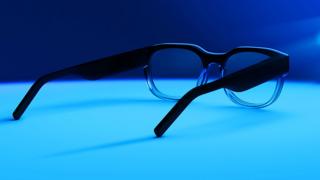
    A stock image of North AR glasses on a table lit by blue lights

    Image copyright
    North

    Smart glasses company North has told customers that their $600 (£460) purchases will stop working in a few days’ time.

    The Canadian company, recently purchased by Google, says its Focals glasses will cease functioning on Friday.

    From then, owners will not be able to use “any features” of the glasses, or connect to the companion app.

    But the company has also said it will automatically refund all customers.

    It promised to send the purchase price back to the original payment method, and to contact those customers whose refunds it could not process.

    At the end of June, North announced it was being acquired by Google, and would not release a planned second-generation device.

    It also said it would “wind down” its first generation smart glasses, released last year.

    Customers found out that meant the smart glasses would be rendered “dumb” through a statement published on the company’s website and by email.

    The Focals glasses, however, come with prescription lenses as an option, meaning they can function as everyday prescription eyewear. The bulky frames, housing a laser, battery, and other kit will no longer do anything that regular spectacles cannot do.

    Ben Wood, chief analyst at CCS Insight, said the pulling of features from cloud-powered hardware is not uncommon – and something that has happened to him before.

    “If you want to be an early adopter and have some fun new tech that an ambitious start-up has created, there’s always a risk that they won’t be able to make the business plan stack up,” he warned.

    “That could either mean the service stops working or you end up finding you have to pay additional charges to maintain service continuity.”

    Not-so-smart homes

    There have been several examples of internet-enabled smart devices that are suddenly rendered “dumb”, losing many features or even becoming unusable when the company changes its business model.

    For example:

    Google made an early but ill-fated attempt to make smart glasses mainstream with its Google Glass product in 2013.

    When it bought North, Google said the company’s “technical expertise” would help it realise its vision of an “ambient computing” future.

    And despite the short notice, Mr Wood says the offer of a full refund for North customers is “exceptionally generous”, and the best approach from a customer relations point of view.

    “For Google, given the small number of North glasses that were actually sold to real end users, it’s a rounding error,” he said.

    “But not all people who invest in startups will be that lucky.”

  • Turkey’s MPs vote to tighten grip on social media

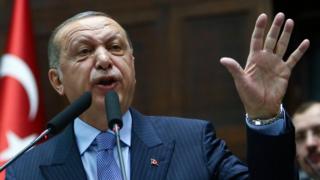
    President of Turkey and the leader of the Justice and Development Party (AK Party) Recep Tayyip Erdogan

    Image copyright
    Getty Images

    Image caption

    Turkish President Recep Tayyip Erdogan has said social media platforms are “immoral”

    Turkey’s parliament has passed a law to control social media platforms, a move human rights groups say poses a severe threat to freedom of expression.

    The law requires social media firms with more than a million Turkish users to set up local offices and comply with requests to remove content.

    If companies refuse, they face fines and may have data speeds cut.

    Facebook, Twitter and YouTube have not yet commented.

    President Recep Tayyip Erdogan has described social media sites as “immoral” and made no secret of his desire to see them tightly controlled.

    The bill was submitted by the ruling AKP and its partner the MHP, which together have a majority in parliament, and passed on Wednesday morning.

    In the past Turkish authorities have temporarily cut internet bandwidth to stop citizens using social media, after terror attacks.

    Under the new law, social media platforms face cuts of up to 95% of bandwidth, rendering them unusable.

    ‘Brazen attack’

    The internet remains a crucial tool for dissent in the country and critics say the move will lead to more censorship. The hashtag #SansurYasasinaDurDe (Say Stop to the Censorship Law) has been trending on Twitter since Tuesday.

    Amnesty International describes it as “the latest, and perhaps most brazen attack on free expression in Turkey”.

    “The internet law significantly increases the reach of the government to police and censor content online, exacerbating risks to those who are already ruthlessly targeted by the authorities simply for expressing dissenting opinions,” said the human rights group’s Turkey researcher Andrew Gardner.

    Presidential spokesman Ibrahim Kalin denied that the bill would lead to censorship, saying it was intended to establish commercial and legal ties with the social media platforms.

  • How much power does tech ‘big four’ have?

    Amazon, Apple, Google and Facebook are the US tech companies that make up the ‘big four’, and together they’re worth $4tn (£3.1tn).

    Each of these companies holds a large percent of the market in their respective industries, so but lawmakers are wondering if they hold too much.

  • Coronavirus: Kodak pivots itself to become strategic drug maker

    Kodak began making drug ingredients four years ago but will not dramatically expand production.

    Image copyright
    Getty Images

    Better known for making cameras, Kodak has moved into drug making and has just secured a $765m (£592m) loan from the US government.

    The fallen giant of the photography industry will make ingredients used in generic drugs to help fight the coronavirus.

    Announcing the loan, the US government said it wanted to reduce dependency on foreign countries for medical supplies.

    Shares in Kodak shot up more than 60% on Tuesday after the announcement.

    Pharmaceutical firms are in a race to find a vaccine for the coronavirus with a handful of human trials underway.

    “Kodak is proud to be a part of strengthening America’s self-sufficiency in producing the key pharmaceutical ingredients we need to keep our citizens safe,” said its executive chairman Jim Continenza.

    At the launch of Kodak Pharmaceuticals, Mr Continenza said it would take three or four years to reach large-scale production.

    “If we have learned anything from the global pandemic, it is that Americans are dangerously dependent on foreign supply chains for their essential medicines,” Peter Navarro, a White House spokesman, said.

    US President Donald Trump called it “one of the most important deals in the history of US pharmaceutical industries” referring to Kodak as “a great American company — you remember this company”.

    Kodak is not the only photography firm to shift direction into drug making. Japan’s Fujifilm is working on a potential Covid-19 vaccine and hopes to start human trials soon.

    Fallen giant

    The Eastman Kodak Company was founded by George Eastman in 1888. The Brownie box was one of its most popular cameras and helped Kodak become a dominant player in the photographic industry.

    The company became famous for its “Kodak moment” tagline but began to struggle financially in the late 1990s as consumers moved away from photographic film and towards digital photography.

    At its peak Kodak employed more than 145,000 people but now has a global workforce of around 5,000.

    In 2012, Kodak filed for Chapter 11 bankruptcy protection in the US and and shifted its focus onto printing and professional services for companies. But it does still make digital and instant cameras for consumers.

    Kodak began making drug ingredients four years ago and will now dramatically expand production at its New York and Minnesota facilities.

  • MacKenzie Scott donates $1.7bn since Amazon boss divorce

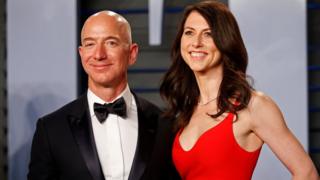
    Jeff and MacKenzie Bezos

    Image copyright
    Reuters

    Image caption

    MacKenzie Scott with ex-husband Jeff Bezos prior to their split

    MacKenzie Scott, Amazon boss Jeff Bezos’s ex-wife, says that she has given $1.7bn (£1.3bn) to charity to date.

    She has made donations to historically black US colleges, climate change groups and health organisations.

    Ms Scott posted about the gifts on social media, also saying that she has changed her surname from Bezos.

    She is the second-richest woman in the world, with a fortune of more than $62bn, according to Forbes.

    She and Mr Bezos divorced last year.

    The novelist, who married Mr Bezos a year before he founded Amazon and was one of the firm’s first employees, received a 4% stake after the split.

    Shortly after announcing the divorce, Ms Scott signed the Giving Pledge, joining a campaign founded by billionaire investor Warren Buffett and ex-Microsoft boss Bill Gates and his wife Melinda. It commits the wealthy to give away the majority of their fortunes to charity.

    Ms Scott said she had “watched the first half of 2020 with a mixture of heartbreak and horror” and was providing an update on the donations to draw attention to the causes during the coronavirus pandemic.

    “My own reflection after recent events revealed a dividend of privilege I’d been overlooking: the attention I can call to organizations and leaders driving change,” she wrote in a blog post on Medium.

    Tech hearing

    Ms Scott’s announcement comes the day before Mr Bezos is scheduled to testify before US lawmakers in Washington. The hearing is part of a wider investigation into the power held by tech giants, including Amazon, Google and Facebook.

    Amazon in particular has been under fire in recent months, including from its own staff, over its environmental record and coronavirus safety measures. The online giant has faced calls to be broken up, including from Tesla boss Elon Musk.

    Mr Bezos, the richest man in the world, has also been subject to personal criticism for not giving away more of his wealth.

    In 2018, he established a charitable fund with a starting pledge of $2bn. This year, he committed $10bn to fight climate change and $100m to hunger relief fund, Feeding America.

    He has not joined the Giving Pledge. As well as Ms Scott, other signatories include Facebook founder Mark Zuckerberg and wife Priscilla Chan, Elon Musk and eBay founder Pierre Omidyar and wife Pam.

    Ms Scott said she had given more than $586m to racial justice organisations and $399.5m to groups aimed at advancing economic mobility. Other causes included gender equality, global development and LGBTQ equality.

    The list of organisations includes those linked to former US presidents Barack Obama and George W Bush, the labour advocacy group One Fair Wage, and other non-profits such as Black Girls Who Code.

    The $20m gift to Tuskegee University, a historically black college, is the largest in the school’s history, president Lily McNair said.

    “There’s no question in my mind that anyone’s personal wealth is the product of a collective effort, and of social structures which present opportunities to some people, and obstacles to countless others,” Ms Scott wrote in a blog post on Medium.

    The groups “offer an opportunity to invest our good fortune in change, no matter what form our good fortune has taken”, she added.

    Ms Scott’s approach differs from that of many other high-profile billionaires, said Brian Mittendorf, a professor at Ohio State University, who researches charity finances.

    He said announcements are often built up in advance, with donors opting to create new organisations to distribute funds, which can make it more difficult to see how the money is being put to use.

    “If the goal of doing this was to generate publicity, you wouldn’t have done it the way she did,” he said. “If the goal was to generate impact… this looks like a pretty good way of doing it.”

    The donations come at a time of need as many charities are seeing a spike in demand due to the pandemic as gifts from smaller donors are declining, Prof. Mittendorf said.

    The list of recipients suggests Ms Scott is trying to address root causes of inequality and racial injustice – priorities that are “more typical” of female than male donors, said Una Osili, a professor of economics and philanthropic studies at Indiana University’s Lily School of Philanthropy.

    The effort to promote a diverse group of organisations – both big and small, led by people of colour and women, also stands out, she said.

  • Reprimand for Wish over nipple tassel ad on BBC recipe app

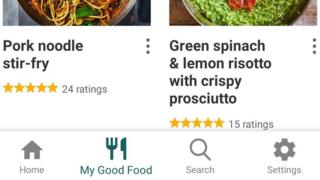
    One of the adverts appeared on the BBC's Good Food app

    Image caption

    One of the “inappropriate” ads appeared on the BBC’s Good Food app

    US online retailer Wish has been reprimanded for promoting “overtly sexual” adverts on platforms that should have been suitable for children.

    It included an advert for a sex toy and one showing a woman wearing nipple tassels.

    UK watchdog the Advertising Standards Authority (ASA) said that Wish.com must ensure that their advertisements are “appropriately targeted”.

    Wish did not agree that the adverts could cause “widespread offence”.

    In 2018, Wish.com breached similar guidelines three times in five months.

    • Coca-Cola halts social media ads over hate content
    • Ben & Jerry’s joins Facebook ad boycott

    The latest rulings involved four adverts that appeared in April and May 2020.

    One of the ads featured on the BBC’s Good Food Guide app.

    It showed a woman from the neck down wearing a corset with her chest partially exposed, covered only by nipple tassels.

    Three further advertisements, including one that featured an image of a male sex toy accompanied by descriptive language, were seen on the Google Play and Google News apps.

    “We considered consumers using apps for recipes, the news and playing solitaire would not expect to see sexually explicit content,” the ASA said in its ruling.

    “We therefore concluded that in those contexts the ads were likely to cause both serious and widespread offence.”

    Limited punishment

    Wish agreed that the ads might not have been appropriate for all forums but did not agree that they were likely to cause serious or widespread offence.

    Immediate Media, the creators of the BBC Good Food app, said the advert in question was delivered as a result of programmatic advertising – the automated buying and selling of online adverts.

    The company did not consider the ad to be suitable for the app’s audience.

    The ASA has limited powers to punish offenders, but it told the BBC it can hand out a number of sanctions to deter repeat offending.

    “We can place our own ads in Google searches, stating that a particular advertiser has broken the rules,” said the spokesman.

    The authority can also invoke mandatory pre-vetting for advertisers who have broken rules on grounds of taste and decency.

    “An advertiser’s reputation can be badly damaged if it is seen to be ignoring rules designed to protect consumers,” added the spokesman.

    The ASA did not explain in its ruling why, given Wish’s previous breaches, it had chosen a reprimand rather than one of the other sanctions.

    It does not have the power to impose fines.