Category: Business News

  • How to Run a Remote Startup Across Time Zones

    It wasn’t long ago that office life was simply a part of every day life. A person with a “real job” made the daily commute to the office, like it or not. They chatted around the water cooler, and then wasted much of the day dodging the boss and avoiding nosy colleagues.

    Times have changed, and anyone with an eye on trends could have seen it coming. As the world went web-based, so did the traditional office space. A study by Global Workplace Analytics says, “Regular work-at-home, among the non-self-employed population, has grown by 115 percent since 2005.”

    Innovative communication tools have evolved to accommodate this new work force. There are tools, apps and programs galore to reconcile time zone differences, connect people virtually and back up the promises of increased productivity.

    But, remote teams face challenges, too, and it’s easy for them to fall apart without the right supports in place. If you are considering a remote startup, here is some advice on how to set up for success.

    Related: How to Start a Business With (Almost) No Money

    Cast a wide net.

    One of the most noteworthy benefits of remote teams is that the talent pool instantly becomes global. In other words, your potential team is no longer dictated by the boundaries of your head office’s city and suburbs.

    More than ever, and especially with millennials, people are embracing a nomadic lifestyle. Why not spend a year in Zanzibar? Or, why not hire a talented team member who wants to spend a year in Zanzibar? There are plenty of remote job boards to tap into.

    Adjust for time zones.

    Now that you’ve assembled your global team of superstars, the challenge is to coordinate.

    While some say that time zones are outdated and counter-productive, we still currently live with them.

    Instead of installing six clocks set to different times on your home office wall, consider tools like Every Time Zone or World Time Buddy. Easily customized, you can add cities at your will and watch a tracker in real time so you’re not expecting your colleague to answer a question at midnight.

    Create a water cooler commons.

    The water cooler effect has both positives (shared theories about what happened on Mr. Robot last night) and negatives (creates fertile ground for office gossip). But, overall it’s a good thing, and the remote team needs a chance to bond, too.

    Thankfully, there are some excellent ways to create a virtual space where everyone is included but no one needs to wear pants. The two most popular options are HipChat and Slack, with Slack edging ahead of the competition. The virtual communication tools connect team members and offer messaging sub channels, direct messages, customized calendars, task assignments and so on. You can start a channel dedicated to awesome high-five gifs or unexpected animal friendship videos. This can be instrumental in building a company culture for people to become invested in.

    Related: Need a Business Idea? Here are 55

    Stay organized.

    One of the biggest trials is keeping your team on task and organized. Communication is key here, and using tools to create a virtual white board work well. Trello is a popular one that allows users to make boards, lists, and cards to stay organized and set priorities.

    You also need a system to make it easy to share large folders and documents, like Dropbox Paper, which has added functionality for collaboration. Anthony Wan, co-founder of Gfresh, combines Slack, Trello, Dropbox Paper and Uber Conference to create a seamless, organized system.

    While having clear tasks is necessary, it’s also a good idea to organize and stick to a schedule for a weekly Skype session or time when everyone can join a Google Hangout. Having this kind of clear, reliable communication means that fewer things will slip through the cracks and trust between teammates will build.

    Mandate a buddy system.

    Remote work can get lonely, and without person-to-person contact, productivity can slip.

    One interesting way companies combat this is by having mini team check-ins. It’s like a buddy system where you have an assigned colleague/friend. But, instead of making sure they are on the bus with you, you connect to make sure they’re on track with their job.

    The teams can be randomly assigned so two unrelated team members get a chance to dive deep into each other’s work and have the opportunity to explain their own work in detail. Switching up the teams every week will create interesting cross-sections and encourage relationships to blossom.

    Related: 5 Low-Cost Franchises You Can Start for as Little as $4,000

    Bring it all together, now.

    Yes, the point of having remote teams is to work remotely, but it’s great to link up face-to-face at least once a year.

    By now, your business should be taking off because you’ve hired the best people from around the world and have implemented the most cutting edge productivity practices, so you can afford it.

    Having your remote team meet up at relevant trade shows kills several birds with one stone. It allows your remote folks work together as a face-to-face team, hone their sales and marketing skills in a direct environment, and gives them valuable feedback from clients and prospects. This gives them valuable insight into how they can best use their skills, but make sure they know how to play the trade show game.

    If you ask remote employees why they pursued their remote position, the answer will often be because they didn’t feel productive or happy in an office setting. As a business owner or manager, this creates an interesting opportunity to capitalize on.

    Running a tight ship takes strategy, diligence and flexibility. But, you might as well take a chance. If you don’t, you might get left behind.

  • Alibaba surges while Walmart stalls

    Alibaba signImage copyright
    Getty Images

    Online retail giant Alibaba has again reported strong earnings, posting a 56% rise in quarterly revenue.

    Net income grew by 94% to 14.7bn yuan ($2.2bn; £1.7bn;) for the three months ending June 30, compared to the same period last year.

    The performance is in sharp contrast to US big box retailer Walmart, which posted a 23% drop in net income.

    Analysts say the two results reflect both a global shift towards e-commerce and a broader shift towards Asia.

    Alibaba’s surging earnings

    Investors have shown unbridled enthusiasm for Alibaba this year. The company’s shares were up 5% on the results, and they are up 81% this year.

    While these numbers seem almost unbelievable by US or European standards, some analysts think there’s still plenty of room for growth.

    “That’s the challenge evaluating these companies because the market dynamics are so different than in the US and Europe,” said Ben Cavender, from China Market Research Group.

    He says e-commerce still only accounts for about 15% of the total retail market in China, so there’s still plenty of untapped potential.

    Image copyright
    Getty Images

    Walmart plays catch-up

    The news isn’t all bad for the once-dominant retailer.

    Store traffic is higher, but profits were down, in part because Walmart is spending money to keep pace with rival Amazon.

    Walmart’s US stores saw a 1.8% rise in sales compared with the second quarter of last year.

    Still, its net income fell 23.2% to due to aggressive spending on e-commerce as well as costs of $788m connected to a one-time debt payment.

    The Amazon in the room

    Both companies are in competition with US ecommerce giant Amazon, which has also seen significant growth in the last year.

    But while Walmart is directly squaring off against Amazon, Alibaba’s chief executive, Jack Ma, has made it clear that he’s not relying on the US market for the company’s growth.

    And while Amazon has a presence in China, it hasn’t made huge inroads.

    “They don’t have the funding, they don’t have the brand recognition. They don’t have the product that people want at the end of the day,” said Mr Cavender.

    On its home turf, Alibaba might be more worried about Walmart, which has a significant bricks-and-mortar presence, and has also formed an alliance with Alibaba’s local rival JD.com

    Battleground South East Asia

    South East Asia, with its rapidly expanding middle class, is shaping up as the next battleground for global e-commerce giants.

    “All of these players are looking at where the emerging spending growth is coming from,” said Mr Cavender.

    Amazon Prime has dipped its toes into South East Asia by setting up shop in Singapore.

    Alibaba has opted for a different route by partnering with established local players.

    In June, it invested a further $1bn in Singapore-based e-commerce platform Lazada Group, and on Thursday it revealed it had invested $1.1bn in Indonesia’s Tokopedia.

  • Stock traders cheer on Bannon exit

    Senior Counselor to the President Steve Bannon helps with last minute preparations before President Donald Trump announces his decision to pull out of the Paris climate agreement at the White House June 1, 2017 in Washington, DC.Image copyright
    Getty Images

    US stocks regained ground on Friday, after it was confirmed President Donald Trump’s polarising adviser Steve Bannon would depart the White House.

    Three major indexes turned higher in mid-morning trading and were modestly up by early afternoon.

    Mr Bannon, a right-wing nationalist, helped shape the “America First” message of Mr Trump’s election campaign.

    He also supported some of Mr Trump’s more radical economic positions.

    In a recent interview with the left-leaning American Prospect magazine, Mr Bannon said the US was in an “economic war” with China, and called for aggressive protectionist moves.

    Cheering broke out on the floor of the New York Stock Exchange as news of Mr Bannon’s exit spread.

    Stocks had been trading in record territory, leading some to forecast a correction.

    Some say Mr Trump’s clashes with North Korea and the domestic fight stirred by his defence of a white supremacist rally in Virginia provided a trigger for the recent losses.

    Stocks will welcome Mr Bannon’s departure if it represents a victory for the more traditional economic advisers in the White House, such as Gary Cohn, a former investment banker, JP Morgan analysts wrote in a note sent to investors on Friday.

    But they warned the firing may not improve odds of actual legislative victories if Mr Bannon remains active politically via his right wing news outlet Breitbart.

    “Mr Bannon’s departure … could wind up having mixed ramifications depending on how it happens and what he winds up doing next,” they wrote.

  • Steve Bannon fired as Trump White House’s top strategist

    Steve BannonImage copyright
    AFP

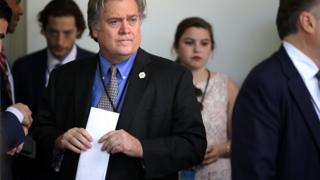
    White House chief strategist Steve Bannon is the latest top aide of President Donald Trump to leave his post.

    Press Secretary Sarah Huckabee Sanders confirmed that Friday was his last day.

    His exit follows a review of his position by White House Chief of Staff John Kelly.

    Mr Bannon, a right-wing nationalist and former head of Breitbart.com, helped shape the “America First” message of Mr Trump’s election campaign.

    But critics had accused the 63-year-old of harbouring anti-Semitic and white supremacist views.

    Mr Bannon is known to have competed for influence in the West Wing against more moderate factions, including members of the Trump family.


    Taking credit did him in

    By Anthony Zurcher, BBC North America reporter

    Steve Bannon may be out as a senior White House adviser, but Bannonism – if that’s what it can properly be called – is still firmly entrenched in the White House.

    Donald Trump has repeatedly boasted that the success of his presidential campaign should properly be attributed to him, not Mr Bannon. And, in the end, Mr Bannon’s desire to take credit for that win may have been what did him in.

    It certainly wasn’t because of any sharp ideological divides between the president and the former head of Breitbart News.

    Border security, aggressive trade protectionism, immigration reform and a certain kind of cultural nostalgia – all were themes that Mr Trump ran on from the start, which Mr Bannon only sharpened and focused. They’re also issues Mr Trump has pushed in recent weeks, even as Mr Bannon has been increasingly marginalised.

    Mr Bannon’s firing will be seen as a win for Chief of Staff John Kelly, whose attempts to instil discipline in the White House will get a boost without the free-wheeling Mr Bannon roaming the hallways.

    Trump was Trump before Mr Bannon came on the scene, however. And as the rollercoaster ride that was politics this week indicates, the president isn’t changing anytime soon.


    Mr Trump fuelled speculation when asked last week about Mr Bannon’s future as he replied: “We’ll see.”

    Mr Bannon’s interview this week with the American Prospect, a liberal magazine, reportedly infuriated the president.

    The White House aide was quoted as dismissing the idea of a military solution in North Korea, undercutting Mr Trump.

    Mr Bannon told associates he thought it was an off-the-record chat and didn’t realise he would be quoted.

    Ms Huckabee Sanders’ statement said: “White House Chief of Staff John Kelly and Steve Bannon have mutually agreed today would be Steve’s last day.

    “We are grateful for his service and wish him the best.”

    Source familiar with the decision said Mr Bannon had been given the chance to leave on his own terms.


    Who else left Trump’s White House team?

    Anthony Scaramucci, communications director – 31 July

    Reince Priebus, chief of staff – 28 July

    Sean Spicer, press secretary – 21 July

    Mike Dubke, communications director, 30 May

    James Comey, FBI director – 9 May

    Michael Flynn, national security adviser – 14 February


    Mr Bannon took over as chief of Trump’s presidential campaign in August 2016.

    He was formerly a US Navy officer, Goldman Sachs investment banker, Hollywood movie producer and head of Breitbart News.

    He has reportedly told friends he could go back to the right-wing outlet that has boisterously supported Mr Trump.

    In a potentially worrying sign for the White House, Breitbart’s senior editor-at-large Joel Pollak tweeted: “#WAR”.

  • Heineken-Punch Taverns pub deal cleared by CMA

    Heineken bottlesImage copyright
    Getty Images

    Heineken’s takeover of Punch Taverns will not face an in-depth competition probe after the brewer offered to sell pubs to address concerns.

    The Competition and Markets Authority (CMA) had said there were 33 areas where pubs would not face sufficient competition if the deal went ahead.

    But following the brewer’s offer to sell pubs in the affected areas the CMA said it was satisfied its concerns had been addressed.

    Heineken will buy 1,895 Punch pubs.

    Private equity firm Patron Capital will buy the remaining 1,329 pubs in the Punch estate.

    “Heineken has offered to sell pubs in each of the affected areas to preserve competition and ensure customers in these locations do not lose out,” the CMA said in a statement.

    “Before reaching a final decision, the CMA carefully assessed and consulted publicly on these proposed undertakings. The CMA is satisfied that its concerns have been addressed and has therefore decided that the merger will not be referred for an in-depth phase 2 investigation,” it added.

    Heineken already owns 1,100 pubs.

    The CMA’s preliminary investigation concluded that the deal would not damage the chances of Heineken’s competitors selling their own products, as the pubs being bought only make up 4% of the market.

    It also felt that it was unlikely Heineken would reduce the choice of beer and cider available in the Punch pubs, as this could lead it to lose business.

  • Wrestling bids to boost interest in China

    Wrestler in mid-airImage copyright
    Getty Images

    US-style professional wrestling is leaping off the top ropes and into the Chinese market.

    From Friday, World Wrestling Entertainment (WWE) is making its video streaming service available in the mainland.

    The part-sport, part soap-opera joins a long list of sports eager to tap into a new customer base.

    Industry-watchers say finding local stars will be key to its success.

    Local partner

    WWE’s service will be available through its Chinese partner PPTV, with subscribers required to download an app to access the content.

    Past events have “received a great response from WWE fans in China,” according to Godfrey Zeng, executive vice president of Suning Sports Media, parent company of PPTV.

    China has held a number of WWE events over the years, and there’s even a local WWE-style wrestling organisation, but this is the first time an entire channel devoted to WWE will be available.

    The network will feature WWE’s major live events and original series, as well as reality shows and classic matches.

    The organisation is kicking things off by making one of its marquee events SummerSlam, which takes place on Monday, available live in Mandarin.

    Crowded market

    Sports ranging from mixed martial arts to Australian rules football have all been trying their luck in China.

    Image copyright
    Getty Images

    Other sports have managed to capitalise on the success of Chinese stars.

    The country’s huge population means that most organisations would only need a small share of the market to see a return on their investment, but some industry watchers caution that it’s not as easy it might seem.

    “Everyone’s trying to break into China, and you’ve all got those much more established sports. Then you’ve got things like rugby, and combat sports and they’re all trying to compete for the same demographic,” said Mark Dreyer, who runs the Inside China Sports website.

    Two-time grand slam champion Li Na helped to make tennis more popular, while Chinese NBA star Yao Ming made a huge difference to basketball’s popularity.

  • Northern, Southern and Merseyrail strikes set for September

    Arriva Rail North trainImage copyright
    Northern Rail

    Image caption

    Arriva runs its Northern services across north-west and north-east England, Cumbria and the East Midlands

    Further rail strikes have been set for next month to coincide with schools going back in the row over driver-only-operated trains.

    Arriva Rail North, Merseyrail and Southern RMT staff will walk out from Friday 1 September with the last strike on Monday 4 September.

    The RMT said no progress had been made over the future of the role of guards, due to safety and job loss fears.

    Arriva Rail North said it is prepared to guarantee jobs.

    ‘Round-table talks’

    Arriva Rail North – which operates under the brand Northern – and Southern workers will walk out on Friday, 1 September and Monday, 4 September.

    Staff at Merseyrail will be on strike on 1 September, 3 September and 4 September.

    RMT General Secretary Mick Cash said: “RMT is bitterly disappointed that Southern Rail have rejected our call for round-table discussions involving all parties with an interest in resolving this dispute.”

    After a meeting with Northern bosses Mr Cash said the “responsibility for the inevitable disruption lies wholly with the company”.

    He added: “It is disgraceful that Merseyrail continue to refuse all reasonable attempts by the union to settle this dispute.

    “RMT has a clear plan for resolving this dispute but that requires round-table talks now to push forwards.”

    Alan Chaplin, Northern’s managing director said: “Northern is prepared to guarantee jobs and current pay for all our conductors for the next eight years, until the end of our franchise. Our offers to discuss every detail on the future responsibilities and training for on-board colleagues have been rejected by RMT.”

    Jan Chaudhry-van der Velde, Merseyrail’s managing director, said: “The RMT say this dispute is about safety. But a recent industry report (RSSB, Risk associated with train dispatch, July 2017) states that: ‘… there is no additional risk for passengers boarding and alighting driver-controlled operation/driver-only operation trains, and indeed that trains without a guard actually appear to lower overall dispatch related safety risk to passengers.”

    Southern has also been approached for comment.

  • Black ownership rules polarise S African mining sector

    South Africa’s mining sector has been thrown into turmoil by new guidelines and legal requirements. The new mining charter stipulates – among other things – an increase in black ownership.

    The government says it wants to transform the sector and redress many inequalities. Mining firms say it could destroy the industry.

    Matthew Davies has more.

  • FTSE 100 down as airlines shares drop after Spain attacks

    Market trader (file picture)Image copyright
    Getty Images

    Shares across the travel sector fell as investors worried about the impact of the Barcelona terror attack on tourism.

    Among the airlines, British Airways owner IAG dropped 1.5% while EasyJet fell 0.7%.

    Shares in hotel companies were also affected, with Intercontinental Hotels Group down 1.5% and Millennium and Copthorne 3% lower.

    By lunchtime, the benchmark FTSE 100 index was down 73.21 points, or 1%, at 7,314.66.

    “As we’ve seen over the last couple of years in Europe, these kinds of atrocities affect tourism and will hit airline earnings,” said Neil Wilson, senior market analyst at ETX Capital.

    “Investors are concerned that demand will fall over the rest of the year, which was already looking like it would be a tough patch for the industry.”

    Randgold Resources was one of the few risers in the FTSE 100, up 1.1%, as the price of gold was bolstered by the metal’s status as a haven in times of uncertainty.

    In the FTSE 250, Hikma Pharmaceuticals was the biggest faller, down 5.8%, after HSBC cut its forecast for the company’s share price.

    Shares in Hikma had fallen sharply on Thursday after the company said full-year revenues would be at the low end of forecasts,

    On the currency markets, the pound edged up 0.1% against the dollar to $1.2875, and was unchanged against the euro at 1.0972 euros.

  • Visits to UK rise amid fall in pound

    Tourists outside Buckingham Palace watching as guardsmen take part in the Changing of the Guard in central LondonImage copyright
    AFP

    The number of visitors to the UK rose to 3.5 million in June, up 7% from the same month last year, according to official figures.

    The number of visitors from North America shot up by 34%.

    While in the UK, the visitors spent £2.2bn, a rise of 2%, the Office for National Statistics (ONS) said.

    The increase comes as the weak pound makes the UK more affordable for visitors, but also follows terror attacks in London and Manchester.

    Meanwhile, UK residents took a June record of 7.2 million trips abroad, up 4%.

    However, with the fall in the value of sterling putting them at a disadvantage, the amount they spent leapt by 15% to £4.6bn.

    Best month

    The big increase in visitors from North America, from 483,000 in June of last year to 650,000 this year, was “clearly buoyed by the particularly sharp drop of the pound against the dollar since mid-2016”, according to Howard Archer, chief economic adviser to the EY Item Club.

    The number of visitors from Europe rose by 2% to 2.241 million.

    The best month so far this year was April, with 3.7 million visitors coming to the UK – up 19% from a year earlier.

    Over the April-to-June quarter the number of visitors from overseas rose to 10.75 million, up 8% from the same period a year earlier.

    But while holiday visits were up by 20% to 4.7 million over the same three months, business visits were down by 4% at 2.4 million.

    VisitBritain director Patricia Yates said: “Tourism is one of Britain’s most valuable export industries and this continued growth demonstrates the industry’s increasing importance as a key driver of economic growth across our nations and regions.”