Samsung Electronics has seen its earnings soar as sales were boosted by millions working and learning from home during the virus pandemic.
The world’s largest maker of smartphones said second quarter operating profits rose 23% compared to last year.
The results were helped by strong demand for computer chips, which pushed up prices on the global market.
Data centres have expanded capacity to support home working and schooling.
“The Memory Business saw robust demand for cloud applications related to remote working and online education as the impact from Covid-19 continued, while demand for mobile was relatively weak,” the South Korean company said in a statement.
Other major memory chip makers, including rival Korean producer SK Hynix and US firm Micron Technology, have also been boosted by people staying at home and consuming internet-based services like video conferencing and movie streaming.
Last week, SK Hynix said its operating profit had tripled in the second quarter from a year ago as server operators ordered memory chips and prices rose.
In June, Micron Technology forecast higher-than-expected revenue this quarter due to strong demand for its chips that power notebooks and data centres.
“Many enterprises are moving their operations to the cloud, and the server computing segment is on the rise,” Prachir Singh, a senior analyst at Counterpoint market research firm told the BBC.
Samsung, which is set to launch its new Galaxy Note and Galaxy Z Fold handsets, also predicted that the market for smartphones will improve in the coming months as well as seeing it becoming increasingly competitive.
New models
“The smartphone market is expected to witness intensifying competition amid a gradual recovery in demand in the second half of the year,” it said.
Despite Covid-19 causing lower demand technology brands continue to release new handsets.
In April, Apple announced a new iPhone SE, reviving a mid-market model it had discontinued in 2018.
A week earlier OnePlus unveiled new models, while the previous month Huawei launched its flagship P40 range.
Meanwhile, Apple’s iPhone 12 and the Google Pixel 5 and 4A are expected to be released later this year.
Samsung shares were a little higher in Seoul trading on Thursday and have gained around 10% this week.
Job interviews are increasingly being conducted by video – over Zoom, Skype or FaceTime for instance – and there is a lot of pressure on candidates scrambling for places due to coronavirus. Jobs coach Dominic Joyce offers eight tips to help you perform well in a live video interview.
Local high streets could be poised for a revival if the trend for home working continues, a survey suggests.
The Royal Institution of Chartered Surveyors’ latest commercial property survey found almost all members – 93% – saw businesses scaling back their office space in the next two years.
It said a move away from urban hubs could prompt a shift to neighbourhoods.
RICS found most members expect retail and office rents to fall further this year.
Three-quarters of the commercial property agencies and valuation businesses it surveyed, said the market was in a downturn, with just over one in 10 predicting conditions had reached the bottom of the cycle.
‘Horrible’ offices look to tempt back workers
Barclays: We want our people back in the office
The vast majority of respondents thought rents would fall in the next three months, the most pessimistic reading since 2008.
Commercial sector ‘polo mint’
Hew Edgar, head of UK government relations for RICS, warned of a “polo mint” effect – a hollowing out of city centres.
But he said this could bring benefits, if properly managed: “With downturn there can be opportunity, government must also look to replace uncertainty with stability; and fill the middle of the commercial sector polo mint.
“Offices and shops in city centres need support as people stay away from their normal workplace, and although local shop hubs are benefitting the market must be addressed as a whole.”
Simon Rubinsohn, RICS Chief Economist, said tenants are thinking about a shift because commercial property in central locations is more expensive, while people are wanting to work more from home and spend extra time in their neighbourhoods.
“For a lot of businesses they are thinking about that opportunity to move towards suburban locations. We’re looking at a very different model going forward: there may still be a central location but it may just be a lot smaller.”
Addressing the housing crisis
He said that will free up property for housing.
“It’s quite clear the pandemic is going to result in more space becoming available. One of the obvious answers to that is to begin… to think about addressing the housing crisis that we have through use of some of this space.”
However, Mr Rubinsohn added building conversions must meet quality standards for housing.
“I think it’s really important that standards form the backbone of this conversion process,” he said.
Mr Edgar said the government’s recent proposal to loosen building development laws was flawed.
“It is possible to deliver viable office-to-residential schemes through the more stringent planning permission process,” he said.
Image caption
Amazon’s Jeff Bezos, Apple’s Tim Cook, Facebook’s Mark Zuckerberg and Google’s Sundar Pichai defended their firms
The heads of some of the world’s biggest tech companies have appeared before Washington lawmakers to defend their firms against claims they abuse their power to quash competitors.
Amazon boss Jeff Bezos said the world “needs large” firms, while the heads of Facebook, Apple and Google argued their companies had spurred innovation.
The appearance comes as lawmakers consider tougher regulation and competition probes are underway.
Some critics want the firms broken up.
Follow live updates of the congressional hearing
Congressman David Cicilline, a Democrat leading the congressional committee holding the hearing, said a year-long investigation by lawmakers had revealed patterns of abuse by the online platforms.
“The dominant platforms have wielded their power in destructive, harmful ways in order to expand,” he said.
What are the concerns about the tech giants?
Critics have said the tech companies abuse their power to benefit their own products, and undercut or acquire rivals, depressing competition – and ultimately hurting the wider economy.
They say regulators charged with enforcing competition rules – known as anti-trust law in the US – have been too lax.
At the hearing, many Republicans signalled they may not be prepared to split up the firms, with one committee member saying “big is not inherently bad”.
But they said they were concerned on other grounds, accusing the firms of suppressing conservative views.
“I’ll just cut to the chase – big tech is out to get conservatives,” said Congressman Jim Jordan, a Republican from Ohio.
At Wednesday’s hearing, much of the attention focused on Google, which lawmakers accused of having stolen content created by smaller firms, like Yelp, in order to keep users on their own website.
Facebook’s acquisition of Instagram, Amazon’s treatment of sellers on its site and Apple’s App store also drew attention.
What do the companies say?
Appearing by remote video, the executives defended their companies, saying their products helped smaller businesses and rejecting the idea that their size allowed them to rest on their laurels.
“Scrutiny is reasonable and appropriate,” Apple boss Tim Cook said in prepared remarks. “But we make no concession on the facts.”
“It’s so competitive I would describe it as a street fight for market share in the smartphone business,” he later said.
In his prepared remarks, Mr Bezos said his firm faced significant competition from firms such as Walmart.
“I love garage entrepreneurs – I was one. But, just like the world needs small companies, it also needs large ones. There are things small companies simply can’t do,” he said.
What has Donald Trump said?
US President Donald Trump is a long-time critic of Amazon and threatened his own action on Twitter, writing: “If Congress doesn’t bring fairness to Big Tech, which they should have done years ago, I will do it myself with Executive Orders.”
He also told reporters that White House officials would be watching the hearing closely.
“There’s no question that what the big tech companies are doing is very bad,” he said.
Boeing has said it will stop making its classic 747 plane and is eyeing steeper job cuts than those it has previously announced.
The firm is also planning to slow production of many of its jets, including the troubled 737 Max.
The changes come as the firm disclosed a $2.4bn (£1.8bn) loss as the virus depressed demand for air travel.
“The reality is the pandemic’s impact on the aviation sector continues to be severe,” said Boeing boss Dave Calhoun.
Airlines around the world have responded to the coronavirus pandemic by reducing their fleets and delaying or cancelling aircraft orders.
This month British Airways became the latest to say it was retiring all of its 747 jets – about 10% of its fleet – citing the fall in passenger demand. Australian airline Qantas has also retired the jet, which marked its 50th anniversary last year.
BA retires entire 747 fleet after travel downturn
Boeing job cuts start to hit nearly 13,000 workers
Boeing said the slowdown may mean deeper job cuts on top of roughly 16,000 layoffs – around 10% of its workforce – it has already planned.
“Our government services, defence and space programs provide some critical stability for us in the near-term as we take tough but necessary steps to adapt for new market realities,” Mr Calhoun said.
“We are taking the right action to ensure we’re well positioned for the future.”
The pandemic has exacerbated the crisis facing Boeing, which was already in trouble following two fatal crashes of its 737 Max plane which killed 346 people.
The jet has been grounded since last March, costing the company some $20bn. The scandal led to the departure of top executives and a string of ongoing investigations.
Boeing said it has re-started production of the 737, but it expects the rate of manufacturing to remain low for the foreseeable future as the virus weighs on the industry.
It said it hoped to be making 31 per month by the beginning of 2022 – instead of during 2021 as planned. That would be roughly half the rate of the firm’s production before the grounding.
Image copyright Reuters
Image caption
Qantas retired its Boeing 747 jets last week
“While there have been some encouraging signs, we estimate it will take around three years to return to 2019 passenger levels,” Boeing said.
Falling sales
Boeing said it lost $2.4bn in the three months to 30 June, as sales fell 25% to $11.8bn.
Last year, it reported a $2.9bn loss in the same quarter, driven by a charge of more than $5bn related to the grounding of the 737 Max.
The sales decline was driven by its commercial unit, which serves passenger airlines. Revenue dropped 65% as the firm delivered just 20 planes in the quarter, compared to 90 a year ago.
Sales in the firm’s defence, space and security unit were essentially flat at $6.5bn.
The owner of Odeon Cinemas has ended its feud with film studio Universal, with the two signing a deal that looks set to transform movie distribution.
In April, AMC banned all Universal films after the studio said it would release new movies at home and on the big screen on the same day.
But now AMC has agreed that Universal films can go to digital services after just 17 days of viewing in cinemas.
These premium services will include AMC’s own Theatres on Demand.
The dispute between the two firms is a product of the coronavirus pandemic. It began in April, when Universal made the film Trolls World Tour available to streaming services only.
It was scheduled for release in cinemas that month, but with cinemas closed because of the Covid-19 lockdown, it was offered as a Premium Video on Demand (PVOD) on streaming platforms such as Apple TV.
Odeon owner bans Universal films in home movie row
Oscars change streaming rules as cinemas stay shut
AMC took umbrage, accusing Universal of “breaking the business model and dealings between our two companies”.
It added: “Going forward, AMC will not license any Universal movies in any of our 1,000 theatres globally on these terms.”
Now, however, it has changed its mind.
AMC chief executive Adam Aron said, “AMC enthusiastically embraces this new industry model, both because we are participating in the entirety of the economics of the new structure, and because premium video on demand creates the added potential for increased movie studio profitability, which should in turn lead to the green-lighting of more theatrical movies.”
Universal Studios’ chair, Donna Langley, said: “The theatrical experience continues to be the cornerstone of our business. The partnership we’ve forged with AMC is driven by our collective desire to ensure a thriving future for the film distribution ecosystem and to meet consumer demand with flexibility and optionality.”
The full terms of the deal are confidential and are not being disclosed.
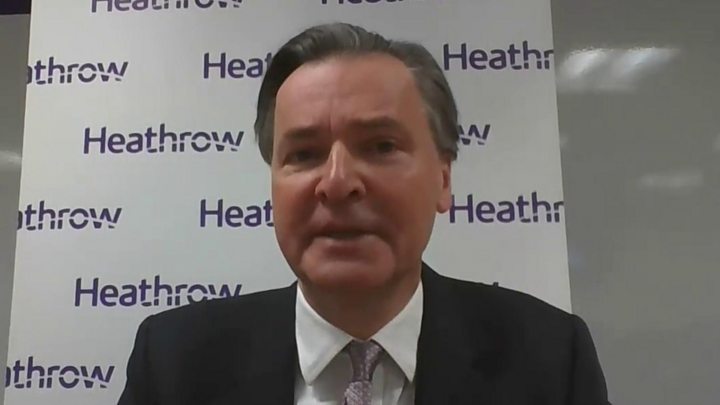
Media captionHeathrow boss John Holland-Kaye: “More work needs to be done, we need to test and learn.”
The culture secretary has told the BBC that coronavirus testing at airports is not a “silver bullet” to stop the need for quarantine.
Oliver Dowden said testing for coronavirus was not enough because the virus can develop over time.
The boss of Heathrow said airports should be allowed to test for coronavirus to avoid the “cliff edge” of quarantine.
The travel industry is seeking ways to rescue the holiday season.
The government’s sudden change to travel advice for Spain at the weekend prompted a fresh wave of confusion and uncertainty to people’s holiday plans.
Travel firm TUI said on Wednesday it had cancelled holidays to the Balearics and Canary Islands until 4 August after the UK extended its advice against non-essential travel to Spain to include its islands.
Coronavirus: Why isn’t the UK testing travellers on arrival?
Heathrow chief executive John Holland-Kaye told the BBC’s Today programme the confusion caused by the changes to guidance over Spain showed the need for an alternative.
‘Quarantine roulette’
The company’s results, out on Wednesday, showed passengers all but stopped travel in the three months to June, falling by 96% on a year ago as global aviation came to a virtual standstill. Revenue was 85% lower than last year at £119m.
Mr Holland-Kaye said: “Today’s results should serve as a clarion call for the Government – the UK needs a passenger testing regime and fast. Without it, Britain is just playing a game of quarantine roulette.”
He said he wanted the government to work with the company on the plan and he could have testing sites set and ready “within weeks”.
But Mr Dowden quashed the idea, saying: “We are not at the point where there is a viable alternative to the 14-day quarantine.”
However, he added that all options were under review.
Image copyright Getty Images
Image caption
Coronavirus testing is available at some German airports
Other countries are operating airport testing. It is voluntary – and free – at some German airports now although that may become mandatory, as it is in France for arrivals from high-risk countries such as the US and Brazil.
The Netherlands approach is to single out people coming from specific areas with high levels of infections – such as a few named regions in Spain and the UK city of Leicester and urge them to self-isolate.
Dr Hans Kluge, Europe regional director for the World Health Organization, endorsed testing at airports as part of general attempts to track the movement of coronavirus.
He told the Today programme: “Testing is never wrong – whether at airports, community or drive-in centres – what’s the difference between day-to-day life and travelling?”
Mr Holland-Kaye said a UK airport test would cost about £150 each, and passengers would be expected to pay.
He acknowledged that was “not cheap”, but that the test would come down over time as more people took it.
But he said there would be those prepared to stand the cost: “There are people who are worried about being able to go back to work or get the kids into school, there will be people who are prepared to pay that to avoid the extra period of quarantine.”
The idea of introducing testing at airports is an attractive idea. The theory being people could travel where they like and just get tested as they arrive back in the country, negating the need to self-isolate.
But the government is not convinced.
Why? Logistically testing all the travellers who arrive every week will be difficult.
Testing capacity has increased but this would stretch the system. Not to mention the practical difficulties of setting up testing facilities in busy airports.
But the other factor, which is perhaps more crucial, is that in the early stages of infection the test may not even pick it up.
Instead, officials are much more persuaded by a more intelligent, targeted approach to self-isolation.
That would involve asking only those coming from certain regions in a country where the infection rates are highest to self-isolate.
That could then be complemented by then asking them to get tested after a week, meaning if they test negative, there would be no need for the full 14-day self-isolation.
All this and more is being discussed behind the scenes.
Mr Holland-Kaye said: “The aim would be to have a test on arrival. We could have it up and running in the next two weeks, then we need to work with government to see what happens next.”
He said the plan would be for passengers to go into quarantine and have another test after eight days: “If they were infected we would be confident that it had shown itself. If it was clear, they would be allowed to go out of quarantine earlier than had been the case. It’s very scientifically based.”
Under current rules, those arriving in the UK from certain countries must self-isolate for 14 days.
The government has indicated that it is keeping all quarantine measures under review.
It is said to be considering an eight-day stretch between tests, whereas figures within the travel sector are keen for a five-day period.
The number of days required between each test is critical in reducing the possibility of “false negative” results.
A false negative result is possible if someone who has recently contracted Covid-19 is not showing symptoms.
FEELING LOST?: How to start thinking about the future
‘HOMELESS HOTEL’: Lockdown life inside emergency accommodation
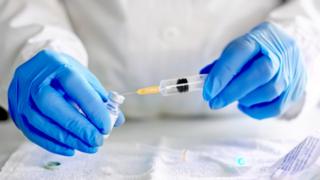
The UK government has signed a fourth coronavirus vaccine deal, securing up to 60 million doses of an experimental treatment being developed by drug giants GSK and Sanofi.
The government has already signed up for 100 million doses of the Oxford University vaccine being developed by AstraZeneca.
It has also secured another 90 million doses of two other promising vaccines.
However, it is still uncertain which, if any, of the vaccines may work.
Governments around the world have pledged billions of dollars for a Covid-19 vaccine and a number of pharmaceutical firms are in a race to develop and test potential drugs.
Coronavirus vaccine: When will we have one?
The vaccine involved in the latest government deal, developed by Sanofi in partnership with GSK, is based on the recombinant protein-based technology used by Sanofi to produce a flu vaccine, as well as GSK’s established pandemic technology.
Sanofi, which is leading the clinical development, said regulatory approval could be achieved by the first half of 2021 if trials were successful.
In the meantime, Sanofi and GSK are scaling up manufacturing to produce up to one billion doses a year overall.
Media playback is unsupported on your device
Media captionCoronavirus vaccine: How close are we and who will get it?
The vaccine has already been at the centre of an international political storm after Sanofi rowed back on an apparent promise to prioritise the US market.
Sanofi chief executive Paul Hudson sparked a row in May by saying the US government had “the right to the largest pre-order because it’s invested in taking the risk”.
But he changed his view after then French Prime Minister Edouard Philippe responded by saying access for all was “non-negotiable”.
In their latest announcement, GSK and Sanofi stressed that they were “committed to making the vaccine available globally”.
Image copyright Getty Images
“With our partner GSK, we are pleased to co-operate with the UK government as well as several other countries and global organisations as part of our ongoing efforts to develop a safe and effective vaccine and make it available as quickly as possible,” said Thomas Triomphe, executive vice-president and global head of Sanofi Pasteur.
Roger Connor, president of GSK Vaccines, added: “We thank the UK government for confirmation of purchasing intent, which supports the significant investment we are already making as a company to scale up development and production of this vaccine.”
UK Business Secretary Alok Sharma said: “It is important that we secure early access to a diverse range of promising vaccine candidates, like GSK and Sanofi, to increase our chances of finding one that works, so we can protect the public and save lives.”
Kate Bingham, who chairs the UK government’s Vaccines Taskforce, said: “This diversity of vaccine types is important because we do not yet know which, if any, of the different types of vaccine will prove to generate a safe and protective response to Covid-19.
“Whilst this agreement is very good news, we mustn’t be complacent or over-optimistic.”
Nissan’s shares have plunged by 10% in Tokyo trading after warning that it would see a record annual loss.
Japan’s second largest carmaker said it expects a $4.5bn (£3.5bn) operating loss this year as the coronavirus hinders its turnaround efforts.
The worse-than-expected forecast came as the company predicted its sales will be the lowest in a decade.
It’s the latest indication of the extent of the damage caused by the pandemic to the global car industry.
“The market outlook remains uncertain and we may see a further deterioration in demand due to a possible second wave of the pandemic,” Nissan’s chief executive Makoto Uchida told investors.
Mr Uchida also said the company would not make a dividend payout to shareholders this year.
Nissan’s global sales slumped 48% in the April-June period as they halved in North America and fell by 40% in China.
Even before the coronavirus pandemic, the company was wrestling with a number of issues.
In May, Nissan announced a major turnaround plan after reporting its biggest loss in two decades for the previous financial year.
Under the four-year plan production will be cut by 20%, and Nissan’s plant in Barcelona, Spain will be closed.
The company’s UK factory in Sunderland was spared but Nissan’s global chief operating head told the BBC that the operation would be “unsustainable” if the UK leaves the European Union without a trade deal.
In May, Nissan’s alliance partner Renault announced that it would shed 15,000 jobs worldwide as part of a €2bn (£1.8bn) cost-cutting plan after seeing sales plunge because of the pandemic.
“This plan is essential,” said interim boss Clotilde Delbos, who announced a bigger focus on electric cars and vans.
Some 4,600 jobs will go in France, and Renault has said six plants are under review for possible cuts and closure.
A website offering £50 bike repair vouchers in England crashed after the government scheme launched on Tuesday night.
An initial 50,000 “Fix Your Bike” vouchers were due to be made available online at 23:45 BST on a first-come, first-served basis.
However, many people took to social media to complain that the website crashed “as soon as it went live”.
The web page is currently showing an error message.
The government previously said the vouchers, which are part of its obesity strategy, were being released in batches “to help manage capacity” so that the scheme promoted by the Department for Transport can be monitored before being rolled out more widely.
Sarah Talbot tweeted that the site had crashed at 23:45 and after “repeated attempts to get on it’s now coming up HTTP Error 404”. She added that it was “very disappointing”.
Aaron Bailey wrote on Twitter that the page had been offline since it was supposed to launch, describing the scheme as a “good idea but poorly executed”.
Another social media user, Tom Dale, joked that “cyclists finally know how it feels to be held up by too much traffic”.
Will a £50 voucher get this bike-shy town moving?
The initiative is part of the government’s obesity strategy which was announced on Monday amid growing evidence of a link between obesity and an increased risk from Covid-19.
The vouchers would typically cover the bill for a standard service and the replacement of a basic component such as an inner tube or cable.
Thousands of miles of new protected cycle lanes, cycle training for children and adults, and access to bikes through the NHS are also part of the government plans to promote cycling.